Best Commission Statement Reconciliation Software for Agencies in 2026
Seven tools that read carrier commission statements and reconcile them to your AMS: Applied Recon, Sensible, Comulate, Ascend, Vertafore and more, by fit and price.
On this page (8)
What is the best commission statement reconciliation software for agencies?
Updated Nov 3, 2026 · ranked by fitApplied Recon ranks first of the 7 tools we compared: best for agencies on Applied Epic. Pricing is by quote. Sensible and Comulate follow.
| # | Tool | Best for | Pricing | Free trial | Security | Vendor site |
|---|---|---|---|---|---|---|
| 1 | Applied ReconCommission reconciliation built into an agency management system | Agencies on Applied Epic | Quote onlyAdd-on to Applied Epic; quoted | — | SOC 2 Type II | Visit site of Applied Recon (opens in a new tab) |
| 2 | SensibleHybrid developer infrastructure | Owned extraction of the statements behind reconciliation | From $499Per document, monthly plans | 14 days | SOC 2 Type II | Visit site of Sensible (opens in a new tab) |
| 3 | ComulateDirect bill automation for large brokers, across AMS systems | Large brokers reconciling across several AMS databases | Quote onlyQuoted | — | SOC 2 not confirmed | Visit site of Comulate (opens in a new tab) |
| 4 | AscendAgency finance automation: direct bill, billing, payments | Statements fetched from carrier portals | Quote onlyQuoted | — | SOC 2 not confirmed | Visit site of Ascend (opens in a new tab) |
| 5 | Vertafore AMS360Agency Management | Agencies on AMS360 | Quote onlyEnterprise | — | SOC 2 not confirmed | Visit site of Vertafore AMS360 (opens in a new tab) |
| 6 | FintaryCommission operations platform: ingestion, reconciliation, producer payouts | Reconciliation plus producer payouts | Quote onlyQuoted | — | SOC 2 not confirmed | Visit site of Fintary (opens in a new tab) |
| 7 | AgencyBlocHealth and life AMS/CRM | Health and life agencies already on AgencyBloc | Quote onlyPackage pricing by request | — | SOC 2 Type II | Visit site of AgencyBloc (opens in a new tab) |


TL;DR
- Commission reconciliation is two jobs: reading each carrier's statement into clean rows, then matching those rows to policies in your agency management system and posting the result.
- Applied Recon is the first stop for Applied Epic agencies: it reads PDF, spreadsheet, scanned and AL3 statements, matches each line on six signals and posts to the Epic general ledger.
- Sensible is the extraction layer for teams that build or own the reconciliation step, with commission statement extraction configured to your schema and published pricing from $499 a month for 750 documents.
- Comulate and Ascend are standalone direct bill tools for brokers on Epic, AMS360 or BenefitPoint; Vertafore lists its Reconciliation Agent as live in AMS360.
- For life, health and benefits agencies paying producers, Fintary and AgencyBloc Commissions+ handle splits, overrides and payouts as well as carrier statements.
A mid-size agency gets commission statements from dozens of carriers every month, each in the carrier’s own layout. One carrier sends a CSV with a row per transaction, another a PDF with policy-level subtotals, a third a scanned page where new business is coded “NB” and a chargeback sits three pages away from the policy it reverses. The accounting team’s job is to match each line to the policy in the agency management system, chase what doesn’t match and post the rest. This guide compares seven tools that take over some or all of that work.
Different tools take on different parts of reconciliation
| Shape | What it focuses on | Tools in this list |
|---|---|---|
| Reconciliation inside the AMS | Reads statements, matches them to AMS transactions and posts to the ledger without leaving the AMS | Applied Recon (Applied Epic), Vertafore Reconciliation Agent (AMS360) |
| Statement extraction layer | Turns any carrier, MGA or wholesaler statement into structured rows for a system you own | Sensible |
| Standalone direct bill automation | Fetches or receives statements, matches them across one or more AMS databases and posts back | Comulate, Ascend |
| Commission operations with producer payouts | Carrier reconciliation plus splits, overrides and producer statements, often for life, health and benefits | Fintary, AgencyBloc Commissions+ |
Most agencies should check what their AMS vendor offers first, since matching and posting are simplest where the policy records already live.
Which tool fits your agency?
- You run Applied Epic: Applied Recon.
- You run AMS360: Vertafore’s Reconciliation Agent, then Ascend or Comulate if you need more.
- You own the reconciliation logic or feed statement data into your own warehouse: Sensible.
- You are a large broker with Epic, AMS360 and BenefitPoint in the mix: Comulate.
- You want statements pulled from carrier portals for you: Ascend.
- Producer payouts are as big a problem as carrier statements: Fintary, or AgencyBloc Commissions+ for health and life agencies already on AgencyBloc.
The 7 best commission statement reconciliation tools
1. Applied Recon: Best for agencies on Applied Epic
Quote only · SOC 2 Type IIFull profile →Visit site of Applied Recon (opens in a new tab)
Best for: Independent agencies and brokerages on Applied Epic that want direct bill and agency bill statements read, matched and posted inside their AMS.
Applied Recon takes statements by forwarded email or as AL3 files through Applied’s carrier network, uses AI to extract and clean the data, then checks each line against the matching Epic transaction on six signals: policy number, line ID, pay period, term dates, line of business, and group vs. individual. Applied says 1,000 carriers are configured and new ones can be added from a sample statement (source). In May 2026 Applied said Recon had grown to more than 140 agencies and that early adopters saved an estimated 8+ hours of reconciliation a week on average (source). Agency bill reconciliation followed in August 2026 for agencies already using Recon for direct bill (source).
Key functionalities
- AI extraction and cleansing of carrier statements in several formats
- Six-signal matching with full, partial and complete mismatches flagged
- Exception review showing what an unmatched line should have matched
- Finalize or suspend a statement and post it to the Epic general ledger
Pros:
- Matching, exceptions and general ledger posting all happen in Epic
- Reads PDF, CSV, spreadsheet, scanned and AL3 statements
- Applied says over 90% of P&C and benefits carriers are already certified
Cons:
- Only for Applied Epic agencies
- Pricing not published; agency bill is an addition to the license
Pricing: Not published; quoted by sales.
Verdict: If you are on Epic, start here before buying a separate tool.
2. Sensible: Best for owned extraction of the statements behind reconciliation
 From $499 · Free trial: 14 days · SOC 2 Type IIFull profile →Visit site of Sensible (opens in a new tab)
Best for: Agencies, MGAs, wholesalers and insurtechs that run reconciliation in their own systems or warehouse and need carrier statements turned into consistent, auditable rows.
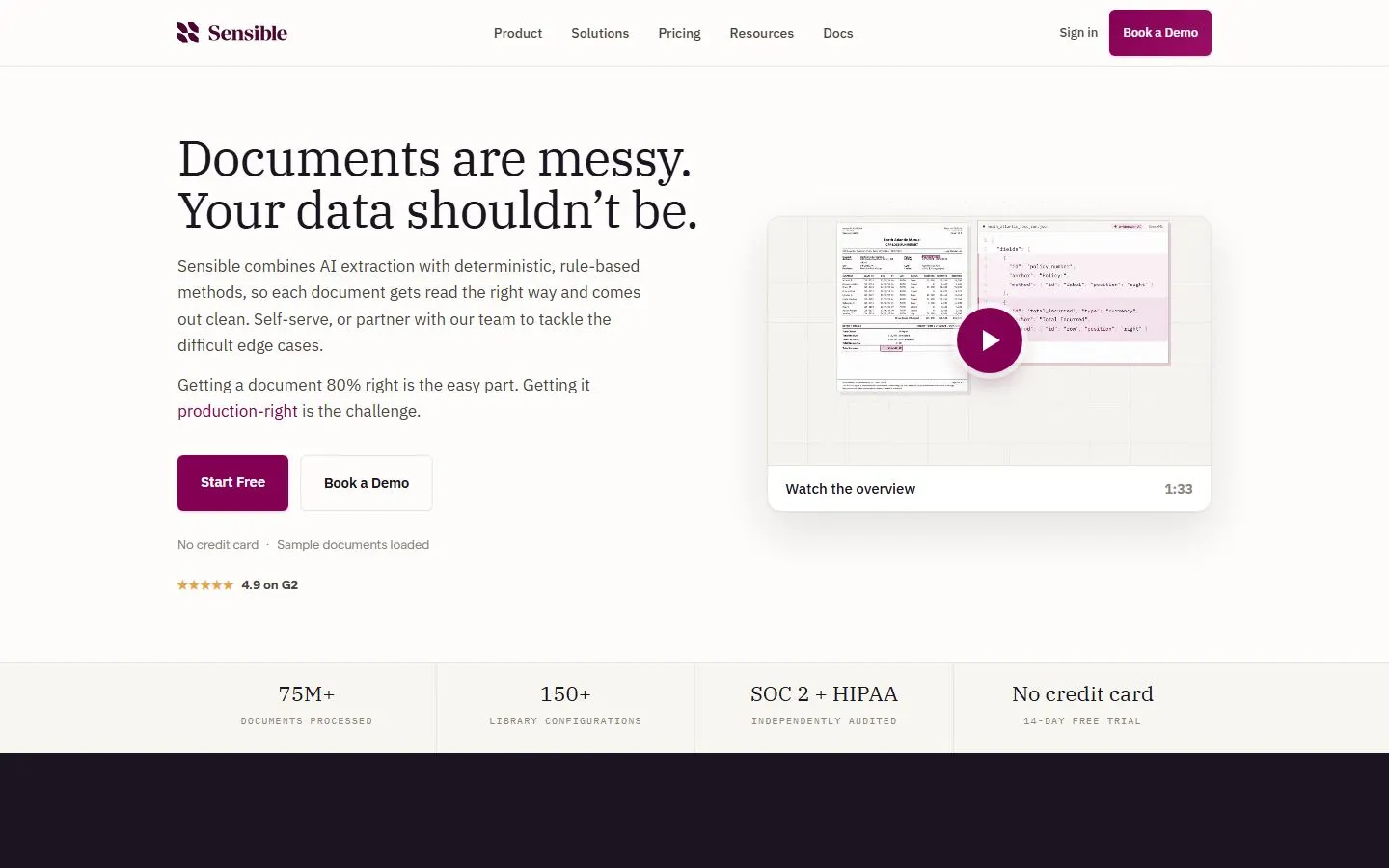
Sensible extracts commission statements from carriers, MGAs, wholesale brokers and program administrators, at summary, policy, transaction or producer-hierarchy level. It configures each extraction to your schema rather than a fixed field list, keeps chargebacks and adjustments linked to the original transactions so a reconciliation system can trace them, and flags low-confidence values for review. Sensible says most production deployments reach 95%+ accuracy with validation rules in place (source). A document is one extraction result, so a 40-page carrier statement counts once (source).
Key functionalities
- Policy, commission calculation and statement summary fields, mapped to your schema
- Producer, sub-agent and override tiers with rates and hierarchy levels
- Confidence thresholds that route uncertain fields to a person
- REST API, Python and Node SDKs, webhooks and Zapier; SOC 2 Type II
Pros:
- Extraction configured to your schema, including producer splits, overrides and chargeback links
- Every value links back to its page and position for audit
- Published per-document pricing and a 14-day free trial
Cons:
- Extraction only: matching to the AMS and ledger posting are built on top
- Configuration sits closer to engineering than a finance team's point-and-click tool
Pricing: From $499/month for 750 documents ($0.57 per additional document); Scale $1,499/month for 3,200 documents. (source)
Verdict: The pick when you want to own how statements are read, or when your statements come from MGAs and wholesalers the AMS tools don't cover.
3. Comulate: Best for large brokers reconciling across several AMS databases
Quote onlyFull profile →Visit site of Comulate (opens in a new tab)
Best for: Large brokers and agency groups that run Epic, AMS360 or BenefitPoint, sometimes several at once, and want direct bill reconciliation and posting in one place.
Comulate captures carrier statements from spreadsheets, PDFs, mail and email, reconciles transactions to policies across connected AMS databases even when policy data differs, and posts the result to the AMS or ERP ledger (source). It lists native integrations with Epic, BenefitPoint, AMS360, Dynamics and Salesforce (source). Comulate says Houchens Insurance Group cut manual work by 90% within a month on BenefitPoint, with 11,000+ transactions reconciled (source).
Key functionalities
- Statement capture from spreadsheets, PDFs, mail and email
- Multi-AMS reconciliation and one-click ledger posting
- Revenue Intelligence: forecasting and policy-level commission drill-downs
Pros:
- Reconciles to policies across one or more AMS databases
- Posts to the AMS or ERP ledger in one click
- Revenue features for finding missing or underpaid commissions
Cons:
- Pricing not published
- SOC 2 report type not stated in its security page text
Pricing: Not published; quoted by sales.
Verdict: Strong when statements need to land in more than one AMS or ledger.
4. Ascend: Best for statements fetched from carrier portals
Quote onlyFull profile →Visit site of Ascend (opens in a new tab)
Best for: Mid-size and large agencies on Applied Epic or AMS360 that want statements collected from carriers as well as matched and posted.
Ascend fetches statements directly from carriers or takes them by forwarded email, reads CSV, PDF and scanned formats, cross-references policy numbers, insured names, premiums and dates against the AMS, and writes matches back after a person approves them (source). Ascend says Henderson Brothers, an Applied Epic agency processing 92 statements a month from 51 payers, cut reconciliation time from 70 to 30 hours a month with an 80% auto-match rate (source).
Key functionalities
- Carrier statement retrieval and email intake
- Auto-matching that Ascend says learns from corrections
- Audit log of every match, override and exception
- Cash Application add-on linking bank deposits to statements
Pros:
- Fetches statements from carriers, so staff stop logging into portals
- Exception queue grouped by type with ranked suggestions
- Ascend says implementation typically takes 2 to 4 weeks
Cons:
- Integrations page names only Applied Epic and AMS360
- Pricing not published
Pricing: Not published; quoted by sales.
Verdict: A good fit when statement collection is as much work as matching.
5. Vertafore AMS360: Best for agencies on AMS360
 Quote onlyFull profile →Visit site of Vertafore AMS360 (opens in a new tab)

Best for: AMS360 agencies that want AI statement matching from their AMS vendor.
Vertafore lists its Reconciliation Agent on the AMS360 page as live, saying it “automatically matches carrier statements to agency transactions,” with figures of 90% time saved, 94% accuracy and 200+ carriers (source). Vertafore announced the agent in April 2026 as part of its Velocity AI Platform, describing it as ingesting carrier statements, matching transactions and flagging exceptions (source).
Key functionalities
- Carrier statement ingestion and transaction matching in AMS360
- Exception flagging for review
- Part of Vertafore’s Velocity AI agents
Pros:
- Built into AMS360 and listed as live
- Vertafore cites 200+ carriers
Cons:
- Few details published beyond headline figures
- Pricing not published
Pricing: Not published; quoted by sales.
Verdict: The obvious first test for an AMS360 agency; ask for a demo on your own carriers.
6. Fintary: Best for reconciliation plus producer payouts
Quote onlyFull profile →Visit site of Fintary (opens in a new tab)
Best for: Brokerages in life, health, benefits or P&C that need carrier statements reconciled and producer commissions calculated in one system.
Fintary says it reads carrier statements as PDF, Excel, CSV or images, runs validation on every transaction and sends failures to a review queue, and tracks chargebacks and retroactive adjustments (source). Its P&C page names Applied Epic, AMS360, HawkSoft, NowCerts and EZLynx among its integrations and compares estimated, received and paid-out amounts so the team reviews exceptions (source).
Key functionalities
- Statement ingestion in any common format
- Reconciliation of expected, received and paid commissions
- Producer hierarchies, splits, overrides and bonuses
- White-label producer portal
Pros:
- Splits, overrides, bonuses and a producer portal alongside reconciliation
- Names HawkSoft, NowCerts and EZLynx as well as Epic and AMS360
- Tracks chargebacks and retroactive adjustments
Cons:
- No security or SOC 2 details on the pages reviewed
- Pricing not published
Pricing: Not published; quoted by sales.
Verdict: Worth a demo when paying producers correctly is half the problem.
7. AgencyBloc: Best for health and life agencies already on AgencyBloc
 Quote only · SOC 2 Type IIFull profile →Visit site of AgencyBloc (opens in a new tab)
Best for: Health, senior, life and benefits agencies, GAs and IMO/FMOs that want commission statements processed inside their AMS and CRM.
AgencyBloc Commissions+ is built into its AMS+ and reads uploaded commission statements with a proprietary mapping tool it says covers 7,500+ carrier maps, flags possible inaccuracies, calculates agent payments and generates agent statements. AgencyBloc says Foulds Health Insurance Agency cut commission tracking time by 75% (source).
Key functionalities
- Carrier-specific statement mapping and import
- Inaccuracy flags and audit tracking
- Agent payment calculation, hierarchies and agent statements
Pros:
- 7,500+ carrier maps for uploaded statements, per AgencyBloc
- Agent payments, hierarchies and agent statements in the same system
Cons:
- Built for health and life, not P&C
- No AI or OCR described for statement reading; pricing not published
Pricing: Not published; priced by transaction volume. (source)
Verdict: A sensible add-on for an AgencyBloc health or life agency; P&C agencies should look higher on this list.
Conclusion: run last month’s statements through it
Pick your three most awkward carriers and one clean one, take last month’s statements and the AMS records they should match, and ask each shortlisted vendor to reconcile them in a demo. Count how many lines land in the exception queue and how long it takes someone to clear them; that number tells you more than the auto-match rate on the vendor’s page.
How did we choose these tools?
The order is our editorial judgment of fit for the job this guide covers, not a test score. Prices appear only where the vendor publishes them or a cited source reports them; otherwise we name the pricing model and mark it "Quote only." SOC 2 status comes from each vendor's trust or security pages. These profiles are desk research: we have not run the products on real files. Full methodology.
FAQs
What is the best commission statement reconciliation software for insurance agencies?
If your agency runs Applied Epic, start with Applied Recon, because it matches statements and posts to the ledger inside Epic. On AMS360, look at Vertafore's Reconciliation Agent first. Brokers with several AMS databases, or Epic shops wanting a separate vendor, should compare Comulate and Ascend. Teams building their own reconciliation, or feeding a data warehouse, can use Sensible to turn carrier statements into structured data.
What is the difference between direct bill and agency bill reconciliation?
With direct bill, the carrier bills the insured and sends the agency a commission statement, so the agency checks that commission against what its system expected. With agency bill, the agency collects premium and remits net to the carrier, so the statement is checked against invoices the agency issued. Applied Recon now handles both in one flow; most standalone tools on this list focus on direct bill.
What fields should commission reconciliation match on?
At minimum policy number, insured name, premium, commission rate and amount, transaction type and effective or term dates. Applied says Recon checks six signals: policy number, line ID, pay period, term dates, line of business, and group vs. individual. Ascend says it cross-references policy numbers, insured names, premiums and dates. Matching on policy number alone misses lines where the statement's number is formatted differently from the AMS record.
Can AI read carrier commission statements in PDF?
Yes. Applied Recon, Comulate, Ascend and Fintary all say they read PDF and scanned statements as well as spreadsheets. Sensible extracts commission statements from carriers, MGAs, wholesalers and program administrators into a schema you define, and links each value to its page and position for audit. Test any tool on your worst carrier formats before buying.
How much does commission reconciliation software cost?
Sensible is the only tool here with published pricing: $499 a month for 750 documents on its Growth plan, $0.57 per extra document, with a 14-day free trial. Applied Recon is sold as an addition to Applied Epic, and Vertafore's agent sits in AMS360; neither publishes a price. Comulate, Ascend, Fintary and AgencyBloc quote by sales.
Do I need separate software if my AMS already has commission download?
Not always. Carrier download brings statement data into the AMS, but someone still has to match it, work the exceptions and post. If your AMS vendor offers AI matching (Applied Recon, Vertafore's Reconciliation Agent), try that first. Standalone tools earn their place when you run more than one AMS, have many carriers outside the download network, or need producer payouts handled too.
Sources
- Applied Recon
- Applied Systems builds on AI reconciliation momentum (May 2026)
- Applied: agency bill reconciliation in Applied Recon
- Sensible: commission statements
- Sensible pricing
- Comulate
- Comulate integrations
- Ascend Direct Bill Automation
- Ascend: Henderson Brothers case study
- Vertafore AMS360
- Vertafore introduces Velocity AI Platform and AI agents (April 2026)
- Fintary for P&C brokerages
- Fintary for health
- AgencyBloc Commissions+
- AgencyBloc pricing