Best COI Data Extraction Software in 2026
Six tools that turn certificates of insurance (ACORD 25 and carrier forms) into structured data, compared: Sensible, Docsumo, Reducto, UiPath, Base64.ai, TrustLayer.
On this page (9)
What is the best COI data extraction software?
Updated Nov 3, 2026 · ranked by fitSensible ranks first of the 6 tools we compared: best for owned certificate extraction inside your own software. Pricing starts at $499 (per document, monthly plans). Free trial: 14 days. Docsumo and Reducto follow.
| # | Tool | Best for | Pricing | Free trial | Security | Vendor site |
|---|---|---|---|---|---|---|
| 1 | SensibleHybrid developer infrastructure | Owned certificate extraction inside your own software | From $499Per document, monthly plans | 14 days | SOC 2 Type II | Visit site of Sensible (opens in a new tab) |
| 2 | DocsumoPre-trained document AI | Certificate checks against contract minimums without code | Quote onlyVolume-based custom quote | 14 days, up to 1,000 pages | SOC 2 Type II | Visit site of Docsumo (opens in a new tab) |
| 3 | ReductoParsing API | Best per-page API for teams writing their own schema | Free to startPer page, usage-based | $150 in free usage | SOC 2 Type II | Visit site of Reducto (opens in a new tab) |
| 4 | UiPath Document UnderstandingEnterprise IDP inside an automation platform | Companies already running UiPath | Quote onlyPer page, metered in AI units or Platform Units | — | SOC 2 not confirmed | Visit site of UiPath Document Understanding (opens in a new tab) |
| 5 | Base64.aiPre-trained document AI | On-premises ACORD extraction | Quote onlyPay per use, subscription or enterprise | Free trial; 100 free credits for new users | SOC 2 Type II | Visit site of Base64.ai (opens in a new tab) |
| 6 | TrustLayerSelf-serve COI tracking with a free tier | Best if you want the compliance answer, not the raw data | Free to startFree tier, then quoted plans | — | SOC 2 not confirmed | Visit site of TrustLayer (opens in a new tab) |



Head-to-headReducto vs Sensible
TL;DR
- COI data extraction reads a certificate of insurance, usually an ACORD 25, and returns its fields as data: insurers A to F with NAIC numbers, each coverage line with policy number, dates, limits and the ADDL INSD and SUBR WVD flags, and the certificate holder.
- Sensible ranks first for teams building certificate checks into their own software. It reads the standard liability certificate, carrier-branded forms and plain-letter proof of coverage, links each value back to its spot on the page, and publishes pricing from $499 a month with a 14-day free trial.
- Docsumo pairs ACORD 25 extraction with checks against your contract minimums; Reducto is a per-page parsing API with an ACORD extraction guide; UiPath publishes a ready-made ACORD 25 model for teams already on its platform; Base64.ai reads ACORD forms and can run on premises.
- If you want software that collects certificates from vendors and chases renewals, you want COI tracking instead. See our COI tracking software list; TrustLayer is the bridge between the two.
- Only Sensible and Reducto publish production prices: Sensible charges per document, so a forty-page certificate packet costs the same as one page, and Reducto charges per page.
A lender closing a loan, a property manager onboarding a tenant and an insurtech building a vendor portal all receive the same thing: a certificate of insurance, usually an ACORD 25, as a PDF. Somebody has to type the insurer letters, policy numbers, expiration dates and limits into a system before anything can be checked. The tools below do that step and hand back structured data. They don’t run the vendor program around it; for that, see our COI tracking software list.
Where the ACORD 25 trips up extraction
The ACORD 25 has a fixed layout, and the certificates people actually receive drift from it. Reducto’s guide notes that ACORD 25s “show up as faxes and low-resolution scans” (source). Sensible’s page says most certificates use the standard layout but revisions differ, and it also handles carrier-branded certificates and plain-letter proof of coverage (source). The coverage section is a table where one insurer letter maps to a carrier listed higher on the page, and the ADDL INSD and SUBR WVD columns are single characters that change what a contract check concludes.
| What you need back | Fields involved | Where reads go wrong |
|---|---|---|
| Who is covered and by whom | Insured, producer, insurers A to F with NAIC numbers | Insurer letter not mapped to the right carrier |
| Whether coverage meets the contract | Coverage type, each occurrence and aggregate limits, umbrella and workers comp | Limits table split across rows or pages |
| Whether coverage is in force | Policy effective and expiration dates per line | Dates misread on low-resolution scans |
| Whether you are protected | ADDL INSD, SUBR WVD, certificate holder name and address | A blank column read as marked, or the reverse |
Different tools solve different parts of the job
| Shape | What it focuses on | Tools in this list |
|---|---|---|
| Hybrid developer infrastructure | Certificate extraction you configure and own, with source links per value | Sensible |
| Pre-trained document AI | Ready-made ACORD models with review screens and contract checks | Docsumo, Base64.ai |
| Parsing API | Per-page parsing and schema extraction you build on | Reducto |
| Enterprise IDP in an automation platform | An ACORD 25 model inside a wider automation suite | UiPath Document Understanding |
| COI tracking with AI reading | Extraction used inside a vendor compliance program | TrustLayer |
Which tool fits your team?
- You are building certificate checks into your own product or portal: Sensible.
- Operations staff will review certificates and you want contract-minimum checks out of the box: Docsumo.
- Your engineers want a cheap per-page API and will write the schema: Reducto.
- Your company already runs UiPath automations: UiPath Document Understanding.
- You need the extraction to run on premises: Base64.ai.
- You want the compliance answer and renewal chasing rather than the raw data: TrustLayer, or the other tools on our COI tracking list.
The 6 best COI data extraction tools
1. Sensible: Best for owned certificate extraction inside your own software
 From $499 · Free trial: 14 days · SOC 2 Type IIFull profile →vs ReductoVisit site of Sensible (opens in a new tab)
Best for: Engineering teams at insurtechs, lenders, property platforms, MGAs and brokers that need certificate fields as JSON in their own systems and want to control and audit how each field is read.
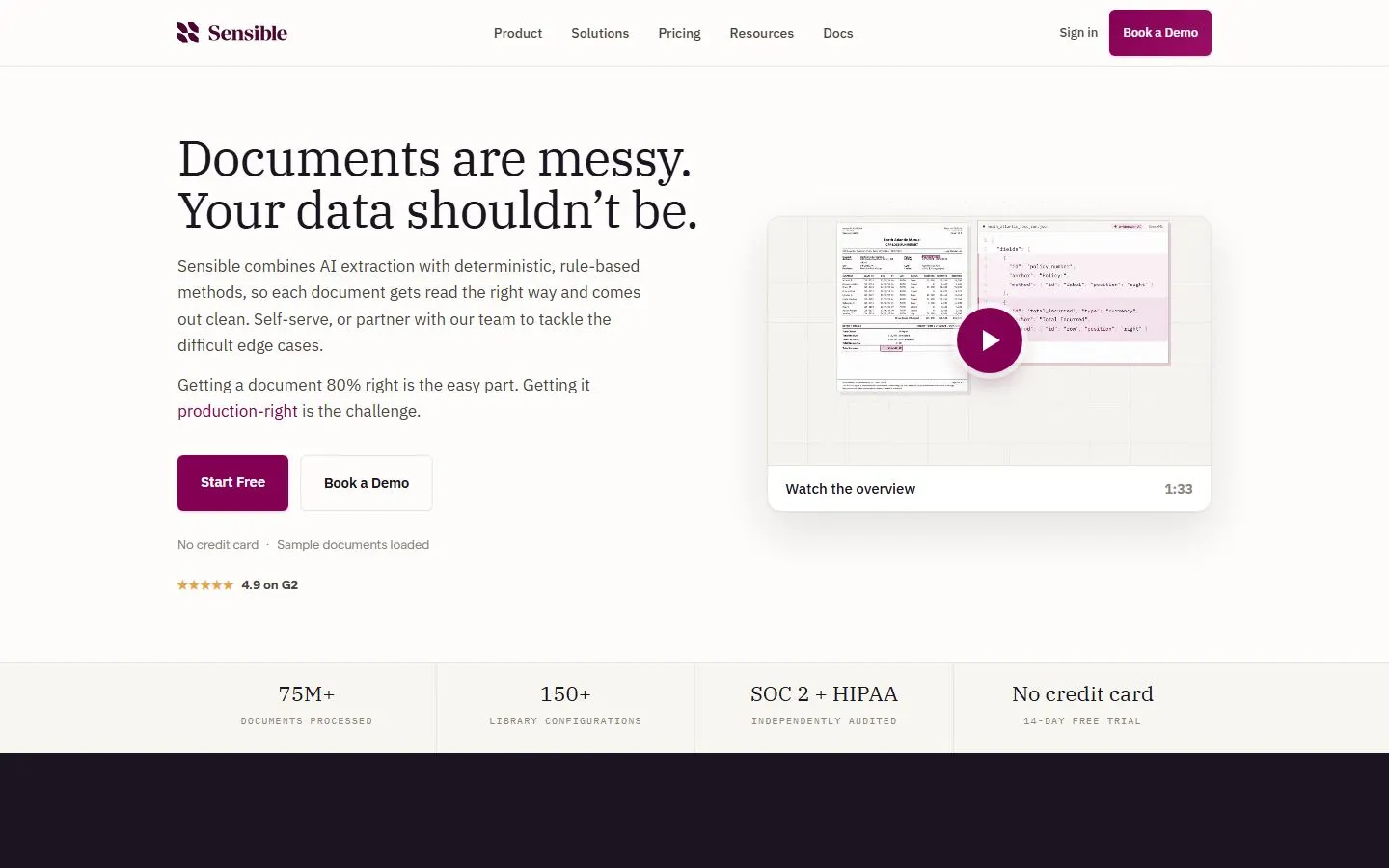
Sensible says it “converts certificates of insurance into structured JSON for vendor compliance and COI tracking.” Its certificate page lists the producer, the named insured, insurers A through F with NAIC numbers, and for each policy the coverage type, insurer letter, policy number, effective and expiration dates, additional insured status and waiver of subrogation. Output is schema-enforced, and Sensible says fingerprints identify the certificate revision while hybrid extraction flags low-confidence endorsement reads for review instead of guessing (source). Pricing counts one extraction as one document, so a 40-page certificate packet costs the same as a single page (source).
Key functionalities
- Revision detection for the standard liability certificate, with configurations for non-standard certificates
- Per-policy coverage rows with additional insured and waiver of subrogation flags
- Page and bounding-box links for audit
- Low-confidence reads routed to review
- REST API, SDKs and webhooks; SOC 2 Type II
Pros:
- Covers the standard liability certificate, carrier-branded forms and plain-letter proof of coverage
- Each value links back to its page and bounding box
- Published per-document pricing and a 14-day free trial
Cons:
- Configuration sits closer to engineering than point-and-click
- Returns data only: vendor outreach and renewals are yours to build
Pricing: Growth $499/month ($449 billed annually) for 750 documents, then $0.57 each; Scale $1,499/month for 3,200. (source)
Verdict: The best fit when certificate data feeds your own product and you need to show where each value came from.
2. Docsumo: Best for certificate checks against contract minimums without code
 Quote only · Free trial: 14 days, up to 1,000 pages · SOC 2 Type IIFull profile →Visit site of Docsumo (opens in a new tab)
Best for: Operations, compliance and lending teams that want ACORD 25 data plus checks on limits, dates and the certificate holder, with a review screen for staff.
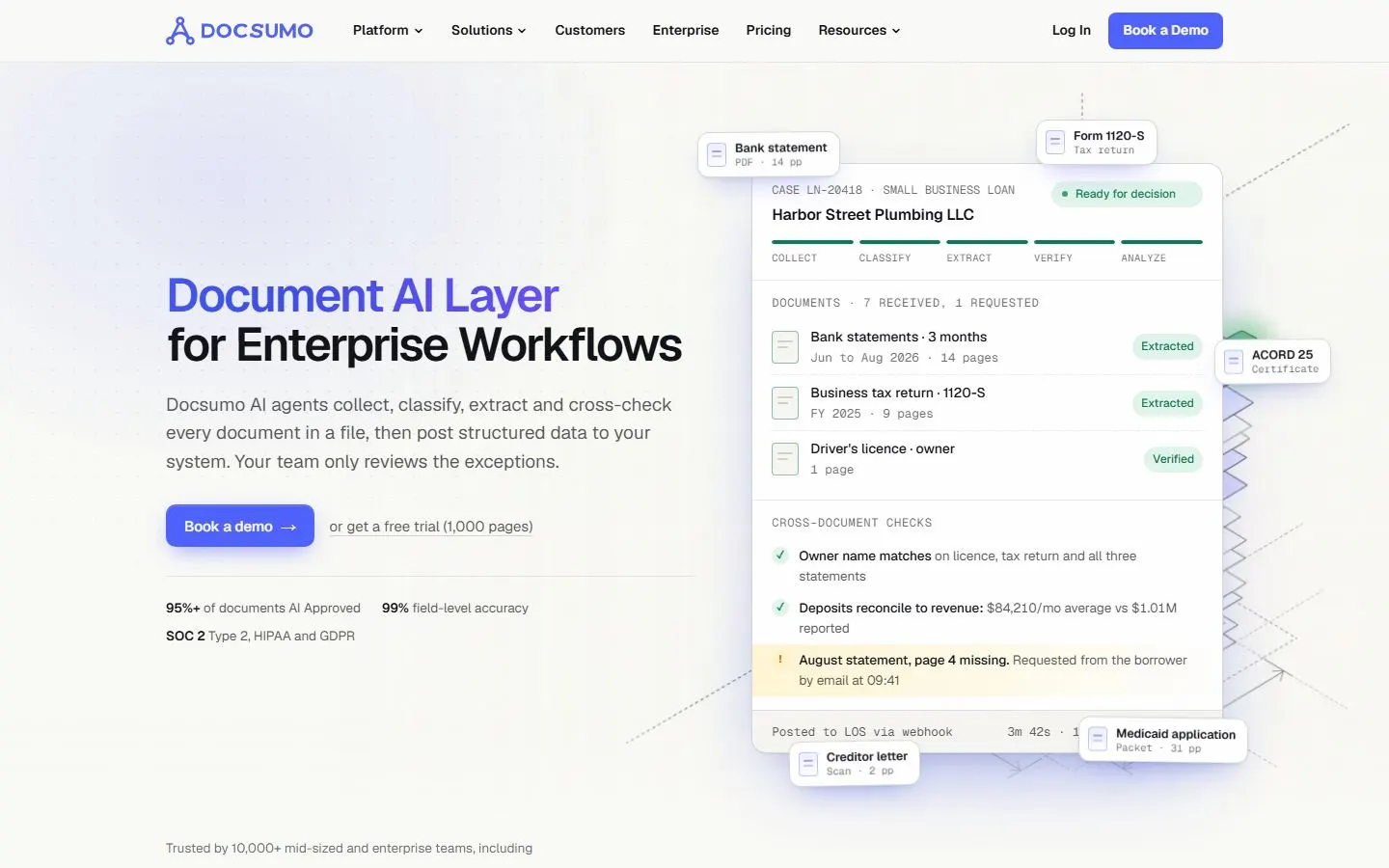
Docsumo says it captures “every field on the certificate, from any edition,” including the issue date, ACORD version, insurers with NAIC numbers, policy terms, additional insured and waiver status, limits and the certificate holder. It then checks that each line is at or above the contract minimum, each policy is in force on the contract start date, and the holder matches your legal name and address (source). Docsumo says its customer Arbor reached “99% extraction accuracy on insurance compliance documents” and saves 3,000+ work hours a month (source).
Key functionalities
- Ready-made models for the ACORD 25, 27 and 28 and the 125, 126, 130 and 140
- Contract checks on limits, dates, holder and endorsements
- JSON by webhook with per-field confidence scores
- Test environment on Business and above
Pros:
- Checks limits, policy dates and holder name against the contract
- Low-confidence values go to review, the rest straight through
- SOC 2 Type 2 and ISO 27001:2022 certified, BAA available
Cons:
- Paid plans are quote-only
- The 99% accuracy figure Docsumo cites is across many document types
Pricing: Free for 14 days with up to 1,000 pages; Business and Enterprise quoted by volume. (source)
Verdict: The closest thing here to a finished certificate checker that still hands you the data.
3. Reducto: Best per-page API for teams writing their own schema
 Free to start · Free trial: $150 in free usage · SOC 2 Type IIFull profile →vs SensibleVisit site of Reducto (opens in a new tab)
Best for: Engineering teams that want low-cost parsing primitives and will define the ACORD 25 schema and validation rules themselves.
Reducto publishes an ACORD extraction guide that treats the ACORD 25 as “the document at the center of COI-tracking workflows” and recommends running Extract with a JSON schema per form type, with citations enabled so each value carries a pointer to its location in the source (source). Its insurance page says it parses ACORD and other insurance forms “with checkboxes and handwriting for straight-through processing” (source). See Reducto pricing for the full rate card.
Key functionalities
- Extract API returning JSON against your schema
- Split and classify for mixed uploads
- Checkbox and handwriting reading
- Citations back to the source page
Pros:
- Extract at $20 per 1,000 pages
- Citations point each value back to the source location
- Split endpoint separates certificates bundled with other documents
Cons:
- No ready-made certificate schema; you write it
- No contract checks or review queue built in
Pricing: $150 in free usage on Standard, then Parse $10 and Extract $20 per 1,000 pages. (source)
Verdict: The lowest published cost per certificate, for teams happy to own the field logic.
4. UiPath Document Understanding: Best for companies already running UiPath
Quote onlyFull profile →Visit site of UiPath Document Understanding (opens in a new tab)
Best for: Carriers, brokers and large companies with UiPath automations that want certificate data extracted in the same platform.
UiPath Document Understanding has an ACORD25 ML package for the Certificate of Liability Insurance, described as used to confirm general liability coverage. Its field table includes producer and contact details, insured, certificate holder, insurers with NAIC numbers, and coverage rows with insurer letter, type, ADDL INSD, SUBR WVD, policy number, dates and limits (source). It runs in Automation Cloud, self-hosted on Automation Suite, or hybrid (source).
Key functionalities
- ACORD25 model with deductible and retention fields
- Classification and extraction metered per page
- Validation screens for human correction
- Hand-off to UiPath automations
Pros:
- Ready-made ACORD25 model with the coverage table broken out by row
- Cloud, self-hosted or hybrid deployment
- Human validation step for corrections
Cons:
- No dollar price published; usage is metered in units
- Docs say up to 77 fields but the table lists 40
- Most of the value depends on already using UiPath
Pricing: Not published; quoted by sales. Metered per page: 0.8 AI units to extract after classification. (source)
Verdict: Easy to justify inside an existing UiPath estate; a heavy way to start if you have none.
5. Base64.ai: Best for on-premises ACORD extraction
Quote only · Free trial: Free trial; 100 free credits for new users · SOC 2 Type IIFull profile →Visit site of Base64.ai (opens in a new tab)
Best for: Carriers and insurtechs that need certificates read inside their own cloud or data center, alongside many other document types.
Base64.ai lists the “ACORD 25: Certificate of liability insurance form” on its ACORD page and says it extracts all ACORD form fields from digital, scanned or handwritten forms. The same page describes an insurtech that sends ACORD 25s to its API and passes the data into its existing workflow (source). Its Document AI plan adds classification, human-in-the-loop verification and 3,000+ pretrained models (source).
Key functionalities
- Pretrained ACORD models plus custom models
- Human-in-the-loop verification
- JSON output by REST API
- Cloud or on-premises deployment
Pros:
- Lists the ACORD 25 among ACORD forms it reads, including scans and handwriting
- Deploys in your cloud or on premises
- SOC 2 Type II, ISO 27001 and HIPAA listed
Cons:
- No dollar prices published
- ACORD page doesn't list the certificate fields returned
Pricing: Not published; quoted by sales. Free trial with 100 free credits. (source)
Verdict: Worth a trial when data has to stay on your servers; ask for the ACORD 25 field list first.
6. TrustLayer: Best if you want the compliance answer, not the raw data
Free to startFull profile →Visit site of TrustLayer (opens in a new tab)
Best for: Companies with a vendor list to keep compliant that would rather have certificates read, checked and chased than build anything on extracted fields.
TrustLayer says it “reads each COI, checks it against your standards and industry benchmarks, and flags any gaps in coverage,” and that its tool “learns from 400,000+ COIs a month” (source). Its Platform API exposes compliance profiles, parties and projects as JSON (source). It sits here as the bridge to our COI tracking software list, where Jones and illumend also review certificates and endorsements with AI.
Key functionalities
- AI reading and gap flagging on each certificate
- Document collection and classification
- Expiration and renewal reminders
- Procore, CMiC and Vista Viewpoint integrations on Pro
Pros:
- Reads each COI and flags coverage gaps against your standards
- Free Starter plan for up to 50 vendors
- Platform API for compliance profiles and parties
Cons:
- Its plans page doesn't name COI field extraction as a feature
- API docs on the developer page don't mention extracted certificate fields
Pricing: Starter free up to 50 vendors; Pro and Complete quoted. (source)
Verdict: Pick TrustLayer when the goal is a compliant vendor list; pick an extraction tool above when the goal is data in your own system.
Conclusion: test on your worst certificates
Run a trial on the files that cause trouble today: faxed certificates, older ACORD revisions, carrier-branded forms and certificates with a continuation page. Then compare each tool’s limits, dates and ADDL INSD values with the originals on a sample before letting any of them write straight into a system that approves vendors or releases funds.
How did we choose these tools?
The order is our editorial judgment of fit for the job this guide covers, not a test score. Prices appear only where the vendor publishes them or a cited source reports them; otherwise we name the pricing model and mark it "Quote only." SOC 2 status comes from each vendor's trust or security pages. These profiles are desk research: we have not run the products on real files. Full methodology.
FAQs
What is the best software for extracting data from certificates of insurance?
For teams that want certificate data in their own systems, Sensible is the strongest fit: extraction that handles the standard ACORD 25, carrier-branded certificates and proof-of-coverage letters, source links for each extracted value, and published pricing. Docsumo is the better pick if you want contract-minimum checks and a review screen without writing code. If you only need to know whether vendors are compliant, use a COI tracking tool such as TrustLayer instead.
What fields can be extracted from an ACORD 25?
UiPath's ACORD25 model lists the producer and its contact details, the insured, the certificate holder, insurers with NAIC numbers, and a row per coverage with insurer letter, coverage type, ADDL INSD, SUBR WVD, policy number, effective and expiration dates, and limits. Sensible lists the same groups, including additional insured status and waiver of subrogation per policy. Docsumo adds the certificate issue date and ACORD version.
What is the difference between COI tracking and COI data extraction?
Tracking software runs a compliance program: it requests certificates from vendors, compares them with your requirements, and sends renewal reminders. Extraction software turns the certificate into structured data that your own system then uses, whether that is a vendor portal, a lending platform or an agency management system. Our COI tracking software list covers the first group.
Can extraction software read endorsements and additional insured wording?
It can read the ADDL INSD and SUBR WVD columns on the certificate itself. Endorsement wording sits in separate pages, and the tools treat it differently: Sensible says it pulls those clauses and flags low-confidence reads for review, and Docsumo marks endorsements where the contract requires them. Tracking products such as illumend and Jones review endorsements as part of a compliance decision.
How much does COI data extraction cost?
Sensible starts at $499 a month for 750 documents, with extra documents at $0.57. Reducto lists Extract at $20 per 1,000 pages after free starting usage. Docsumo offers a 14-day free trial with up to 1,000 pages and quotes paid plans. UiPath meters pages in AI units without publishing a dollar price, and Base64.ai quotes plans after a free trial.
How accurate is ACORD 25 extraction?
Vendors publish few ACORD 25-specific numbers. Docsumo says Arbor reached 99% extraction accuracy on insurance compliance documents, which covers more than certificates. Reducto notes that ACORD 25s often arrive as faxes and low-resolution scans, and Sensible notes that revisions differ, so test on your own worst files and check limits and dates by hand on a sample.
Sources
- Sensible: certificates of insurance
- Sensible pricing
- Docsumo: ACORD form extraction
- Docsumo
- Docsumo security
- Reducto: ACORD form extraction
- Reducto pricing
- UiPath docs: ACORD25 ML package
- UiPath docs: Document Understanding metering and charging
- Base64.ai: Automating ACORD data extraction
- Base64.ai pricing
- TrustLayer
- TrustLayer plans
- TrustLayer developers