Best AI Auto Claims Estimating Software in 2026
Six auto claims estimating and photo damage assessment tools compared: CCC Intelligent Solutions, Mitchell, Tractable, Solera Qapter, Claim Genius and Snapsheet, by approach, fit, pricing and security.
TL;DR
- AI auto estimating tools fall into three shapes: full claims ecosystems (CCC, Mitchell, Solera Qapter), photo-AI specialists (Tractable, Claim Genius), and claims platforms with virtual appraisal built in (Snapsheet).
- CCC Intelligent Solutions leads for US carriers because its estimating network is already where many repair shops and insurers work; the company says 300+ insurers use its platform.
- Tractable and Claim Genius are the pure photo-AI options. Tractable sells to insurers across FNOL triage, estimate pre-population and claim review; Claim Genius is an API-first engine that outputs Mitchell-format estimates.
- Mitchell and Solera Qapter fit teams that already estimate on those platforms and want AI added without switching estimating systems.
- None of the six publishes pricing. Every comparison starts with a sales conversation, so ask each vendor for accuracy results measured on your own claims.






Auto claims estimating used to mean an appraiser, a set of photos and an estimating system. AI now sits in the first steps: sorting claims at first notice of loss, reading damage from photos and pre-filling an estimate. Buyers struggle to compare the tools because vendors publish their own accuracy and cycle-time claims, measured differently, and because several of the biggest names are also the estimating systems the AI has to feed.
This guide compares six tools insurers shortlist for the job. It does not repeat vendor accuracy percentages, because none are independently comparable. It covers how the tools differ, each tool in turn, a side-by-side table and a guide to which fits which team.
What do the estimating platforms do and where do teams add AI vendors?
CCC, Mitchell and Solera Qapter are the estimating systems themselves. They hold parts, labor and repair-procedure data, and the repair shops and insurers that exchange estimates. Their AI features sit on top of that data. Teams add a separate photo-AI vendor when they want a specific capability, such as FNOL triage by photo, or when they want to keep their choice of estimating system open.
Different tools solve different parts of the estimating problem
| Shape | What it focuses on | Tools in this list |
|---|---|---|
| Claims ecosystem | Estimating, repair network, review and total loss in one connected platform, with AI modules added | CCC Intelligent Solutions, Mitchell, Solera Qapter |
| Photo-AI specialist | Reading damage from images and producing or pre-filling an estimate | Tractable, Claim Genius |
| Claims platform with virtual appraisal | Workflow, virtual appraisal and payment in one claims system | Snapsheet |
Ecosystems suit carriers that want one data model from estimate to repair. Photo-AI specialists suit teams that want to add AI to an existing estimating system or build a self-service photo claims flow. A claims platform with virtual appraisal suits carriers that want to run the whole workflow from one vendor.
The 6 best AI claims estimating tools for auto insurers
1. CCC Intelligent Solutions: Best for US carriers who want AI inside the dominant estimating network
 Quote onlyFull profile →
Best for: US auto carriers and multi-line insurers that already work with CCC's repair network and want AI added to estimating, review and total loss.
CCC Intelligent Solutions runs a cloud platform that connects insurers, repairers, parts suppliers and other parties in auto claims. For insurers its site lists auto physical damage, casualty, fraud detection, subrogation and payments, and it describes the physical damage product as AI-powered software and management tools for claims from creation to resolution (source).
Key functionalities
- Auto physical damage claims software for estimate management, with AI described by the company as part of the workflow
- Fraud detection that the company says uses photos and cross-carrier intelligence
- Subrogation automation aimed at recovery and cycle time
- Casualty claims and insurer payments products on the same platform
- Scale figures stated by the company: 300+ insurers, 18M+ claims processed annually and 5,000+ parts suppliers
Pros:
- Connects insurers and repair shops on one platform, so AI output reaches the system shops already use
- Company reports 300+ insurers and 18M+ claims processed a year
- Covers adjacent steps: casualty, subrogation, fraud detection and payments
Cons:
- AI modules typically sit on top of an existing CCC contract and add cost
- Moving off the platform later is hard once estimating and shop workflows depend on it
- Pricing not published
Pricing: Not published; quoted by sales.
Verdict: The broadest fit for US auto carriers, mainly because it is where many estimates already live. Carriers outside the US, or those wanting to avoid single-vendor dependence, should weigh a photo-AI specialist.
2. Mitchell: Best for insurers already estimating on Mitchell
 Quote onlyFull profile →
Best for: Auto insurers that estimate on Mitchell or want one vendor for photo capture, estimating, review and total loss, with room to connect an outside AI.
Mitchell, part of Enlyte, sells claims technology to insurers and collision repairers. Its insurer pages list photo capture within loss profiling and dispatch, automated estimating that uses AI to generate damage assessments, estimate compliance, automated review and total loss evaluation (source).
Key functionalities
- Photo capture that helps determine the best inspection method
- Automated estimating that the company says uses AI to generate damage assessments
- Estimate compliance rules applied to estimates against preset criteria
- Automated review to speed appraisal review and auditing, including file prioritization
- Total loss valuation and settlement managed from one place
- The Mitchell Intelligent Open Platform, which the company says lets insurers connect a preferred AI provider
Pros:
- Covers the insurer workflow from dispatch through total loss and settlement
- Open platform lets insurers connect a preferred AI provider
- Glass claims management available on the same platform
Cons:
- Insurer pages describe products by name with little detail on AI capabilities
- Less visible AI-first positioning than the photo-AI specialists
- Pricing not published
Pricing: Not published; quoted by sales.
Verdict: A logical choice if your estimators and shops are on Mitchell. Ask for documentation of what its automated estimating covers before treating it as a photo-AI replacement.
3. Tractable: Best for a dedicated photo-AI layer across triage, estimating and review
 Quote onlyFull profile →
Best for: Mid-size and large insurers with high auto claim volumes that want AI at FNOL, in estimate writing and in claim review.
Tractable applies computer vision to vehicle damage photos. Its insurer page lists FNOL triage that classifies claims as total loss, repairable or cash settlement; an AI-generated preliminary estimate that pre-populates estimatics; claim review that flags potential errors or fraud; and subrogation support (source).
Key functionalities
- FNOL triage from first-notice photos into total loss, repairable or cash settlement
- Preliminary estimates pre-populated into estimating systems
- Claim review that flags possible errors or fraud for adjusters
- Subrogation review of inbound packets and contention report creation
- Desktop and API integration with FNOL, estimatics and claim review systems
Pros:
- Covers several steps: FNOL triage, estimate pre-population, claim review and subrogation
- Named insurer case studies include Admiral and Aviva
- Offers desktop and API integration options
Cons:
- Hidden damage found at teardown still needs manual supplements
- Complex or OEM-procedure repairs need human review
- Pricing not published, and the outcome statistics on its site come with no stated methodology
Pricing: Not published; quoted by sales.
Verdict: A strong choice when you want AI layered onto your existing estimating system. Treat its cycle-time and automation figures as vendor claims and test them on your own claims.
4. Solera Qapter (Audatex): Best for insurers on Audatex who want AI estimating from the same vendor
 Quote onlyFull profile →
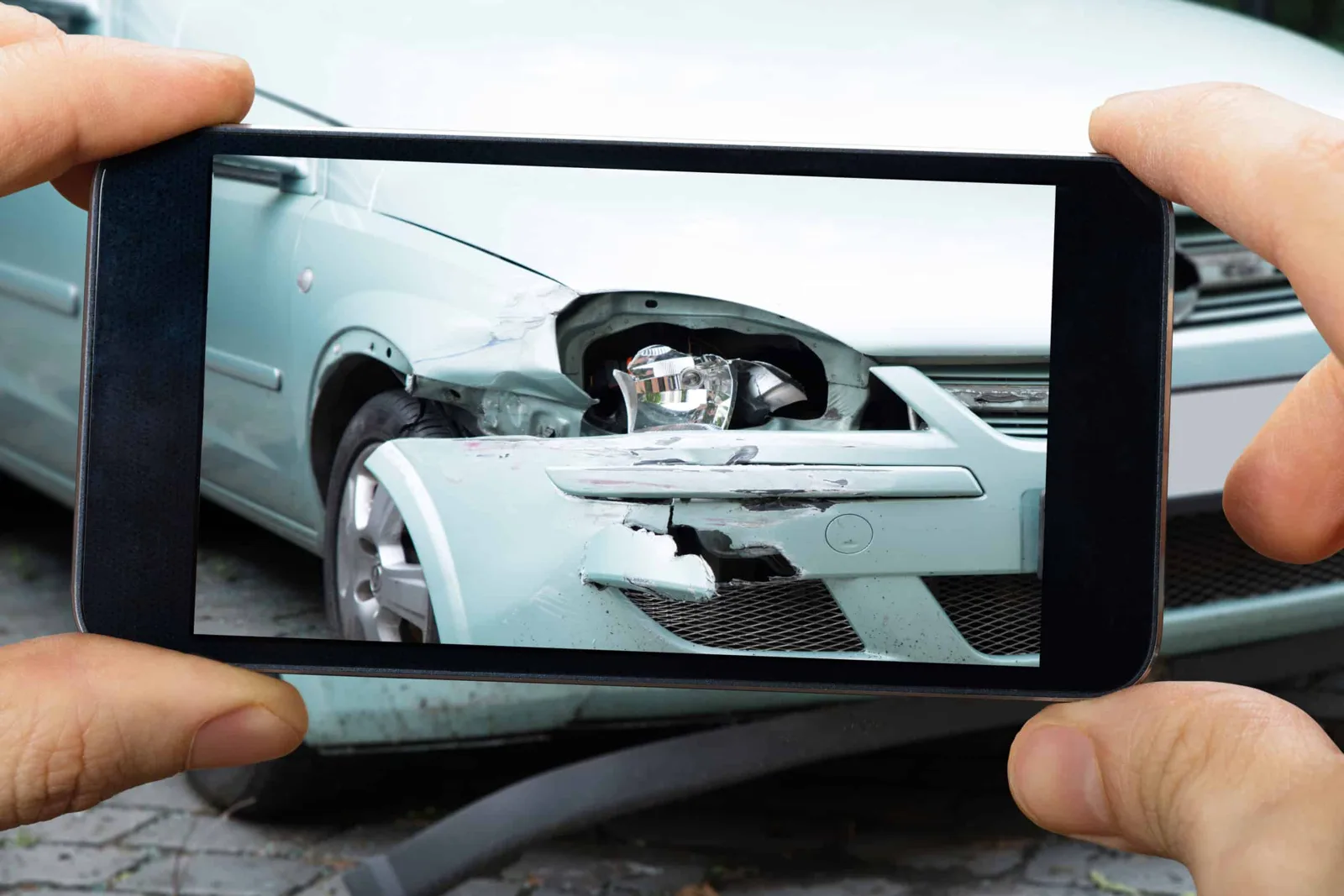
Best for: Insurers and TPAs, particularly in Europe, that already use Audatex estimating and want photo-based estimating in the same lineage.
Solera Qapter is Solera’s AI estimating product. Trade press reports that Solera launched it in 2021, described the AI estimating as ready for light to medium damage and said Audatex Estimating had been renamed Qapter (source).
Key functionalities
- AI-generated estimates from photos submitted to an insurer or a shop
- Guided photo capture that can ask for a better photo and give real-time feedback
- Damage detection speed improvements reported in a 2021 update
- Region-specific labor times in North America
- Modular suite that Solera says includes heavy-duty vehicle estimating
Pros:
- Same vendor as the Audatex estimating platform
- Real-time feedback on photo quality, according to press coverage
- Keeps region-specific labor-time data in North America
Cons:
- Most public detail dates from 2021 launch coverage, so confirm current capabilities
- Positioned for light to medium damage; complex cases stay with estimators
- Pricing not published
Pricing: Not published; quoted by sales.
Verdict: A natural fit for existing Audatex customers. Others should ask Solera for current references and capability documentation before shortlisting.
5. Claim Genius: Best for API-first photo claims workflows
 Quote onlyFull profile →

Best for: Carriers and TPAs building self-service photo claims flows who want an API for damage detection and repair estimates, especially on Mitchell.
Claim Genius provides computer vision that turns photos of vehicle damage into repair estimates. It targets self-service and FNOL flows where policyholders submit their own photos.
Key functionalities
- Damage detection from photos, with severity classification
- Repair-versus-replace and total loss prediction
- Line-by-line repair estimates
- REST API and mobile SDKs for guided photo capture on iOS and Android
Pros:
- API and mobile SDK approach lets teams embed it in their own claims app
- Focused on the photo-to-estimate step rather than a full platform
- Outputs estimates in Mitchell format
Cons:
- Small vendor, so large production rollouts carry vendor risk
- No repair network or parts sourcing, so it covers only the estimating step
- Pricing not published
Pricing: Not published; quoted by sales.
Verdict: Best for engineering-led teams building a photo claims flow. Carriers on CCC or Audatex should confirm the integration path first.
6. Snapsheet: Best for a claims platform with virtual appraisal built in
 Quote onlyFull profile →
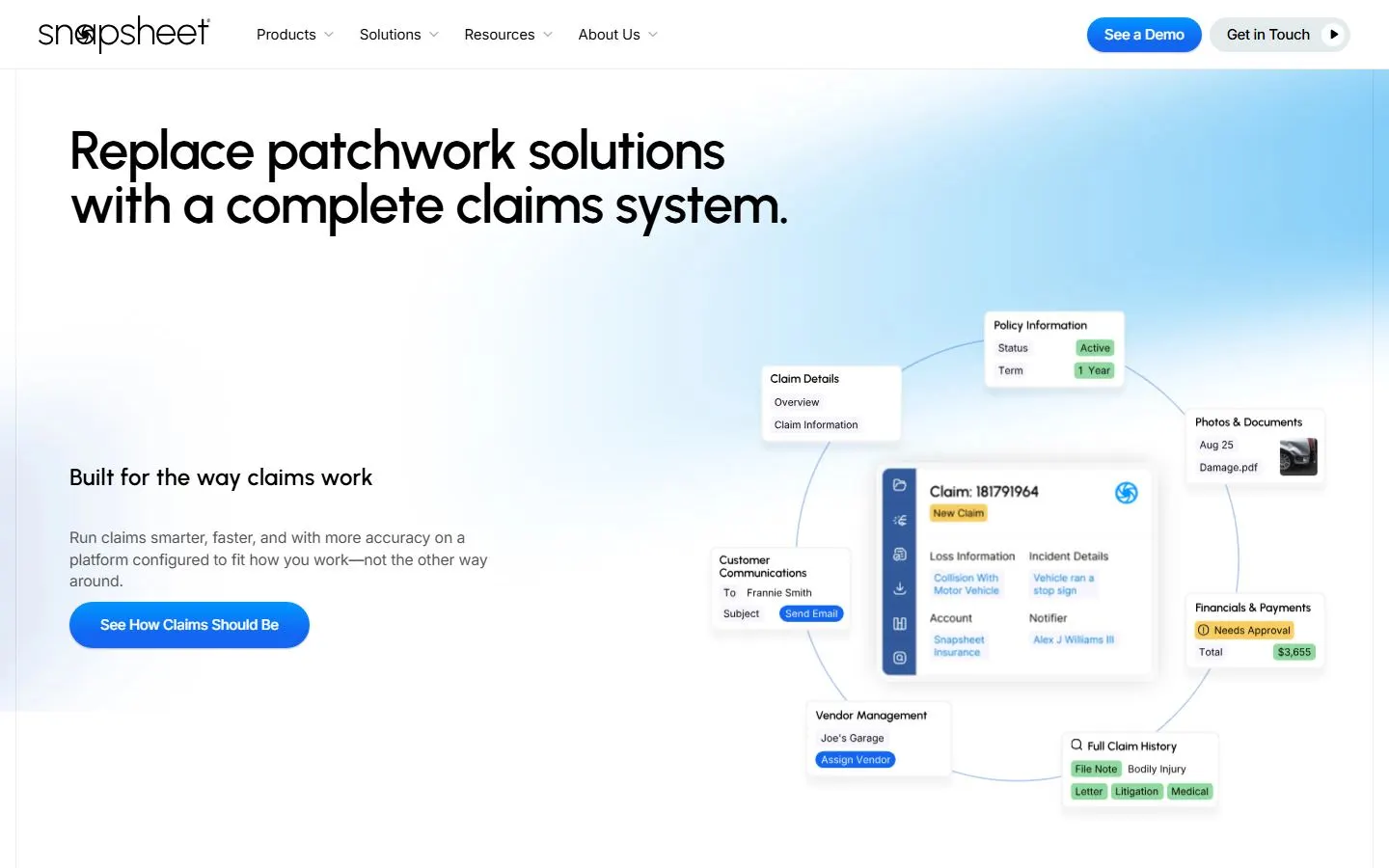
Best for: P&C carriers with high auto physical damage volume that want workflow, virtual appraisal and payments from one vendor.
Snapsheet is a claims management platform whose products include virtual vehicle appraisals. Its site promotes faster cycle times, predictable costs and more accurate outcomes across inspection methods and vehicle types, and lists an AI product marked as available in 2026 (source).
Key functionalities
- Virtual vehicle appraisals across several vehicle types
- Claims platform with no-code workflows, integrations and APIs
- Total loss settlement and payments
- Analytics and oversight reporting
- A Trust Center hosted on Vanta; confirm certifications there
Pros:
- Virtual appraisal sits inside the same platform as workflow and payments
- No-code workflow builder lets claims staff change routing
- Covers private passenger, boat, RV, motorcycle, utility, exotic and heavy-duty vehicles, per its site
Cons:
- AI estimating is marketed as available in 2026, with little product detail yet
- Customer logos on its site do not say which products each customer uses
- Pricing not published
Pricing: Not published; quoted by sales.
Verdict: Choose it as a claims platform first. Treat its AI estimating as new until you see it demonstrated on your own claims.
How do these tools compare side by side?
| Tool | Approach | Best for | Pricing | Free trial | Security |
|---|---|---|---|---|---|
| 1CCC Intelligent Solutions | Insurance Claims AI | U.S. auto carriers and multi-line insurers already in the CCC ecosystem who want to activate AI modules for damage estimation, total loss, and (via EvolutionIQ) complex claims management | Quote only | — | SOC 2 unverified |
| 2Mitchell | Estimating platform | Auto insurers that already estimate on Mitchell, or want one vendor for estimating, review and total loss with the option to plug in a third-party AI. | Quote only | — | SOC 2 unverified |
| 3Tractable | Insurance Claims AI | Mid-to-large P&C insurers with high auto claim volumes seeking to reduce cycle time and adjuster workload on standard claims | Quote only | — | SOC 2 unverified |
| 4Solera Qapter (Audatex) | Estimating platform | Insurers and TPAs, especially outside North America, that already use Audatex and want photo-based estimating from the same vendor. | Quote only | — | SOC 2 unverified |
| 5Claim Genius | Claims Automation | Carriers and TPAs building self-service photo claims workflows who want an API-first damage estimation engine, particularly those using Mitchell as their estimating platform | Quote only | — | SOC 2 unverified |
| 6Snapsheet | Claims Management | P&C carriers processing high volumes of auto physical damage claims who want to automate FNOL triage, virtual appraisal, and payment disbursement in a single platform | Quote only | — | SOC 2 unverified |
Which tool fits your team?
- You are a US carrier and want AI inside the estimating network where shops already work: CCC Intelligent Solutions.
- Your estimators already use Mitchell: Mitchell.
- You want a dedicated photo-AI layer for triage, pre-populated estimates and review: Tractable.
- You are on Audatex, especially in Europe: Solera Qapter.
- You are building a self-service photo claims app: Claim Genius.
- You want a claims platform with virtual appraisal and payments from one vendor: Snapsheet.
Conclusion: test the AI on your own claims before you commit
The ecosystems have the estimating data, the photo-AI specialists have focused tools, and no vendor here publishes pricing or comparable accuracy. Start with your estimating system, since it narrows the list fastest. Then ask two or three vendors to run a sample of your closed claims, including supplements, and compare results against what your appraisers wrote.
FAQs
What is the best AI auto claims estimating software?
It depends on your estimating system. CCC fits US carriers that want AI inside the dominant estimating and repair network. Mitchell and Solera Qapter fit teams already on those estimating platforms. Tractable fits insurers that want a dedicated photo-AI layer for triage and estimate pre-population. Claim Genius fits teams building an API-driven photo claims flow.
How accurate is AI photo damage estimating?
No independent, comparable accuracy figure exists for these vendors, and this guide does not publish one. Vendors report their own results using different methods. Solera has said its tool is ready for light to medium damage, and hidden damage found at teardown still needs a manual supplement whichever tool wrote the first estimate. Ask each vendor to test on a sample of your closed claims.
Can AI estimate hidden damage from photos?
No. Photos show exterior damage, so damage found during teardown still leads to supplements handled by a repairer and an appraiser. AI estimating mainly speeds up the first estimate and triage.
What is the difference between photo AI and an estimating platform?
An estimating platform such as CCC, Mitchell or Solera Qapter holds the parts, labor and repair-procedure data that a final estimate is built on. A photo-AI tool such as Tractable or Claim Genius identifies damage from images and produces or pre-fills an estimate that usually lands in one of those platforms.
Do these tools replace appraisers?
No. They handle straightforward claims and flag the rest for people. Vendors typically describe the goal as moving routine claims faster while appraisers focus on complex damage and supplements.
How much does AI claims estimating software cost?
None of the six vendors in this list publishes pricing. CCC, Mitchell, Tractable, Solera, Claim Genius and Snapsheet all quote through sales, usually by claim volume or module.
What is Solera Qapter and is it the same as Audatex?
Qapter is Solera's AI photo estimating product. Solera has said Audatex Estimating was renamed Qapter, so insurers on Audatex estimating are on the same lineage.
Should we pick an estimating ecosystem or a standalone photo-AI vendor?
If your estimators, repair network and total loss process already run on one platform, adding that platform's AI keeps one data model. A standalone photo-AI vendor makes sense when you want to keep estimating system choice open or need a specific capability such as FNOL triage by photo.