Best Underwriting Submission Intake Software in 2026
Seven submission intake tools for carriers, MGAs and wholesalers compared: Cytora, Sensible, Indico Data, SortSpoke, FurtherAI and more, by approach, pricing and security.
On this page (8)
What is the best underwriting submission intake software?
Updated Nov 3, 2026 · ranked by fitCytora ranks first of the 7 tools we compared: best for intake run as a configured product across lines and countries. Pricing is by quote. Sensible and Indico Data follow.
| # | Tool | Best for | Pricing | Free trial | Security | Vendor site |
|---|---|---|---|---|---|---|
| 1 | CytoraRisk digitization platform | Intake run as a configured product across lines and countries | Quote onlyNot published; quoted by sales | — | SOC 2 not confirmed | Visit site of Cytora (opens in a new tab) |
| 2 | SensibleHybrid developer infrastructure | Owned extraction under the intake pipeline you build | From $499Per document, monthly plans | 14 days | SOC 2 Type II | Visit site of Sensible (opens in a new tab) |
| 3 | Indico DataEnterprise IDP | Large carriers ranking submissions against appetite | Quote onlyEnterprise | — | SOC 2 Type II | Visit site of Indico Data (opens in a new tab) |
| 4 | SortSpokeInsurance workflow automation | Triage rules that underwriters set themselves | Quote onlyEnterprise | — | SOC 2 Type II | Visit site of SortSpoke (opens in a new tab) |
| 5 | FurtherAIIntelligent Document Processing | MGAs that want intake and eligibility checks in one workspace | Quote onlyEnterprise | — | SOC 2 Type II | Visit site of FurtherAI (opens in a new tab) |
| 6 | Bevaya (formerly Roots Automation)Insurance workflow automation | Intake bought as a priced, task-specific agent | From $4,000Per AI agent / month, billed annually | — | SOC 2 Type II | Visit site of Bevaya (formerly Roots Automation) (opens in a new tab) |
| 7 | AppulateSubmission intake and exchange platform | Submissions that start with retail agents | Quote onlyUsage-based; quoted | — | SOC 2 not confirmed | Visit site of Appulate (opens in a new tab) |






Head-to-headCytora vs FurtherAIFurtherAI vs SortSpokeBevaya (formerly Roots Automation) vs SortSpoke
TL;DR
- Submission intake software reads the broker email and its attachments (ACORD applications, loss runs, SOVs, supplementals), turns them into one structured record and checks it against appetite before an underwriter picks it up.
- Cytora ranks first for carriers, MGAs and wholesale brokers that want intake handled as a product: pre-built schemas by line and country, confidence thresholds with a review console, and routing into CRM, policy and rating systems. Applied Systems bought it in September 2025.
- Sensible is the pick when your team builds the intake pipeline and wants to own the extraction underneath it, with source links for every value and published pricing from $499 a month for 750 documents.
- Indico Data, SortSpoke and FurtherAI pair extraction with appetite triage; Bevaya sells intake as a per-agent subscription at $4,000 a month; Appulate also works on the agent side, chasing missing answers before the submission arrives.
- Only Sensible and Bevaya publish prices. The rest quote by sales.
A commercial submission rarely arrives as one document. It comes as a broker email with an ACORD 125 and a line supplement, three years of loss runs from two carriers, a statement of values in somebody’s spreadsheet layout and a supplemental application that may or may not have been signed. Before anyone can decide whether the risk is in appetite, someone has to open all of it, work out which file is which, key the fields into a system and notice what is missing. That first stretch is submission intake, and it is where the tools on this list do their work.
This list covers that stretch only: getting submission documents into clean data, checked and routed. What happens after (clearance decisions, risk analysis, pricing, quote and bind) is the job of an underwriting workbench, and several of those products include their own intake.
Different tools solve different parts of the intake problem
| Shape | What it focuses on | Tools in this list |
|---|---|---|
| Risk digitization platform | Intake as a configured product: schemas by line, review console, routing to downstream systems | Cytora |
| Hybrid developer infrastructure | The extraction layer under an intake pipeline you build, with validation and source links | Sensible |
| Insurance intake and triage | Extraction plus appetite rules that rank and route submissions | Indico Data, SortSpoke, FurtherAI |
| Prebuilt AI agents | Task-specific agents for inbox monitoring, ACORDs, loss runs and SOVs, priced per agent | Bevaya |
| Submission exchange | Collection from agents, follow-up for missing answers, delivery to carrier and MGA systems | Appulate |
Teams that want intake running without building it start with Cytora or the triage tools. Teams that already have an underwriting platform and engineers to connect it usually want an extraction layer they control, which is where Sensible fits.
Which tool fits your team?
- You want submissions digitized, reviewed and routed across lines and countries without building it yourself: Cytora.
- Your engineers own the intake pipeline and you want extraction you can version and audit: Sensible.
- You are a large carrier and want appetite ranking on top of extraction: Indico Data.
- Underwriters, not IT, should set the triage rules: SortSpoke.
- You are an MGA that wants intake, SOV work and eligibility checks in one workspace: FurtherAI.
- You want a published price and one agent per task: Bevaya.
- Your submissions come from retail agents and arrive incomplete: Appulate.
The 7 best submission intake tools
1. Cytora: Best for intake run as a configured product across lines and countries
 Quote onlyFull profile →vs FurtherAIVisit site of Cytora (opens in a new tab)
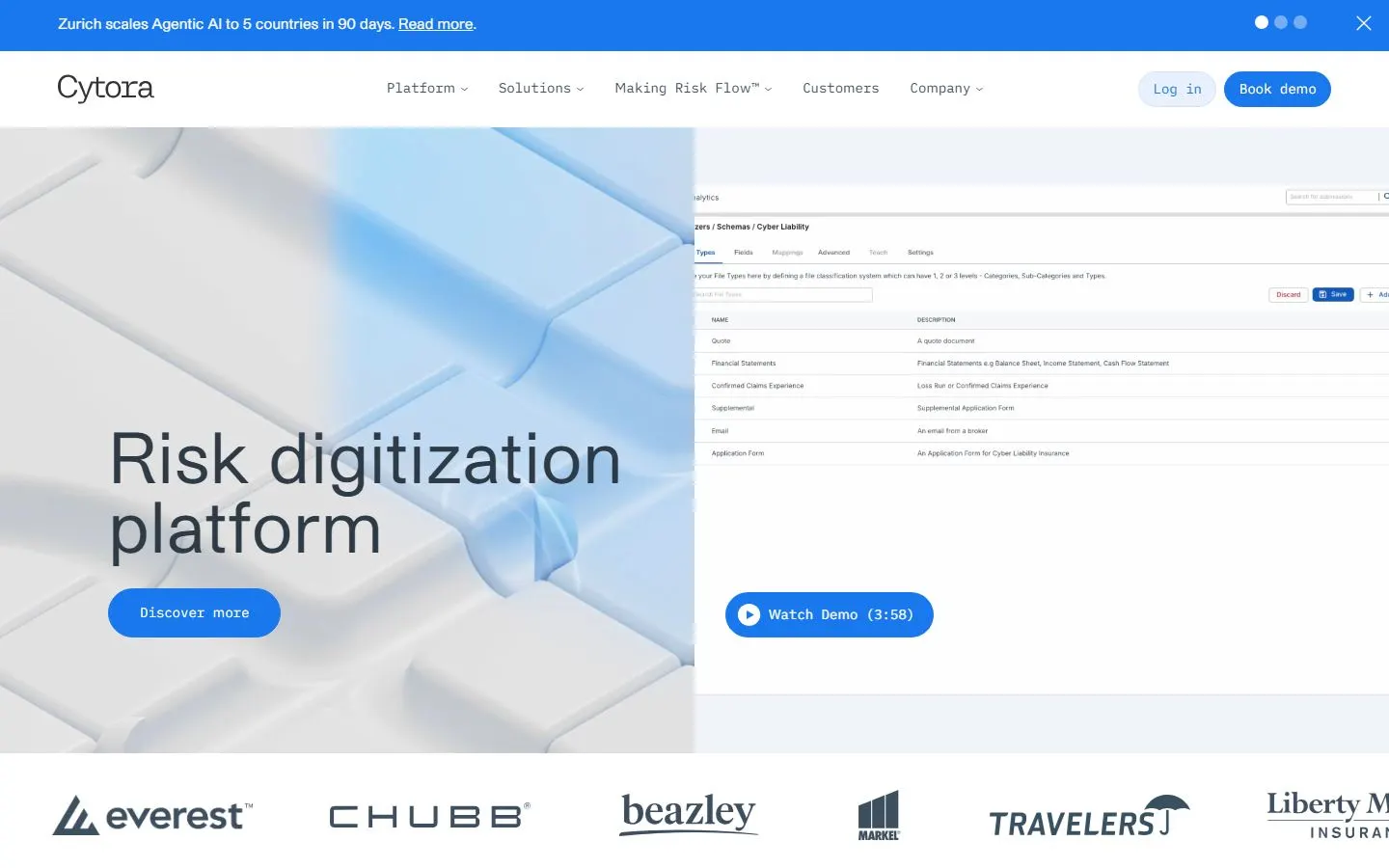
Best for: Commercial insurers, MGAs, wholesale brokers and reinsurers that want new business, renewals and mid-term changes digitized and routed without building the pipeline themselves.
Cytora says its platform “digitizes your entire new business intake with out-of-the-box line of business schemas” and pre-integrated data sources for clearance, client accumulation and risk evaluation, and that it does not require training (source). Reviewers set confidence thresholds at schema and field level, and each field shows where it came from in the submission (source). Applied Systems bought Cytora in September 2025, and Cytora now runs as a business unit of Applied under its own name (source). Cytora cites Zurich cutting manual processing time by over 80% while scaling to more than 20 markets; that figure is Cytora’s (source).
Key functionalities
- Intake from email, API, audio and video, with related messages linked over time
- Auto-responses to brokers when data is missing
- Auto-evaluation against risk appetite and eligibility for straight-through processing
- Review console with role-based task assignment
- Parallel routing to CRM, policy and rating systems, plus webhooks
- 140+ languages, per Cytora
Pros:
- Out-of-the-box schemas by segment, line of business and country, configurable in natural language
- Field-level confidence thresholds, a review console and provenance for every field
- Routes data in parallel to CRM, policy administration and rating systems, with webhooks
Cons:
- Pricing not published
- No SOC 2 report shown on its site; it shows an ISO 27001 certificate
Pricing: Not published; quoted by sales.
Verdict: The strongest first choice when the goal is intake that runs as a product, with review and routing included. Teams that only need structured data from documents can spend less with an extraction layer.
2. Sensible: Best for owned extraction under the intake pipeline you build
 From $499 · Free trial: 14 days · SOC 2 Type IIFull profile →Visit site of Sensible (opens in a new tab)
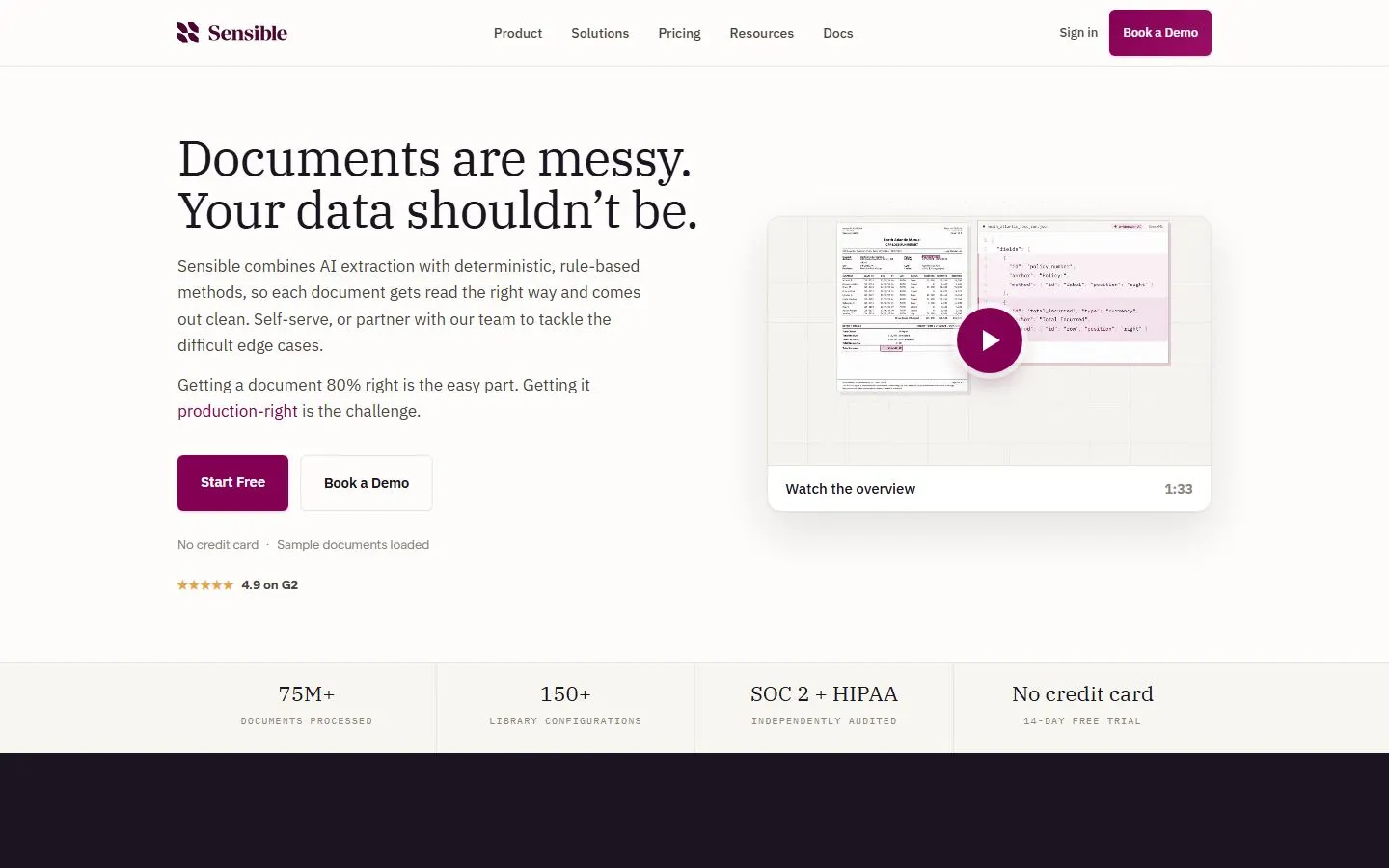
Best for: Engineering and operations teams at MGAs, carriers, brokers and insurtechs that run their own intake workflow and want the document extraction underneath it to be configurable, testable and priced per document.
Sensible describes itself as “the extraction layer under your underwriting intake: schema-validated and traceable to the source page.” Documents arrive as PDF, scan or photo by email, API or batch with no pre-sorting by carrier; Sensible identifies the document type before extraction, and a failed validation check flags the field and can send the document to human review (source). For loss runs, it says it stitches claim tables that span pages into one output and offers prebuilt loss run templates in its configuration library (source).
Key functionalities
- Document classification ahead of extraction (loss runs, dec pages, certificates, quotes)
- Layout rules plus LLM parsing in versioned configurations
- Validation rules that flag fields before they reach a rating engine
- Low-confidence review queue with configurable thresholds
- Typed JSON through a REST API, SDKs and webhooks
- SOC 2 Type II on every plan; HIPAA with a BAA and custom region on Enterprise
Pros:
- Classifies each document type before extraction runs
- Every value links to its page and bounding box for audit
- Published per-document pricing and a 14-day free trial with no credit card
Cons:
- You build triage, appetite rules and routing on top
- Configuration sits closer to engineering than to an underwriter's desk
Pricing: From $499/month for 750 documents ($0.57 per additional document); Scale $1,499/month for 3,200 documents. (source)
Verdict: The right choice when your team owns the intake flow and wants the extraction layer to be predictable and auditable, and when you want to see the price before a sales call.
3. Indico Data: Best for large carriers ranking submissions against appetite
 Quote only · SOC 2 Type IIFull profile →Visit site of Indico Data (opens in a new tab)
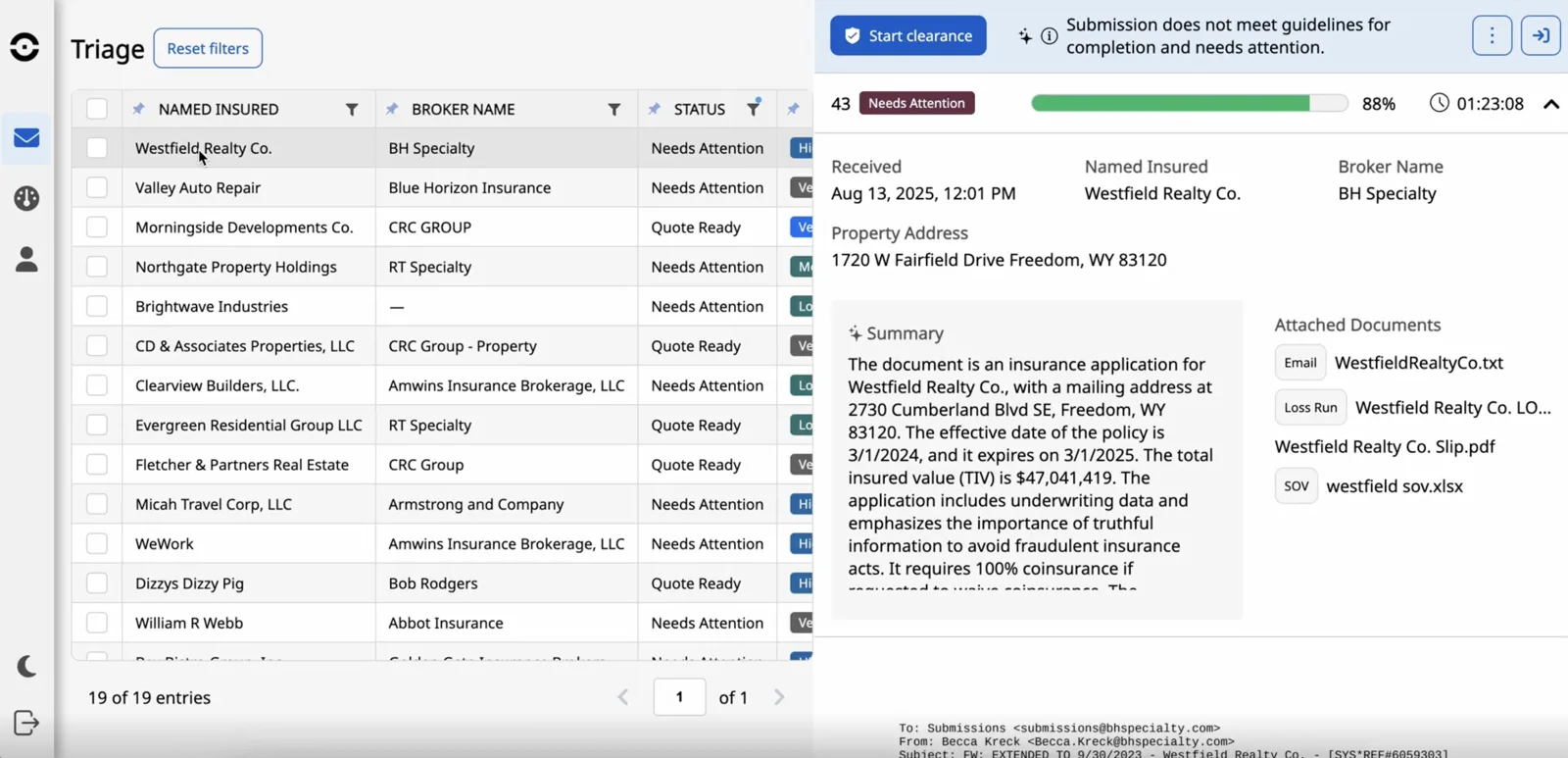
Best for: Large carriers and MGAs that want emails, spreadsheets, loss runs and SOVs assembled into one submission record and ranked against their appetite.
Indico Data says it “extracts, enriches, validates, and organizes the data into one complete submission record,” then evaluates submissions against carrier-defined appetite, underwriting rules and business priorities and pushes the quote and submission record into the policy system (source). Its security page says it is SOC 2 Type II certified and runs on AWS with a single-tenant deployment model (source).
Key functionalities
- Ingestion of emails, documents, spreadsheets, loss runs, SOVs and supplementals
- Extraction, enrichment and validation into a single submission record
- Appetite and guideline screening, ranking and routing
- Push to the policy system; headless or standalone output as JSON or Excel/CSV
Pros:
- Builds one complete submission record from emails, SOVs, loss runs and supplementals
- Ranks submissions against carrier-defined appetite and shows its reasoning
- SOC 2 Type II, AWS hosting and a single-tenant model, per its security page
Cons:
- Enterprise sales and implementation
- Pricing not published
Pricing: Not published; quoted by sales.
Verdict: A strong fit for carriers with high volumes that want triage included with extraction. More than a small MGA needs.
4. SortSpoke: Best for triage rules that underwriters set themselves
 Quote only · SOC 2 Type IIFull profile →vs FurtherAIvs Bevaya (formerly Roots Automation)Visit site of SortSpoke (opens in a new tab)
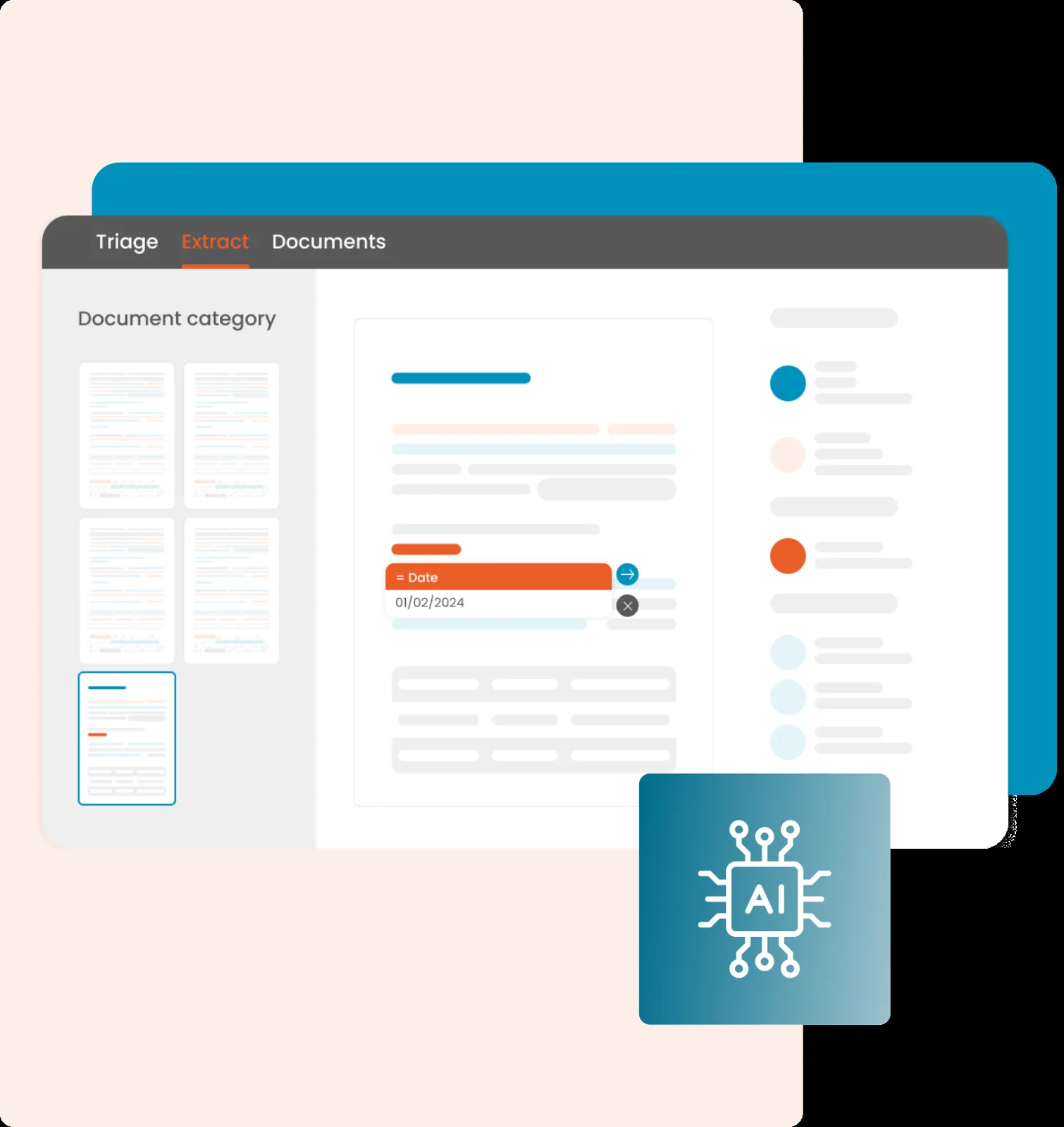
Best for: E&S, specialty and P&C underwriting teams that want every extracted field checked and want business users to own the triage rules.
SortSpoke pulls data from ACORD forms, loss runs, SOVs, supplementals and the broker’s email body, arriving by forwarded email or upload. Its triage page says “in appetite” has to become comparisons on named values such as class code, state, limit and prior losses, and that anything that can’t be written that way should be routed to a person (source). SortSpoke reports a 5x efficiency gain at Great American Custom Insurance on the same page.
Key functionalities
- Extraction from ACORD 125, 126, 140, loss runs and SOVs
- Per-value confidence scoring with reviewer queue
- Business-user triage rules on extracted fields
- Output as CSV or through APIs and connectors
Pros:
- Business users change triage rules without technical support
- Confidence score on each value, with low scorers sent to a reviewer
- SOC 2 Type 2 and HIPAA, per SortSpoke
Cons:
- Integrations are described in general terms, so confirm connectors for your systems
- Pricing not published
Pricing: Not published; quoted by sales.
Verdict: A good fit when underwriting leadership wants control of what counts as in appetite and wants a person on every uncertain field.
5. FurtherAI: Best for MGAs that want intake and eligibility checks in one workspace
 Quote only · SOC 2 Type IIFull profile →vs Cytoravs SortSpokeVisit site of FurtherAI (opens in a new tab)

Best for: MGAs, carriers and brokers that want submission intake, SOV standardization, loss run summaries and eligibility checks handled by one AI workspace.
FurtherAI describes a deployment at an unnamed MGA with over $1.5 billion in premium where its assistant extracted ACORD applications, SOVs and loss runs, added web data, surfaced high-priority submissions and checked eligibility. FurtherAI says average time to clear a submission fell from about 32 minutes to about 1 (source). Its security page lists SOC 2 Type II, ISO 27001, GDPR and HIPAA (source).
Key functionalities
- Extraction from ACORD applications, SOVs and loss runs
- SOV standardization for commercial property
- Missing-data flags, enrichment and eligibility checks
- Prioritization of high-value submissions
Pros:
- Published MGA case study with time-to-clear figures
- SOC 2 Type II, ISO 27001, GDPR and HIPAA on its security page
- Contractual guarantee that customer data is not used to train models
Cons:
- Case study customer is not named
- Pricing not published
Pricing: Not published; quoted by sales.
Verdict: A practical choice for MGAs that want intake and checking automated in front of their existing systems.
6. Bevaya (formerly Roots Automation): Best for intake bought as a priced, task-specific agent
 From $4,000 · SOC 2 Type IIFull profile →vs SortSpokeVisit site of Bevaya (formerly Roots Automation) (opens in a new tab)
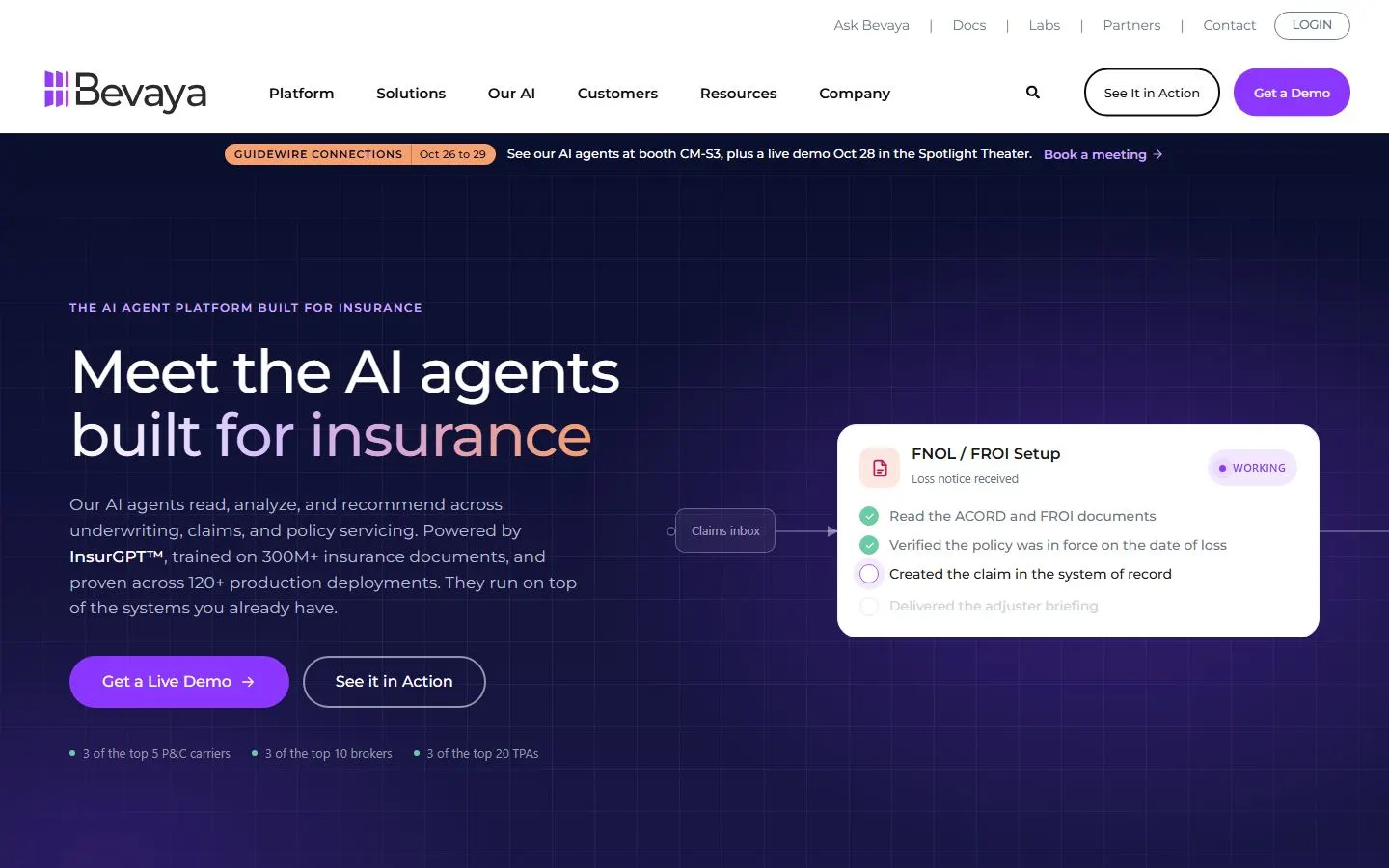
Best for: Carriers and MGAs that want separate agents for inbox intake, ACORDs, loss runs and SOVs and want to know the list price before talking to sales.
Bevaya, formerly Roots Automation, says its Submission Intake agent “monitors broker inboxes, classifies submissions, extracts data from ACORDs and supplementals” and populates underwriting systems. Separate agents extract ACORD forms and validate them against carrier rules, structure loss histories and normalize SOVs (source).
Key functionalities
- Broker inbox monitoring and submission classification
- ACORD extraction with validation against carrier rules
- Loss run and SOV agents that output structured data
- Push to underwriting systems
Pros:
- Published price per agent
- Separate agents for submission intake, ACORD extraction, loss runs and SOVs
- SOC 2 Type 2 attested, per its pricing page
Cons:
- Annual billing per agent, so a full intake setup with several agents adds up
- Its pricing page gives two different figures for included credits
Pricing: $4,000 per AI agent per month, billed annually; 5% off for 2 agents, 10% for 3, up to 20% for 4 or more. (source)
Verdict: A fit for teams that want to start with one intake task and add agents later at a known price.
7. Appulate: Best for submissions that start with retail agents
Quote onlyFull profile →Visit site of Appulate (opens in a new tab)
Best for: MGAs, wholesalers and carriers whose submissions come from retail agents and arrive incomplete, and who want follow-up handled before the underwriter sees the file.
Appulate says it captures information from applications, loss runs, spreadsheets, supplemental forms and supporting documents and delivers structured submission data “into underwriting, rating, policy administration, and other core systems through an API” (source). Its forms ingestion product reads ACORDs, supplementals, loss runs and SOVs, including handwritten PDFs, and returns XML or JSON (source). It names preconfigured integration options for Guidewire, Insurity, Expert Insured, TRUE and AIM (source).
Key functionalities
- Intake by email, upload, portal or API
- Missing-information and consistency checks before underwriting
- Automated follow-up questionnaires to agents
- Structured XML or JSON into core systems
Pros:
- Flags missing information and sends follow-up questionnaires to the agent
- Named integration options for Guidewire, Insurity, Expert Insured, TRUE and AIM
- Agent-side platform lets one submission go to several markets
Cons:
- No security certification named on its product pages
- Pricing not published
Pricing: Usage-based; not published, quoted by sales.
Verdict: A good fit when incomplete agent submissions are the bottleneck. Ask for security documentation early.
Conclusion: measure intake on your messiest week
Pull a week of real submissions, including the ones with scanned loss runs, a broken SOV and no supplemental, and run them through two or three of these tools. Count how many fields a person had to correct, how many submissions were routed to the right desk, and how long each took to reach an underwriter. Once intake is clean, the underwriting workbench list covers the tools underwriters use to work the risk.
How did we choose these tools?
The order is our editorial judgment of fit for the job this guide covers, not a test score. Prices appear only where the vendor publishes them or a cited source reports them; otherwise we name the pricing model and mark it "Quote only." SOC 2 status comes from each vendor's trust or security pages. These profiles are desk research: we have not run the products on real files. Full methodology.
FAQs
What is underwriting submission intake software?
It takes a commercial submission as it arrives, usually a broker email with an ACORD application, loss runs, a statement of values and supplementals, and turns it into structured data. Most tools also classify each document, flag missing or low-confidence fields for review, check the risk against appetite and send the record to the underwriting, rating or policy system.
What is the difference between submission intake and an underwriting workbench?
Intake ends when the submission is clean, complete and routed. A workbench is where the underwriter then works the risk: clearance, analysis, pricing, quote and bind. Some vendors, such as Kalepa and hyperexponential, cover both and are compared in our underwriting workbench list.
What is the best submission intake software for MGAs?
Cytora has a dedicated MGA offering and handles digitization, review and routing in one product. FurtherAI publishes an MGA case study where average time to clear a submission fell from about 32 minutes to about 1, per FurtherAI. Appulate suits MGAs whose submissions come from retail agents. MGAs with engineers who want to own the extraction can build on Sensible.
How much does submission intake software cost?
Sensible publishes plans from $499 a month for 750 documents ($0.57 per additional document) with a 14-day free trial. Bevaya lists $4,000 per AI agent per month, billed annually. Cytora, Indico Data, SortSpoke, FurtherAI and Appulate quote by sales.
Can intake software triage submissions against appetite?
Several can. Indico Data says it screens, prioritizes and routes submissions using your appetite and underwriting guidelines. SortSpoke lets business users write triage rules on extracted values such as class code, state, limit and prior losses. Cytora says it can auto-evaluate submissions against risk appetite. Sensible flags fields that fail validation and leaves appetite rules to your own system.
Which submission intake tools are SOC 2 compliant?
Sensible lists SOC 2 Type II on all plans. Indico Data's security page says it is SOC 2 Type II certified. SortSpoke cites SOC 2 Type 2 and HIPAA. FurtherAI lists SOC 2 Type II, ISO 27001, GDPR and HIPAA. Bevaya says it is SOC 2 Type 2 attested. Cytora shows an ISO 27001 certificate. Appulate's product pages name no certification, so ask for a report.
Sources
- Cytora
- Cytora new business intake
- Cytora human review
- Cytora routing
- Cytora acquired by Applied Systems
- Sensible for insurance
- Sensible: loss runs
- Sensible pricing
- Indico Data underwriting
- Indico Data security and architecture
- SortSpoke submission triage
- SortSpoke
- FurtherAI submissions processing case study
- FurtherAI security
- Bevaya AI agent library
- Bevaya pricing
- Appulate Submission Intelligence Platform
- Appulate insurance forms ingestion
- Appulate core system integration