Best ACORD Form Extraction Software in 2026
Seven tools that extract data from ACORD forms (25, 125, 126, 130, 140 and more) compared: Sensible, Docsumo, Reducto, SortSpoke, Indico Data, Roots and Hyperscience, by approach, pricing, security and fit.
TL;DR
- ACORD forms look standardized, but versions, agency-management-system exports, scans, checkboxes and handwriting make them harder to parse than they appear.
- Sensible leads for teams that want ACORD extraction they own and can audit, alongside loss runs and other insurance documents, with published pricing from $499 a month and a 14-day free trial.
- Docsumo offers pre-trained models for ACORD 25, 125, 126 and 140; Reducto is a parsing API that handles checkboxes and handwriting; SortSpoke, Indico Data and Roots extract ACORDs as part of submission intake.
- Certificates of insurance (ACORD 25) are short and high-volume, so per-page pricing can be cheaper there; application packets (ACORD 125/126/140) favor per-document pricing.
- Only Sensible and Reducto publish production pricing; Docsumo publishes a free trial and quotes paid plans.







ACORD forms are supposed to be the easy part of insurance paperwork. In practice, the same ACORD 125 arrives as a clean export from one agency management system, a flattened PDF from another, a scan with handwritten corrections, or one form buried on page 12 of a 40-page submission. Checkboxes decide coverage, edition dates change field positions, and supplements vary by line. This guide compares seven tools insurance teams use to turn ACORD forms into structured data.
Different tools solve different parts of the ACORD problem
| Shape | What it focuses on | Tools in this list |
|---|---|---|
| Hybrid developer infrastructure | Configurable extraction you own, across ACORDs and the rest of the insurance document mix | Sensible |
| Pre-trained document AI | Ready-made models for common ACORD forms with review workflows | Docsumo |
| Parsing API | Layout-aware parsing including checkboxes and handwriting, priced per page | Reducto |
| Insurance workflow automation | ACORD extraction as one step of submission intake | SortSpoke, Indico Data, Roots |
| Enterprise IDP | High-volume forms processing with human review and handwriting | Hyperscience |
If ACORD data feeds your own systems, start with an extraction layer (Sensible, Docsumo, Reducto). If underwriters need the whole submission triaged, start with intake workflow tools.
The 7 best ACORD form extraction tools
1. Sensible: Best for owned, auditable ACORD extraction alongside other insurance documents
 From $499 · Free trial: 14 days · SOC 2 Type IIFull profile →
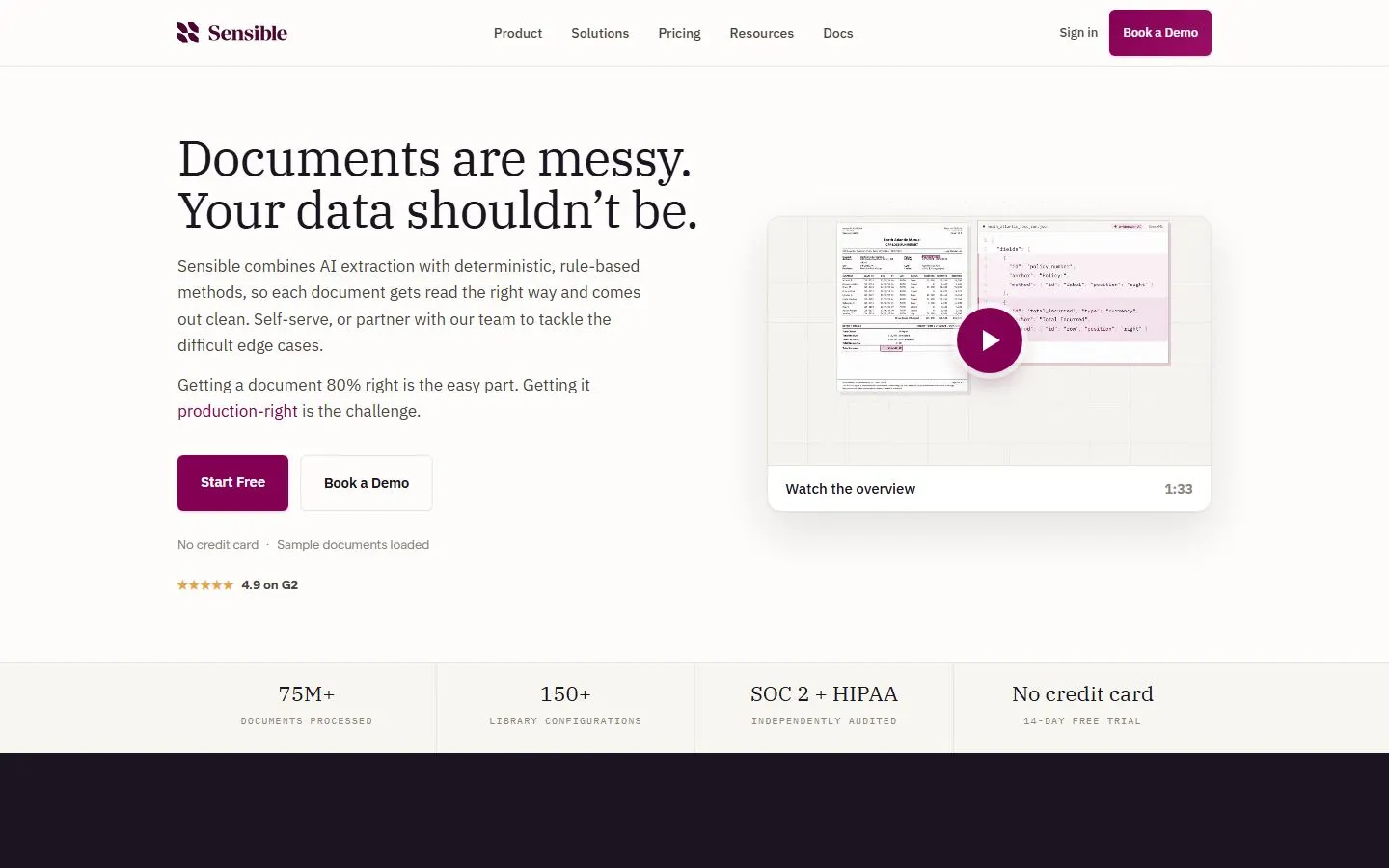
Best for: Engineering and operations teams at MGAs, carriers, brokers and insurtechs that process ACORD forms together with loss runs, dec pages and certificates, and want extraction logic they control.
Sensible combines layout rules with LLM parsing in versioned configurations, so a known ACORD layout extracts the same way every run while unexpected variations fall back to the LLM. Its insurance page lists ACORD forms alongside loss runs, certificates of insurance, dec pages, niche carrier forms and ad-hoc broker submissions. (source)
Key functionalities
- Layout-based extraction for fixed ACORD fields, LLM parsing for free text and attachments
- Validation rules that flag fields failing a check (for example, missing policy dates)
- Typed JSON output through a REST API, SDKs and webhooks
- SOC 2 Type II; HIPAA and custom region on Enterprise
Pros:
- Same configuration approach for ACORDs and every other insurance document
- Source-text highlighting for each extracted value supports audit
- Published per-document pricing and a 14-day free trial
Cons:
- Configuration work sits closer to engineering than point-and-click
- Extraction only: submission triage and routing are built on top
Pricing: From $499/month for 750 documents ($0.57 per additional document); Scale $1,499/month for 3,200 documents. (source)
Verdict: The best fit when ACORD forms are one part of a wider insurance document pipeline you want to own and audit.
2. Docsumo: Best for pre-trained ACORD models with review workflows
 Quote only · Free trial: 14 days, up to 1,000 pages · SOC 2 Type IIFull profile →
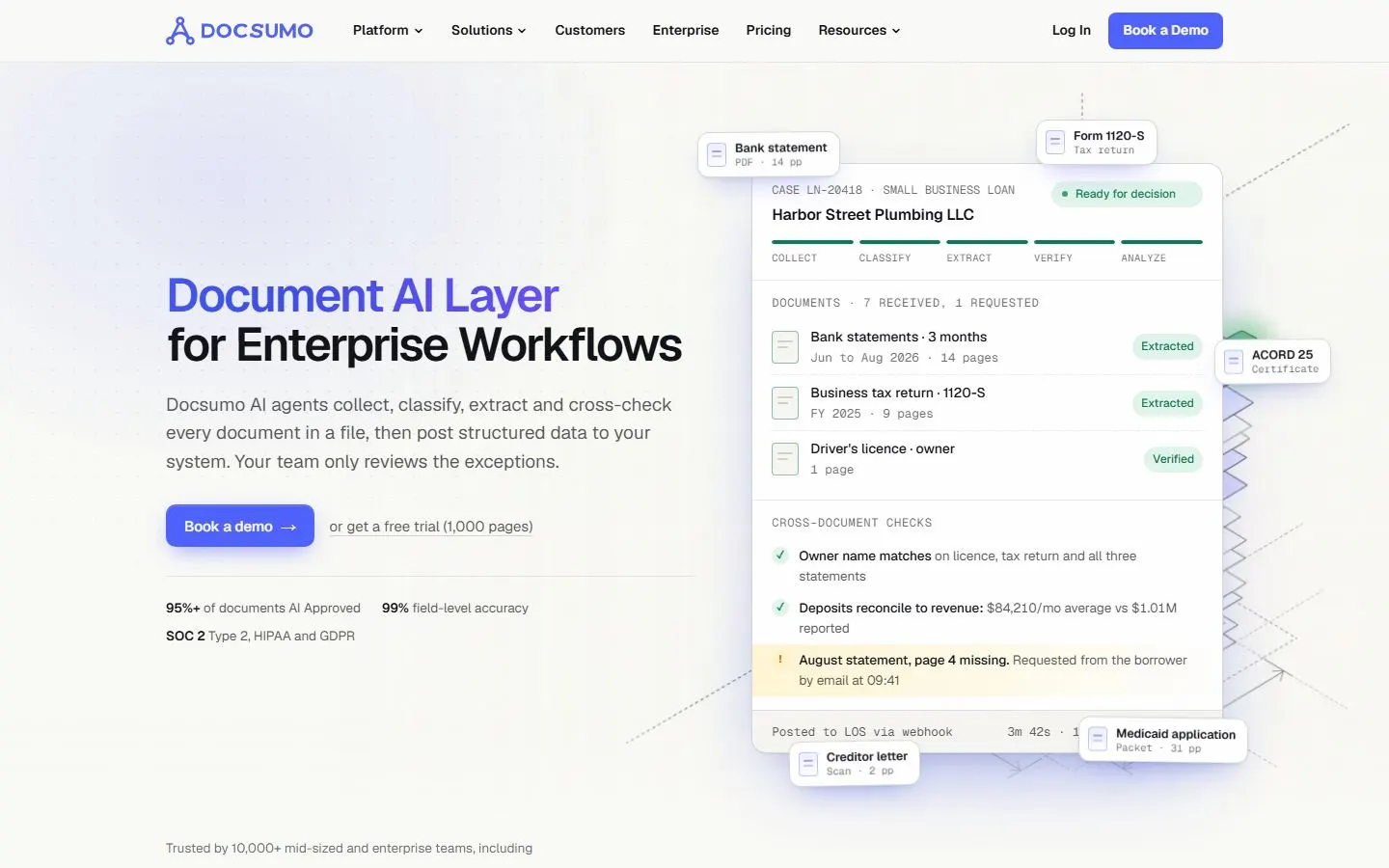
Best for: Insurance operations teams that want ready-made models for ACORD 25, 125, 126 and 140 and a review interface, without building extraction themselves.
Docsumo says its models process ACORD 25, 125, 126 and 140 forms, certificates of insurance and loss runs without templates, alongside lending documents. (source)
Key functionalities
- Pre-trained models for common ACORD forms
- Field and table extraction with an AI document reviewer
- Auto-classification and splitting of multi-document files (Business plan)
- APIs, webhooks and Excel exports
Pros:
- Pre-trained models for several ACORD forms
- SOC 2 Type 2, ISO 27001 and HIPAA on every plan, per its security page
- Free trial on your own files
Cons:
- Paid plans are quote-only
- Broad document focus rather than insurance-only
Pricing: 14-day free trial with up to 1,000 pages; Business and Enterprise quoted by volume. (source)
Verdict: A practical choice for certificate and application processing where pre-trained models and a review queue matter more than owning the logic.
3. Reducto: Best parsing API for ACORD checkboxes and handwriting
 Free to start · Free trial: $150 in free usageFull profile →
Best for: Engineering teams that want a per-page parsing API and will build their own ACORD field logic on top.
Reducto says it “reliably parses ACORD and other insurance forms with checkboxes and handwriting for straight-through processing.” (source)
Key functionalities
- Parse API (structured blocks and markdown) and Extract API (schema JSON)
- Split and classify endpoints for combined submission files
- Visual grounding of extracted values
Pros:
- Says it handles checkboxes and handwriting on insurance forms
- Transparent per-page pricing with free starting credits
Cons:
- No prebuilt insurance workflow; you assemble the logic
- Per-page cost grows with long submission packets
Pricing: $150 in free usage, then Parse $10 and Extract $20 per 1,000 pages. (source)
Verdict: A strong building block when your engineers want parsing primitives rather than a finished product.
4. SortSpoke: Best for underwriter-configured submission intake
 Quote only · SOC 2 Type IIFull profile →
Best for: E&S and specialty underwriting teams receiving ACORD applications inside messy broker submissions.
SortSpoke is trained on insurance documents such as ACORD forms, loss runs and SOVs, and pairs extraction with human validation. (source)
Key functionalities
- Submission package splitting and classification
- Underwriter-facing configuration and validation
- Human-in-the-loop review on uncertain fields
Pros:
- Built for submission packages, including ACORD-to-supplement consistency
- Underwriters can adjust extraction without developers
- SOC 2 Type 2 and HIPAA-compliant infrastructure
Cons:
- Focused on submission intake
- Pricing not published
Pricing: Not published; quoted by sales.
Verdict: A good fit when ACORDs arrive as part of complex submissions that underwriters review.
5. Indico Data: Best for large carriers unbundling high-volume submissions
 Quote onlyFull profile →
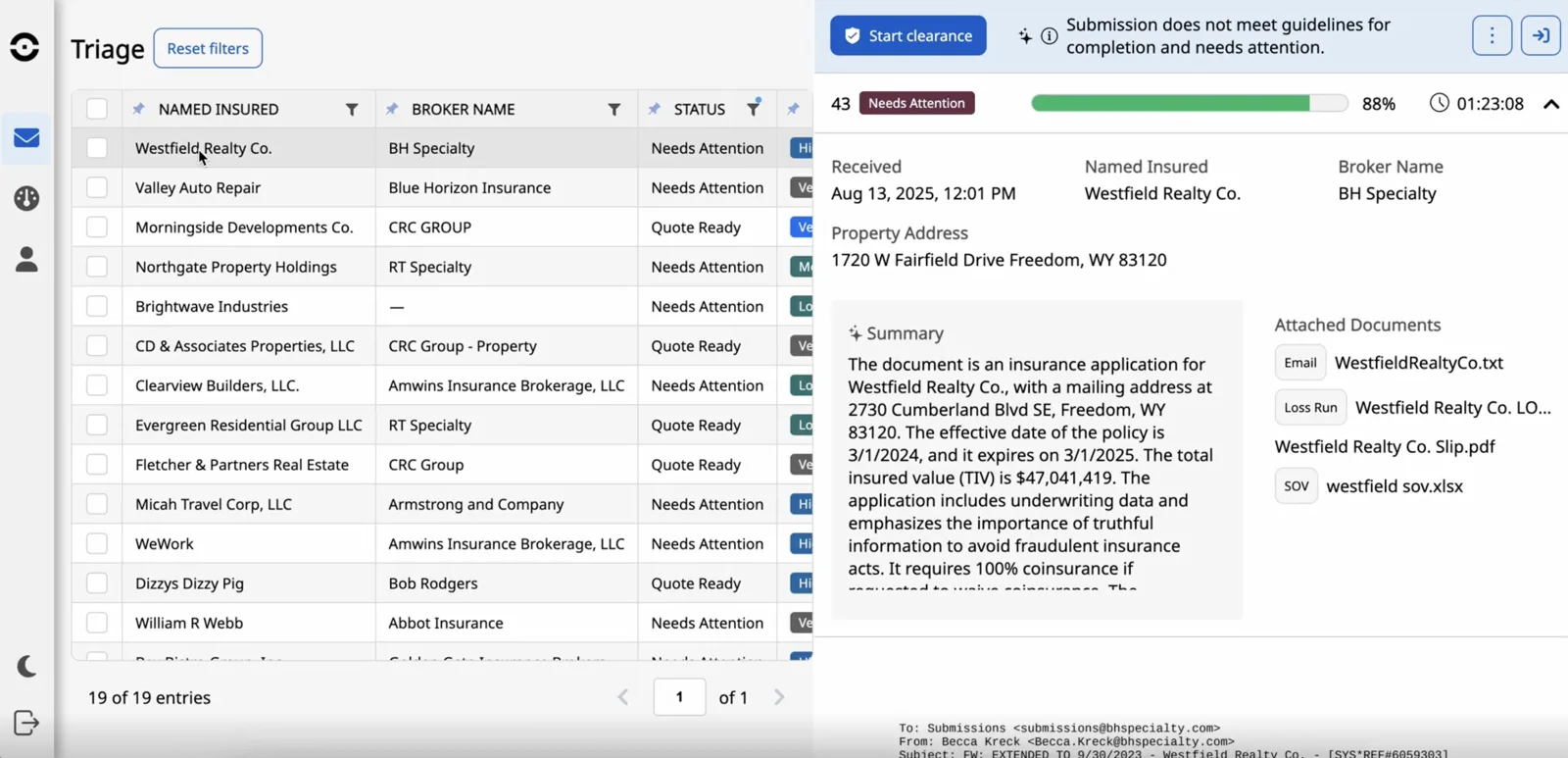
Best for: Large carriers and MGAs that process ACORDs alongside emails, SOVs and loss runs across many lines.
Indico Data says its extraction agents unbundle submissions and claims, capturing data from emails, attachments, SOVs, loss runs and ACORDs. (source)
Key functionalities
- Submission unbundling and classification
- Extraction across ACORDs, SOVs and loss runs
- Routing and review for underwriting teams
Pros:
- Covers ACORDs, SOVs, loss runs and emails in one intake flow
- Insurance-specialist vendor
Cons:
- Enterprise sales and implementation
- Pricing not published
Pricing: Not published; quoted by sales.
Verdict: Strong for enterprise submission intake; more than a team needs if ACORD extraction is the only goal.
6. Roots Automation: Best for automated intake into underwriting systems
 Quote only · SOC 2 Type IIFull profile →
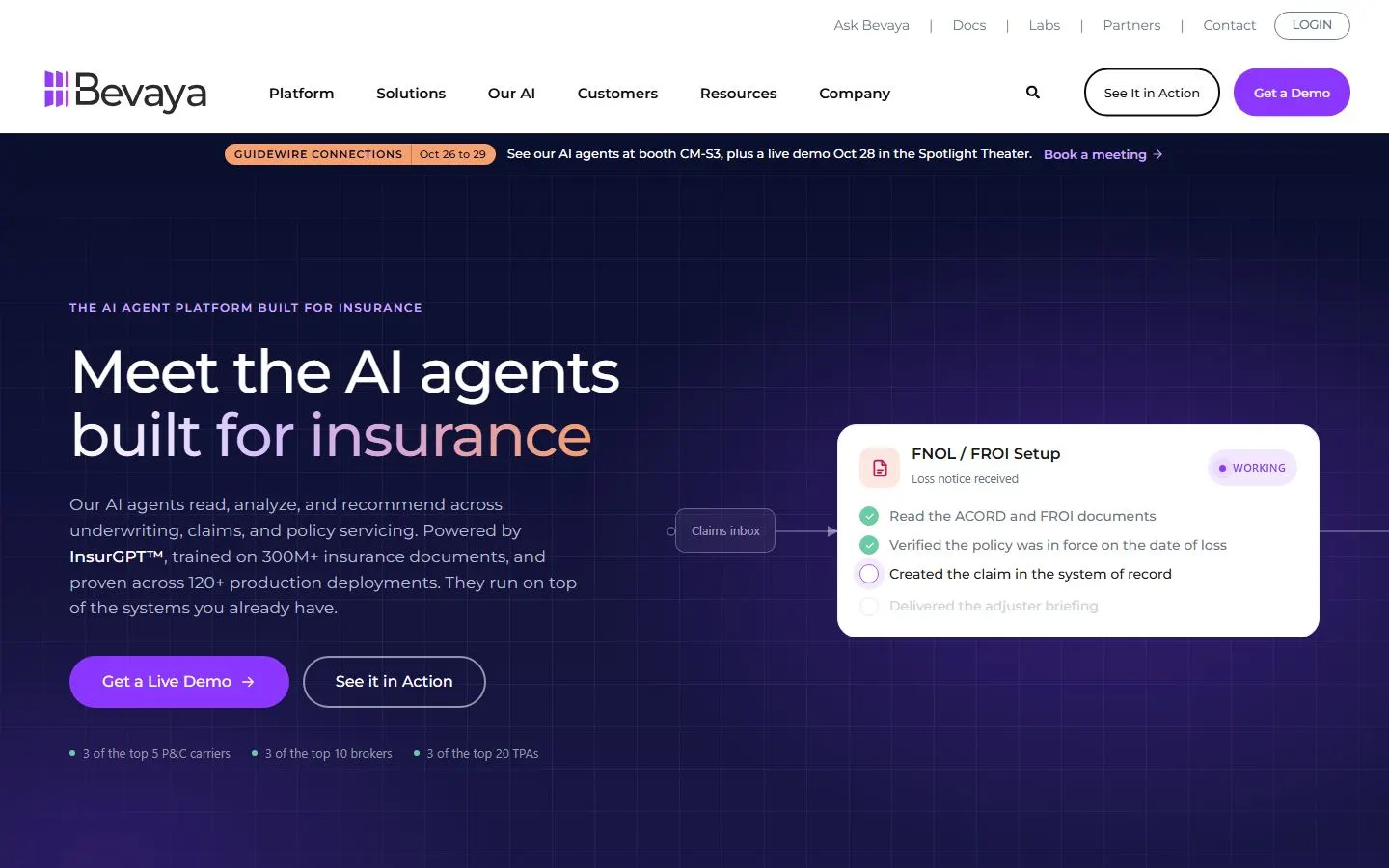
Best for: Carriers and MGAs that want broker inbox monitoring, ACORD extraction and system population handled by AI agents.
Roots (now Bevaya) says it monitors broker inboxes, classifies submissions, extracts data from ACORDs and supplementals, validates fields against carrier rules and populates underwriting systems. (source)
Key functionalities
- Broker inbox monitoring and submission classification
- ACORD and supplemental extraction with rule validation
- Push to underwriting systems
Pros:
- Extracts from all ACORD forms and validates against carrier rules, per its site
- Covers the wider intake workflow
Cons:
- More than you need for extraction alone
- Pricing not published for extraction-only use
Pricing: Not published for ACORD extraction; agent pricing by quote.
Verdict: A fit for operations leaders automating the full intake process rather than a single extraction step.
7. Hyperscience: Best for enterprise forms processing with handwriting
 Quote onlyFull profile →
Best for: Large carriers processing high volumes of scanned and handwritten forms across departments.
Hyperscience lists ACORD forms, explanations of benefits and health insurance cards among the insurance documents it automates. (source)
Key functionalities
- Forms extraction with confidence thresholds and human review
- Handwriting recognition
- Enterprise deployment options
Pros:
- Known for handwriting and low-quality scans
- Built for organization-wide rollouts
Cons:
- Enterprise implementation effort
- Pricing not published
Pricing: Not published; quoted by sales.
Verdict: Best when ACORDs are part of a large paper-forms program spanning departments.
How do these tools compare side by side?
| Tool | Approach | Best for | Pricing | Free trial | Security |
|---|---|---|---|---|---|
| 1Sensible | Hybrid developer infrastructure | Engineering, product and operations teams at MGAs, carriers, brokers and insurtechs that process varied insurance documents and want extraction logic they own and can audit. | From $499 | 14 days | SOC 2 Type II |
| 2Docsumo | Pre-trained document AI | Insurance and financial operations teams that want pre-trained models for common forms such as ACORD certificates and applications, with review workflows, without building extraction logic themselves. | Quote only | 14 days, up to 1,000 pages | SOC 2 Type II |
| 3Reducto | Parsing API | Engineering teams processing complex insurance documents (SOVs, bordereaux, multi-page loss runs) where table extraction accuracy is critical | Free to start | $150 in free usage | SOC 2 unverified |
| 4SortSpoke | Insurance workflow automation | E&S and specialty carriers processing non-standard submission packages who need underwriter-configurable extraction without developer dependency | Quote only | — | SOC 2 Type II |
| 5Indico Data | Enterprise IDP | Large carriers and London Market participants processing high volumes of diverse document types across multiple languages and lines of business | Quote only | — | SOC 2 unverified |
| 6Roots Automation | Insurance workflow automation | Carriers and MGAs wanting AI workers that handle complete insurance workflows including submission intake, policy checking, and bordereaux management | Quote only | — | SOC 2 Type II |
| 7Hyperscience | Enterprise IDP | Large carriers with legacy paper workflows and handwritten documents needing near-perfect extraction accuracy on structured forms | Quote only | — | SOC 2 unverified |
Which tool fits your team?
- ACORDs are one of many document types you process, and engineers own the pipeline: Sensible.
- You want pre-trained ACORD models and a review queue: Docsumo.
- You want a parsing API and will build the field logic: Reducto.
- ACORDs arrive inside broker submissions that underwriters triage: SortSpoke, Indico Data or Roots.
- You run a large paper and handwriting program across departments: Hyperscience.
Conclusion: validate the checkboxes
Whichever tool you choose, test it on your worst ACORDs: scanned, handwritten, older editions and multi-form packets. Then check checkbox fields and dates by hand on a sample before trusting straight-through processing.
FAQs
What is the best software for extracting data from ACORD forms?
For teams that want to own and audit extraction across ACORD forms and other insurance documents, Sensible is the strongest fit, with published per-document pricing. Docsumo is a good option for pre-trained ACORD 25, 125, 126 and 140 models with review workflows. Submission-focused teams should look at SortSpoke, Indico Data or Roots, which extract ACORDs as part of intake.
Can AI read ACORD 25 certificates of insurance?
Yes. ACORD 25 certificates are among the most automated insurance documents because the layout is consistent. Docsumo lists ACORD 25 among its pre-trained models, and Sensible, Reducto and the submission-intake tools also process them. Accuracy depends on scan quality and whether additional insureds and endorsements are attached.
How do you extract checkboxes and handwriting from ACORD forms?
Use a tool that reads checkbox states and handwriting explicitly rather than plain OCR text. Reducto says it parses ACORD and other insurance forms with checkboxes and handwriting; Hyperscience is known for handwriting recognition at enterprise scale. Always validate checkbox fields, because a misread box changes coverage.
Which ACORD forms matter most for commercial insurance?
The ACORD 125 (commercial insurance application) is the core of most commercial submissions, with line-specific supplements such as the 126 (commercial general liability), 130 (workers compensation), 131 (umbrella) and 140 (property). The 25 (certificate of liability insurance) is the most common certificate.
How much does ACORD form extraction cost?
Sensible starts at $499 per month for 750 documents ($0.57 per additional document). Reducto charges $20 per 1,000 pages to extract after $150 in free usage. Docsumo offers a 14-day free trial with up to 1,000 pages and quotes paid plans. SortSpoke, Indico Data, Roots and Hyperscience quote by sales.
Do I need an IDP platform or an API for ACORD forms?
If ACORD data flows into your own systems and engineers maintain the pipeline, an API with configurable extraction (Sensible, Reducto) is usually faster and cheaper. If underwriters need a queue to review submissions, a workflow product (SortSpoke, Indico Data, Roots) covers intake end to end.