Best Loss Run Parsing Software in 2026
Five tools that extract claims data from carrier loss runs compared: Sensible, SortSpoke, Indico Data, Roots and Docsumo, by approach, pricing, security and who each fits.
TL;DR
- Loss runs are hard to parse because every carrier formats them differently: landscape vs portrait, repeating headers, subtotals mid-table, and claims split across pages.
- Sensible leads for teams that want loss run extraction they own, with layout configurations for known carrier formats and LLM parsing for the rest, published pricing from $499 a month, and a 14-day free trial.
- SortSpoke, Indico Data and Roots parse loss runs as part of submission and renewal intake; Docsumo lists loss runs among its pre-trained document types.
- Long loss runs (hundreds of pages) favor per-document pricing over per-page pricing.
- Whatever you choose, reconcile extracted claim totals against the carrier's stated totals before the data reaches pricing.





A loss run is just a table of claims: dates, amounts, statuses and descriptions. But every carrier lays that table out differently, and the variation is what breaks automated parsing. Some carriers use landscape pages with policy-level headers, some put open and closed claims in one table with subtotals mid-stream, and multi-page reports repeat headers with columns that shift slightly from page to page. Underwriters and brokers end up rekeying the numbers that matter most for pricing. This guide compares five tools built to extract loss run data.
Different tools solve different parts of the loss run problem
| Shape | What it focuses on | Tools in this list |
|---|---|---|
| Hybrid developer infrastructure | Layout configurations for known carrier formats plus LLM parsing for the rest, owned by your team | Sensible |
| Insurance workflow automation | Loss runs parsed inside submission or renewal intake, with human validation | SortSpoke, Indico Data, Roots |
| Pre-trained document AI | Ready-made models with a review interface | Docsumo |
Teams pricing risks in their own systems usually want an extraction layer; underwriting teams that review submissions in a queue usually want the workflow tools.
The 5 best loss run parsing tools
1. Sensible: Best for owned loss run extraction across carrier formats
 From $499 · Free trial: 14 days · SOC 2 Type IIFull profile →
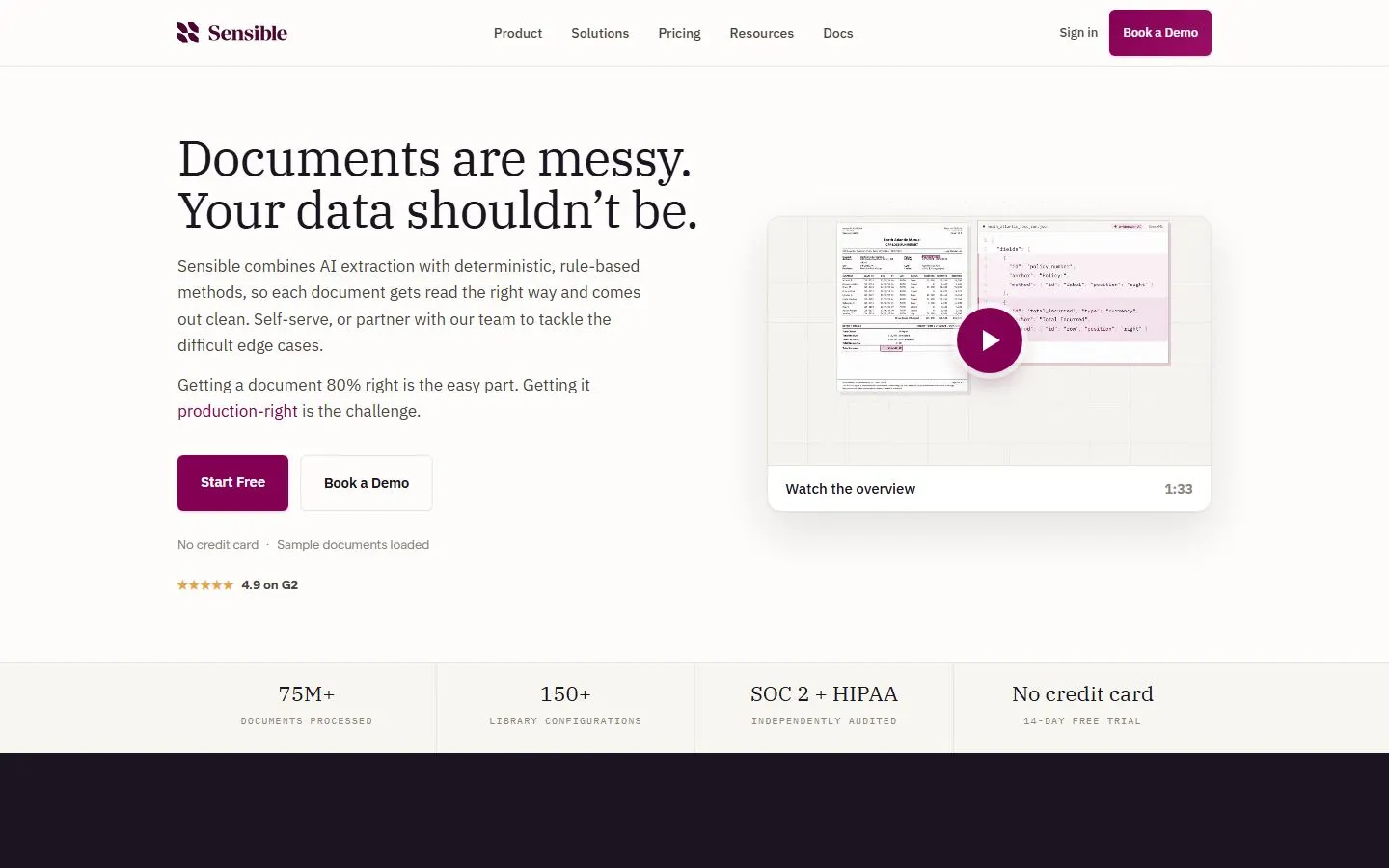
Best for: MGAs, carriers, brokers and insurtechs that pull loss run data into their own rating, underwriting or analytics systems and want extraction they control.
Sensible makes loss runs a core use case. Its insurance page says it processes 300+ page loss runs in under a minute and reports 100% accuracy on supported loss run formats, alongside dec pages, niche carrier forms and broker submissions. These are the company’s figures. (source)
Key functionalities
- Carrier-specific layout configurations, versioned and testable
- LLM parsing for formats without a configuration
- Validation rules and source-text highlighting for every value
- REST API, SDKs and webhooks for long files
Pros:
- Deterministic layout rules for known carrier formats, LLM parsing for unfamiliar ones
- Per-document pricing stays flat on 300-page loss runs
- Validation rules can reconcile claim lines against stated totals
Cons:
- Configuration work sits closer to engineering than point-and-click
- No underwriting queue or triage; you build workflow on top
Pricing: From $499/month for 750 documents ($0.57 per additional document); Scale $1,499/month for 3,200 documents. (source)
Verdict: The strongest fit when loss run data feeds your own systems and you need consistent, auditable output across many carriers.
2. SortSpoke: Best for underwriter-validated loss runs in submissions
 Quote only · SOC 2 Type IIFull profile →
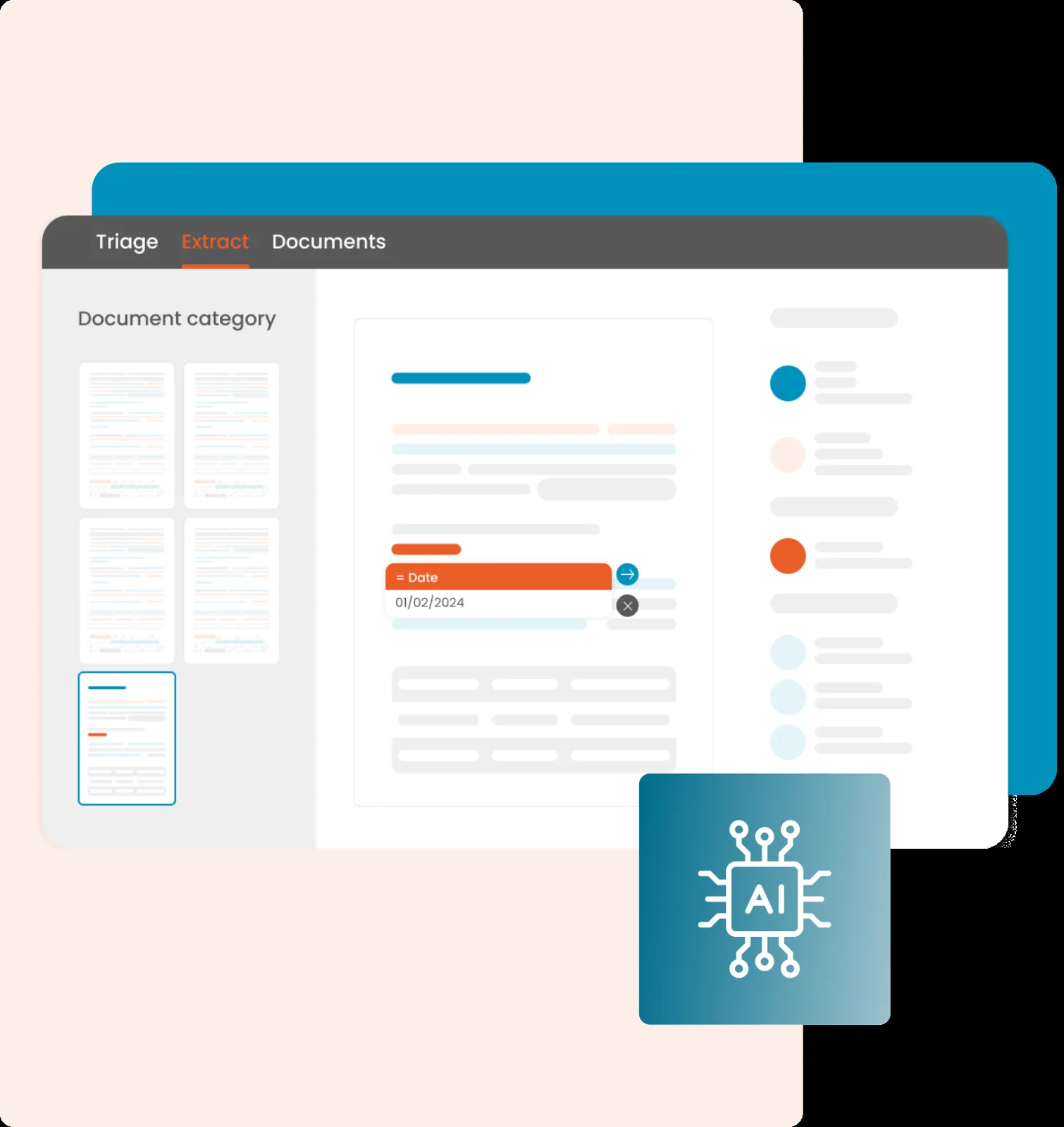
Best for: E&S and specialty underwriting teams that want loss runs and submissions turned into data their underwriters verify.
SortSpoke says it turns “submissions and loss runs into data your underwriters can trust,” pairing insurance-trained extraction with human validation. (source)
Key functionalities
- Loss run and submission extraction with human-in-the-loop review
- Underwriter-facing configuration
- Integration into underwriting workflows
Pros:
- Human validation built into extraction
- Underwriters configure without developers
- SOC 2 Type 2 and HIPAA-compliant infrastructure
Cons:
- Focused on submission intake
- Pricing not published
Pricing: Not published; quoted by sales.
Verdict: A good fit when underwriters want to see and verify every extracted loss before pricing.
3. Indico Data: Best for high-volume SOV and loss run ingestion at large carriers
 Quote onlyFull profile →
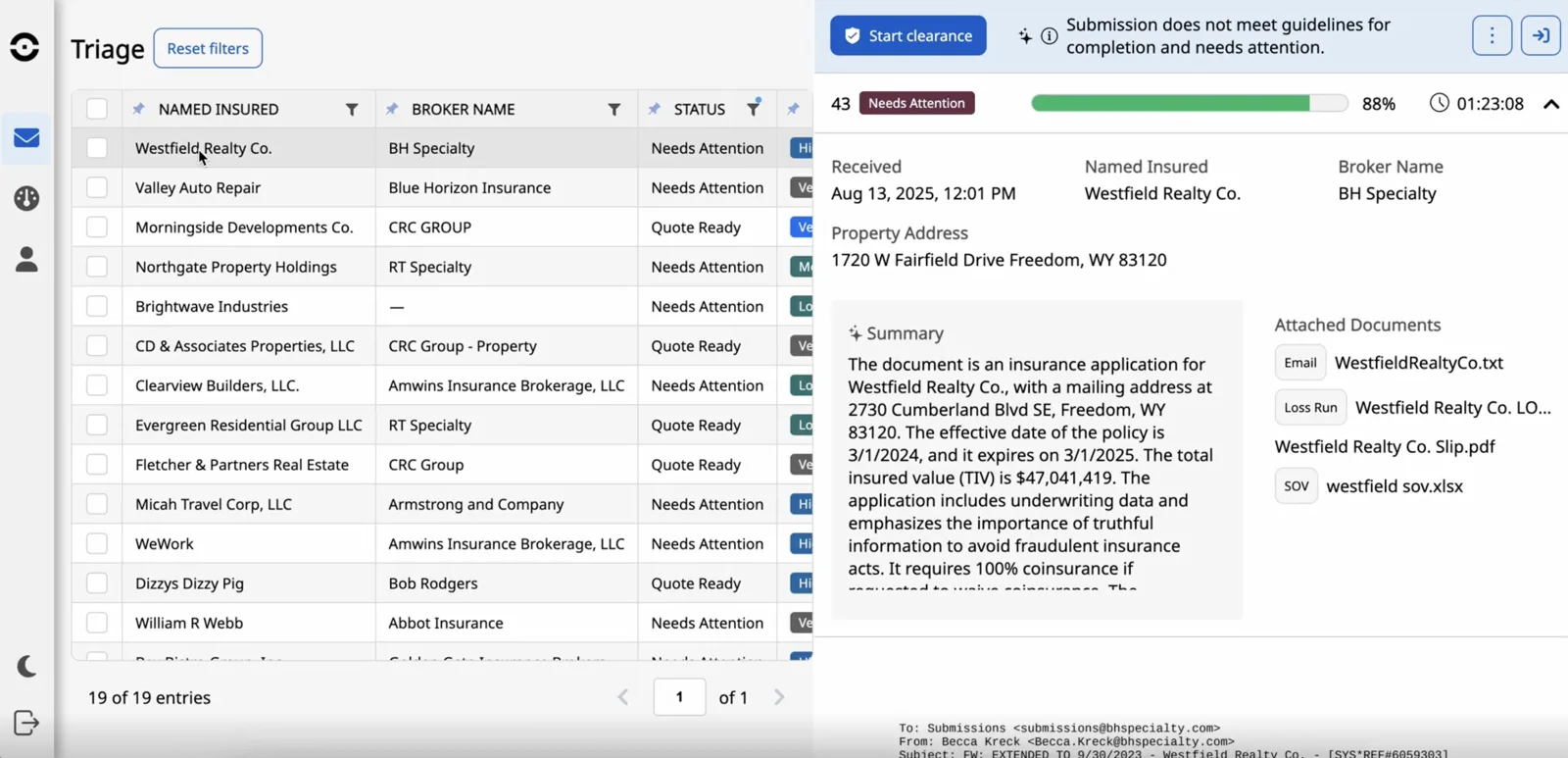
Best for: Large carriers and MGAs processing loss runs together with SOVs, ACORDs and emails across lines of business.
Indico Data highlights SOV and loss run processing and cites Convex streamlining SOV and loss run ingestion and routing. (source)
Key functionalities
- Extraction agents across loss runs, SOVs, ACORDs and emails
- Routing to underwriting teams
- Review workflows
Pros:
- Handles loss runs, SOVs and ACORDs in one intake flow
- Customer case study on SOV and loss run ingestion (Convex)
Cons:
- Enterprise sales and implementation
- Pricing not published
Pricing: Not published; quoted by sales.
Verdict: Strong for enterprise intake where loss runs are one of several high-volume document types.
4. Roots Automation: Best for renewal packages assembled by AI agents
 Quote only · SOC 2 Type IIFull profile →
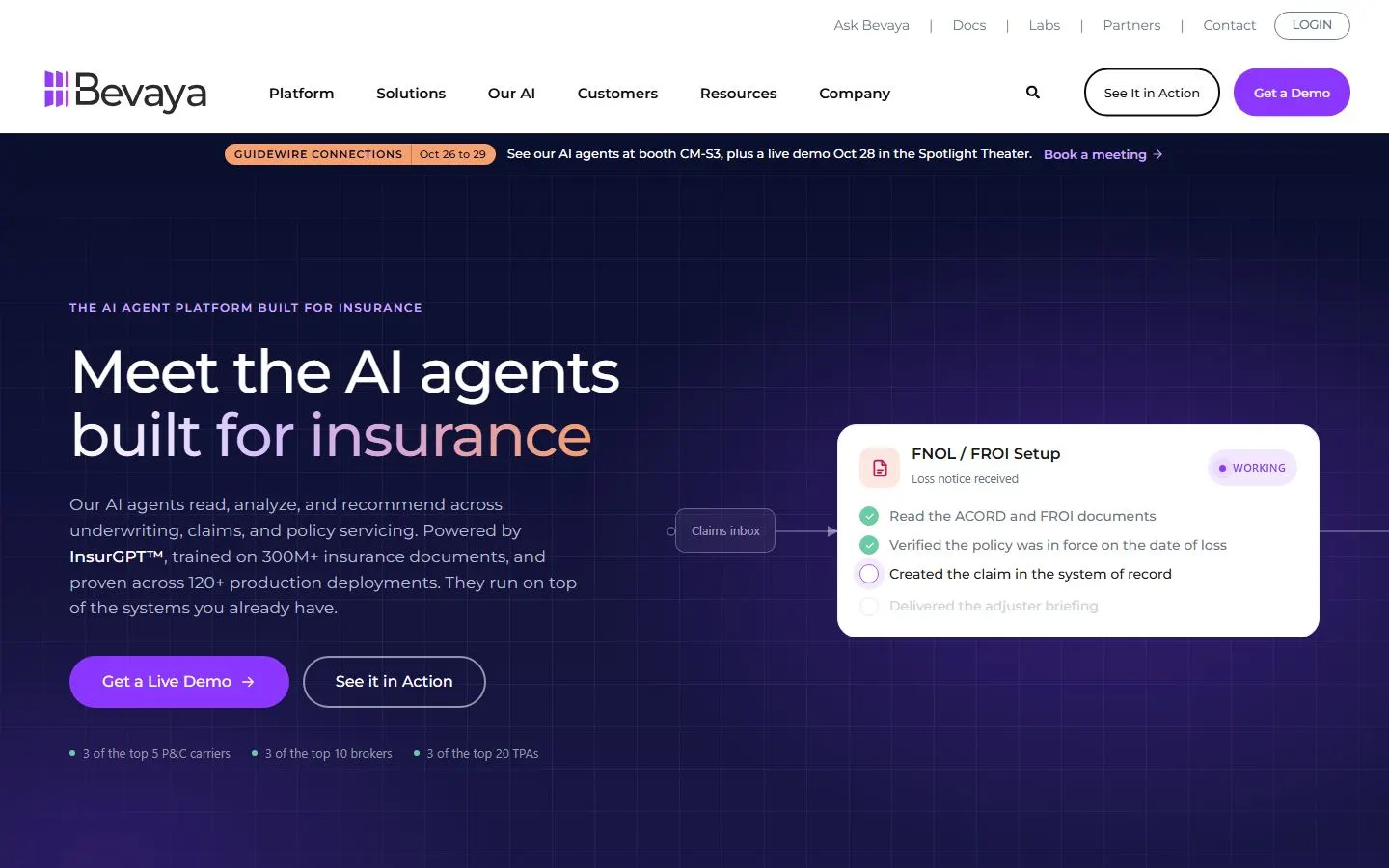
Best for: Carriers and MGAs that want renewals assembled automatically, including refreshed exposures and loss runs.
Roots (now Bevaya) says its agents pull expiring policy data, refresh exposures and loss runs, and assemble a renewal package for the underwriter, using models trained on specific document types including loss runs. (source)
Key functionalities
- Loss run extraction within renewal and intake workflows
- Document-type-specific models with a verification layer
- Push to underwriting systems
Pros:
- Covers the renewal workflow, not just extraction
- Insurance-trained models per document type, per its site
Cons:
- More than you need for extraction alone
- Pricing by quote
Pricing: Not published for loss run extraction; agent pricing by quote.
Verdict: A fit for teams automating renewal assembly end to end.
5. Docsumo: Best for pre-trained extraction with a review queue
 Quote only · Free trial: 14 days, up to 1,000 pages · SOC 2 Type IIFull profile →
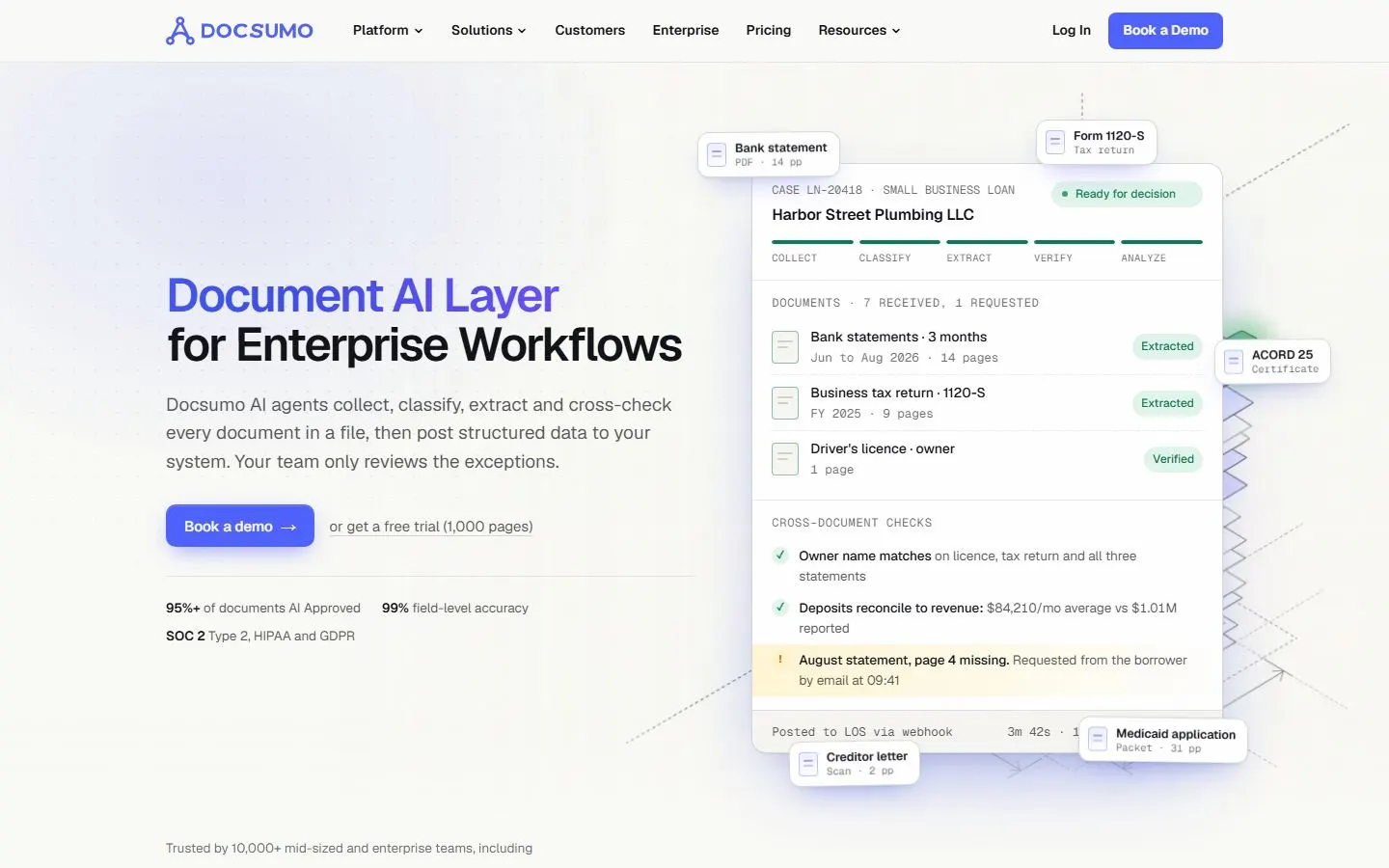
Best for: Operations teams that want pre-trained models for loss runs and certificates with a review interface.
Docsumo lists loss runs alongside ACORD forms and certificates of insurance among the documents its models process without templates. (source)
Key functionalities
- Pre-trained models and table extraction
- AI document reviewer and validation
- APIs, webhooks and Excel exports
Pros:
- Lists loss runs among pre-trained document types
- SOC 2 Type 2, ISO 27001 and HIPAA per its security page
- Free trial on your own files
Cons:
- Less insurance-specific depth than the workflow tools
- Paid plans quote-only
Pricing: 14-day free trial with up to 1,000 pages; paid plans quoted by volume. (source)
Verdict: Worth testing for standard carrier formats; check it on your hardest multi-page loss runs before committing.
How do these tools compare side by side?
| Tool | Approach | Best for | Pricing | Free trial | Security |
|---|---|---|---|---|---|
| 1Sensible | Hybrid developer infrastructure | Engineering, product and operations teams at MGAs, carriers, brokers and insurtechs that process varied insurance documents and want extraction logic they own and can audit. | From $499 | 14 days | SOC 2 Type II |
| 2SortSpoke | Insurance workflow automation | E&S and specialty carriers processing non-standard submission packages who need underwriter-configurable extraction without developer dependency | Quote only | — | SOC 2 Type II |
| 3Indico Data | Enterprise IDP | Large carriers and London Market participants processing high volumes of diverse document types across multiple languages and lines of business | Quote only | — | SOC 2 unverified |
| 4Roots Automation | Insurance workflow automation | Carriers and MGAs wanting AI workers that handle complete insurance workflows including submission intake, policy checking, and bordereaux management | Quote only | — | SOC 2 Type II |
| 5Docsumo | Pre-trained document AI | Insurance and financial operations teams that want pre-trained models for common forms such as ACORD certificates and applications, with review workflows, without building extraction logic themselves. | Quote only | 14 days, up to 1,000 pages | SOC 2 Type II |
Which tool fits your team?
- Loss run data feeds your own rating or underwriting systems: Sensible.
- Underwriters review every submission and want validated loss data: SortSpoke.
- You are a large carrier processing loss runs with SOVs and ACORDs: Indico Data.
- You want renewals assembled automatically: Roots.
- You want pre-trained models and a review queue for standard formats: Docsumo.
Conclusion: test on your ugliest carrier formats
Collect loss runs from your ten most common carriers plus your three worst, run them through two or three shortlisted tools, and reconcile the extracted totals against the carriers’ own totals. The tool that gets those right without manual cleanup is the one to buy.
FAQs
What is the best software for parsing insurance loss runs?
For teams that want to own and audit extraction across many carrier formats, Sensible is the strongest fit, with layout configurations for known formats, LLM parsing for unfamiliar ones, and published pricing. For underwriting teams that want loss runs handled inside submission intake, SortSpoke, Indico Data and Roots are the main options.
Why are loss runs hard to extract?
Each carrier formats loss runs differently. Tables change orientation, headers repeat on every page with shifting columns, subtotals appear mid-table, and a single claim can span lines or pages. Generic OCR returns text but loses which number belongs to which claim and column.
How should extracted loss run data be validated?
Reconcile claim-level paid, reserved and incurred amounts against the carrier's stated totals, check that every claim has a date of loss and status, and flag claims whose totals don't sum. Tools with validation rules (such as Sensible) can flag failures automatically instead of passing them through.
How fast can AI process a long loss run?
It depends on the tool and whether human review is in the loop. Sensible says it processes 300+ page loss runs in under a minute; workflow tools with human validation trade speed for review. Ask vendors for timing on your longest loss runs.
How much does loss run parsing software cost?
Sensible starts at $499 per month for 750 documents, priced per document regardless of page count. Docsumo offers a 14-day free trial with up to 1,000 pages and quotes paid plans. SortSpoke, Indico Data and Roots quote by sales.