Best Insurance Document Extraction Software in 2026
Seven document extraction tools for insurance teams compared: Sensible, Hyperscience, Indico Data, Roots, SortSpoke, Reducto and Nanonets, by approach, documents handled, pricing, security and who each fits.
TL;DR
- Insurance document extraction tools fall into four shapes: hybrid developer infrastructure (Sensible), enterprise IDP platforms (Hyperscience, Indico Data), insurance workflow automation (Roots, SortSpoke), and general-purpose parsing APIs and no-code tools (Reducto, Nanonets).
- Sensible leads this list for teams that want extraction logic they own, across ACORD forms, loss runs, dec pages and quotes, with published per-document pricing from $499 a month and a 14-day free trial.
- Hyperscience and Indico Data suit large carriers standardizing many document types across departments; neither publishes pricing.
- Roots and SortSpoke go beyond extraction into submission intake workflows; SortSpoke lets underwriters configure extraction without engineers.
- Only three of the seven publish pricing (Sensible, Reducto, Nanonets), so most comparisons start with a sales call.







Insurance runs on documents that were never designed to be parsed. An ACORD 125 from one agency management system looks different from the same form exported by another, every carrier formats its loss runs its own way, and statements of values arrive as spreadsheets, scans and PDFs with merged cells. Carriers, MGAs, brokers and insurtechs all end up solving the same problem: turning that pile into reliable, structured data before an underwriter, a rating engine or a claims system touches it.
This guide compares seven tools insurance teams shortlist for that job. It starts with how they differ, then covers each tool, and ends with a side-by-side table and a short guide to which one fits which team.
Different tools solve different parts of the document problem
The seven tools solve different problems, and grouping them by shape makes the choice easier than ranking them on one scale.
| Shape | What it focuses on | Tools in this list |
|---|---|---|
| Hybrid developer infrastructure | Extraction logic defined as versioned configuration, combining layout rules with LLM parsing across varied documents | Sensible |
| Enterprise IDP | One platform automating many document types across departments, with human-in-the-loop review | Hyperscience, Indico Data |
| Insurance workflow automation | Submission intake and underwriting workflows built on extraction | Roots, SortSpoke |
| Parsing API | High-accuracy parsing of complex tables and layouts, priced per page | Reducto |
| No-code workflow automation | Visual builder connecting extraction to business systems without engineering | Nanonets |
Hybrid infrastructure suits teams that treat extraction as part of their product or core operations. Enterprise IDP fits large carriers standardizing document handling across departments. Workflow automation fits underwriting teams that want intake handled end to end, parsing APIs fit engineers building their own pipelines, and no-code tools put the workflow in an operations team’s hands.
The 7 best document extraction tools for insurance teams
1. Sensible: Best for owned, auditable extraction across varied insurance documents
 From $499 · Free trial: 14 days · SOC 2 Type IIFull profile →
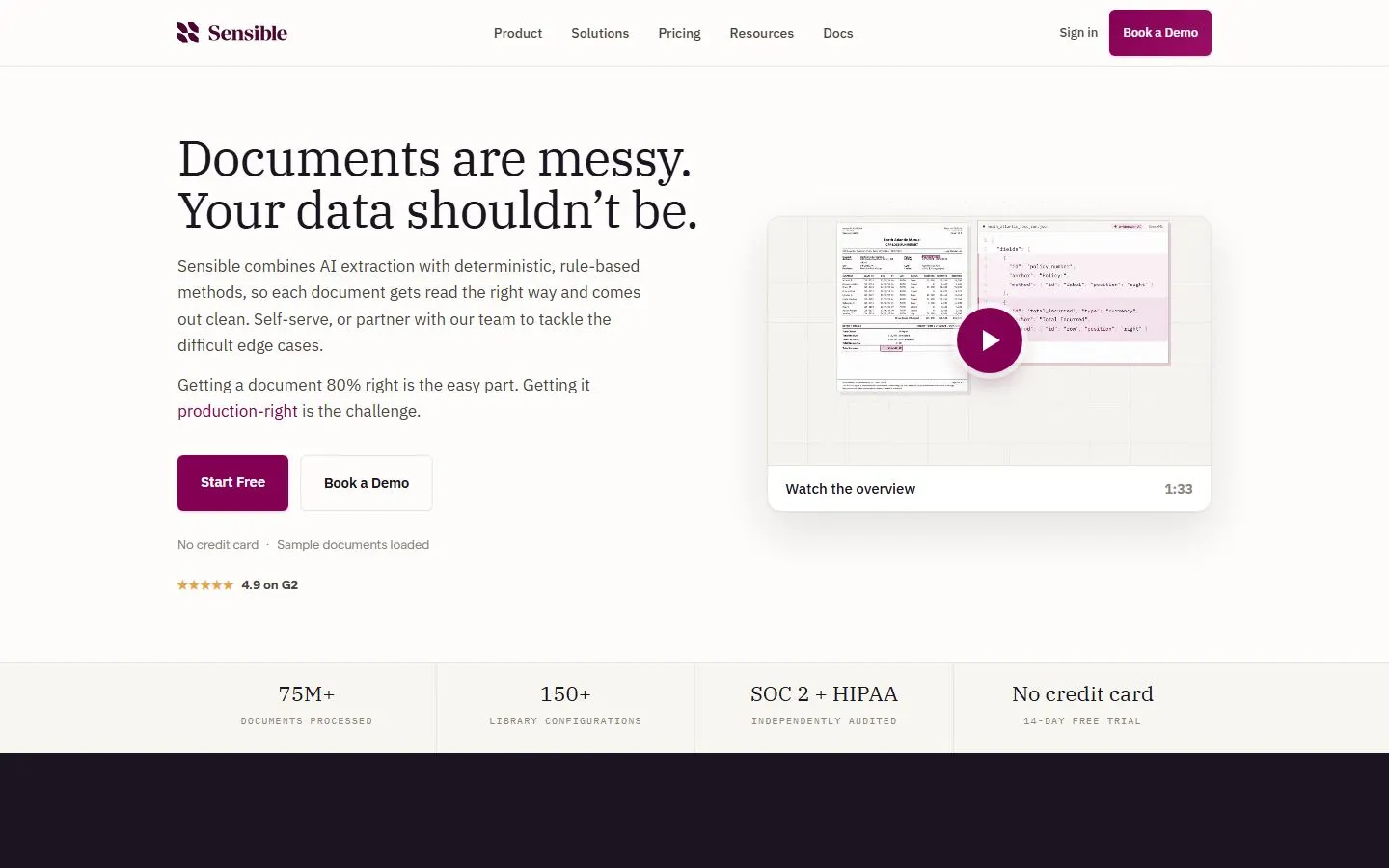
Best for: Engineering, product and operations teams at MGAs, carriers, brokers and insurtechs that process a varied mix of insurance documents, need results without a review-queue delay, and want pricing they can model before talking to sales.
Sensible combines layout-based extraction with LLM parsing under one schema-validated API. Extraction is written in SenseML, a configuration language that runs OCR, layout analysis, LLM parsing and type casting as one pipeline. For insurance, Sensible supports common documents including ACORD forms, loss runs, declaration pages, certificates of insurance, commission statements and insurance quotes (source), and teams can build their own configurations or have Sensible’s managed services team build them from sample documents.
Key functionalities
- Hybrid extraction pairs deterministic layout rules with LLM parsing: layout rules return the same value every run where structure is predictable, and the LLM handles sections that vary, such as free-text loss descriptions.
- Validation rules run against extracted values (for example, confirming claim line items sum to a stated total), and any field that fails is flagged instead of passing through unchecked.
- The Sensible app highlights the source text behind every extracted value, so a reviewer or auditor can trace any number to the original page.
- Configurations are versioned, testable and deployable through CI/CD, so a fix for one carrier’s loss-run format lives in Git rather than in one person’s head.
- Integration runs through a REST API, Python and Node SDKs, and webhooks for long or high-volume files.
- Security: SOC 2 Type II and GDPR on every plan; HIPAA with a signed BAA and custom region deployment on Enterprise.
Pros:
- Handles a wide mix of insurance documents without a retraining step for each new format
- Per-document pricing stays predictable regardless of page count, which matters for long loss runs and policy packets
- Source-text traceability supports audit and regulatory review
Cons:
- Writing and refining SenseML is closer to engineering work than point-and-click setup
- Extraction-focused: routing, triage and underwriting decisions are built on top of the output, not included
Pricing: Per document. Growth is $499 per month ($449 billed annually) with 750 documents and $0.57 per additional document; Scale is $1,499 per month ($1,349 annually) with 3,200 documents and $0.53 per additional document; Enterprise is custom from 10,000 documents per month. A 14-day free trial is available. (source)
Verdict: The strongest fit for insurance teams that want to own and audit their extraction across many document types, with published pricing and fast response times. Teams that want a finished underwriting workflow rather than structured data should also look at Roots or SortSpoke.
2. Hyperscience: Best for enterprise-scale accuracy on forms and handwriting
 Quote onlyFull profile →
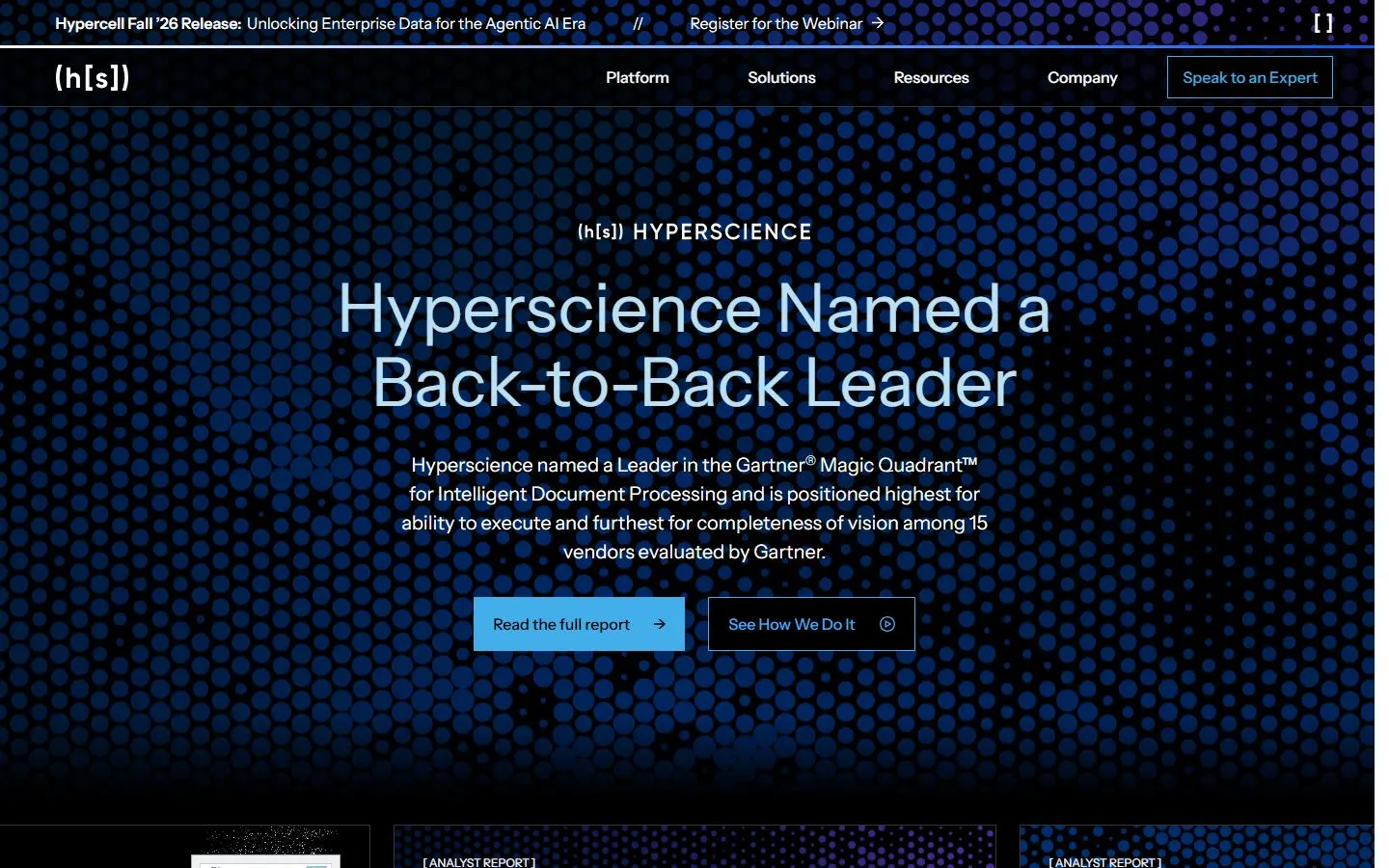
Best for: Large carriers with high volumes of paper, scanned and handwritten documents, standardizing extraction across many departments.
Hyperscience is an enterprise intelligent document processing platform built around human-in-the-loop accuracy. Its best-known strength is handwriting recognition, which matters for hand-completed first notice of loss forms, adjuster notes and legacy claims files.
Key functionalities
- Machine learning models for structured and semi-structured forms, with confidence thresholds that route uncertain fields to human reviewers
- Handwriting recognition for scanned and hand-completed documents
- Deployment options for regulated enterprises, including private cloud
Pros:
- Strong on handwritten and low-quality scanned documents
- Built for organization-wide rollouts across departments
Cons:
- Enterprise sales cycle and implementation effort
- Less suited to small teams or digital-native documents
Pricing: Not published; enterprise contracts quoted by sales.
Verdict: A fit for large carriers whose document problem is volume and handwriting across many departments. Mid-size MGAs and insurtechs will usually find it heavier than they need.
3. Indico Data: Best for breadth of insurance document types at large carriers
 Quote onlyFull profile →
Best for: Large carriers, reinsurers and London Market participants processing many document types across lines of business and languages.
Indico Data focuses on insurance and says it supports more than 900 insurance document types, from ACORD applications to London Market slips and reinsurance treaties. It trains models on a carrier’s own documents.
Key functionalities
- Insurance-specific catalogue of document types across lines and geographies
- Model training on your own document corpus
- Human review workflows and integrations with core insurance systems
Pros:
- Long-tail document coverage for complex, multi-line carriers
- Insurance-specialist vendor
Cons:
- Enterprise sales and implementation; not self-serve
- Pricing not published
Pricing: Not published; quoted by sales.
Verdict: A strong candidate for large, multi-line carriers whose problem is the long tail of document types. Smaller teams should weigh implementation time.
4. Roots Automation: Best for end-to-end submission intake workflows
 Quote only · SOC 2 Type IIFull profile →
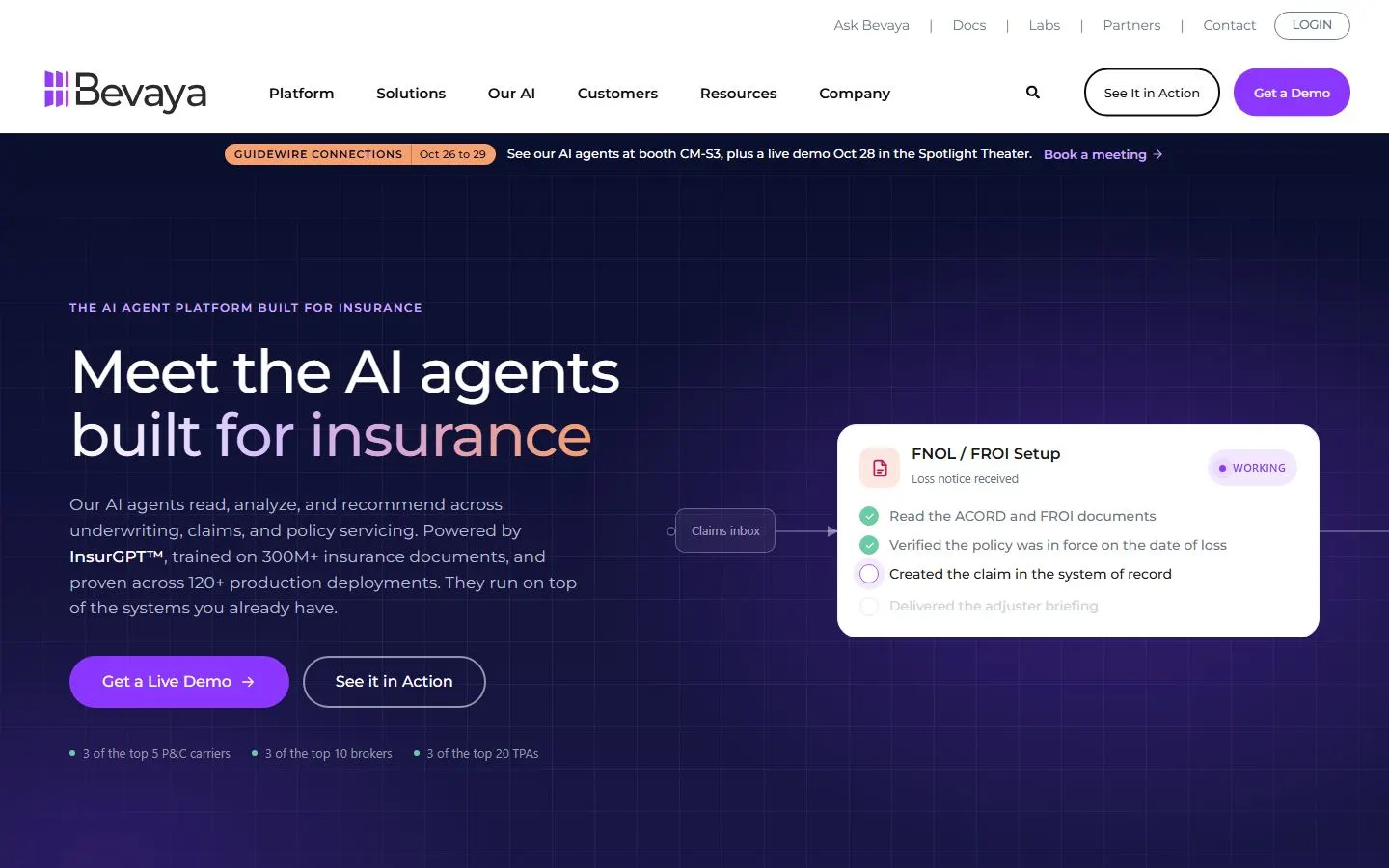
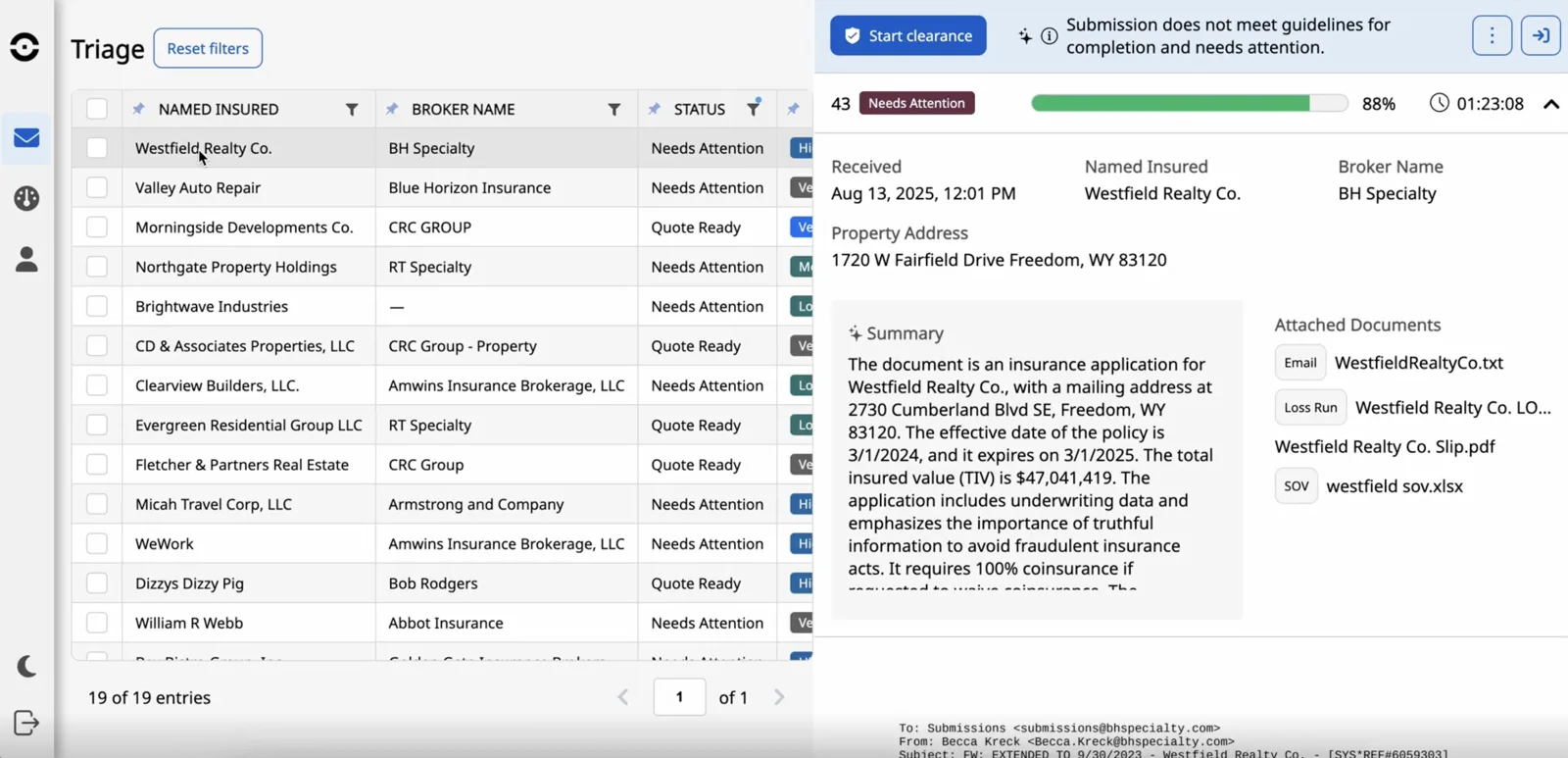
Best for: Carriers and MGAs that want AI to handle complete workflows, such as submission intake, policy checking and bordereaux, not just extraction.
Roots (Roots Automation) builds “Digital Coworkers” on InsurGPT, a model the company says was trained on more than 250 million insurance documents. Rather than returning fields for your team to route, Roots runs the workflow and escalates exceptions.
Key functionalities
- Insurance-tuned language model for extraction and classification
- Workflow automation for submission intake, policy checking and bordereaux
- Confidence scoring with escalation to human reviewers
Pros:
- Covers the workflow, not just the data
- Insurance-native model and use cases
Cons:
- More than you need if you only want structured data
- Pricing not published
Pricing: Not published; quoted by sales.
Verdict: A fit for operations leaders who want to automate a whole intake process. Teams that want to own extraction inside their own systems will prefer an extraction layer.
5. SortSpoke: Best for underwriter-configured submission extraction
 Quote only · SOC 2 Type IIFull profile →
Best for: E&S and specialty carriers and MGAs processing non-standard broker submissions, where underwriters want to adjust extraction without developers.
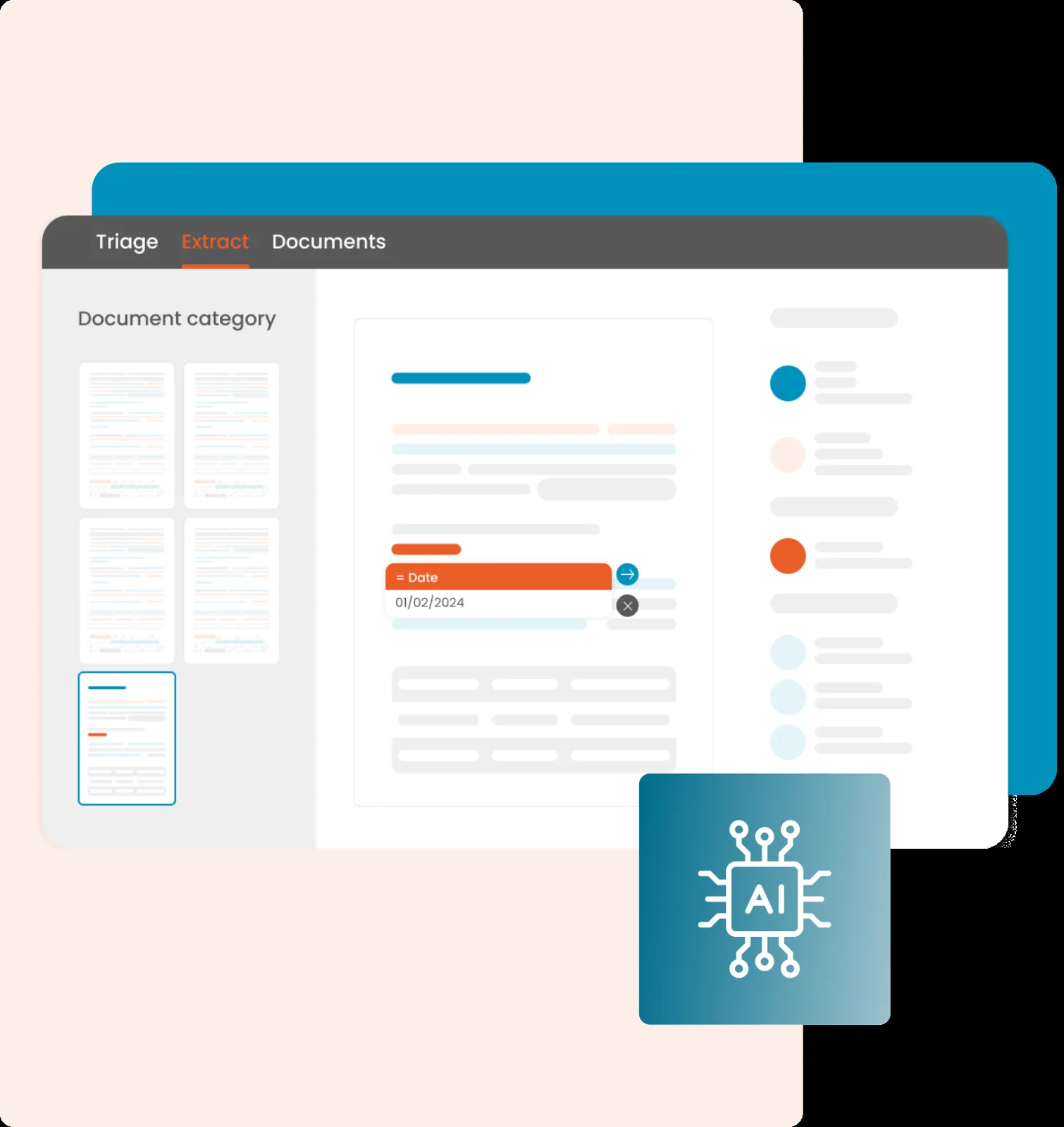
SortSpoke is built for submission intake. Its no-code interface lets underwriting staff adjust field mappings, add document types and set confidence thresholds, with human-in-the-loop review on uncertain fields.
Key functionalities
- Underwriter-facing configuration of fields, document types and validation
- Human-in-the-loop review that improves extraction over time
- SOC 2 Type 2 and HIPAA-compliant infrastructure on AWS (source)
Pros:
- Puts control with underwriters rather than IT
- Focused on the messiest submissions (E&S and specialty)
Cons:
- Focused on submission intake rather than claims, policy servicing or bordereaux
- Pricing not published
Pricing: Not published; quoted by sales.
Verdict: A good fit for specialty underwriting teams with varied broker submissions and limited engineering support.
6. Reducto: Best for engineers parsing complex tables at a per-page price
 Free to start · Free trial: $150 in free usageFull profile →
Best for: Engineering teams building their own pipelines for table-heavy documents such as SOVs, bordereaux and multi-page loss runs.
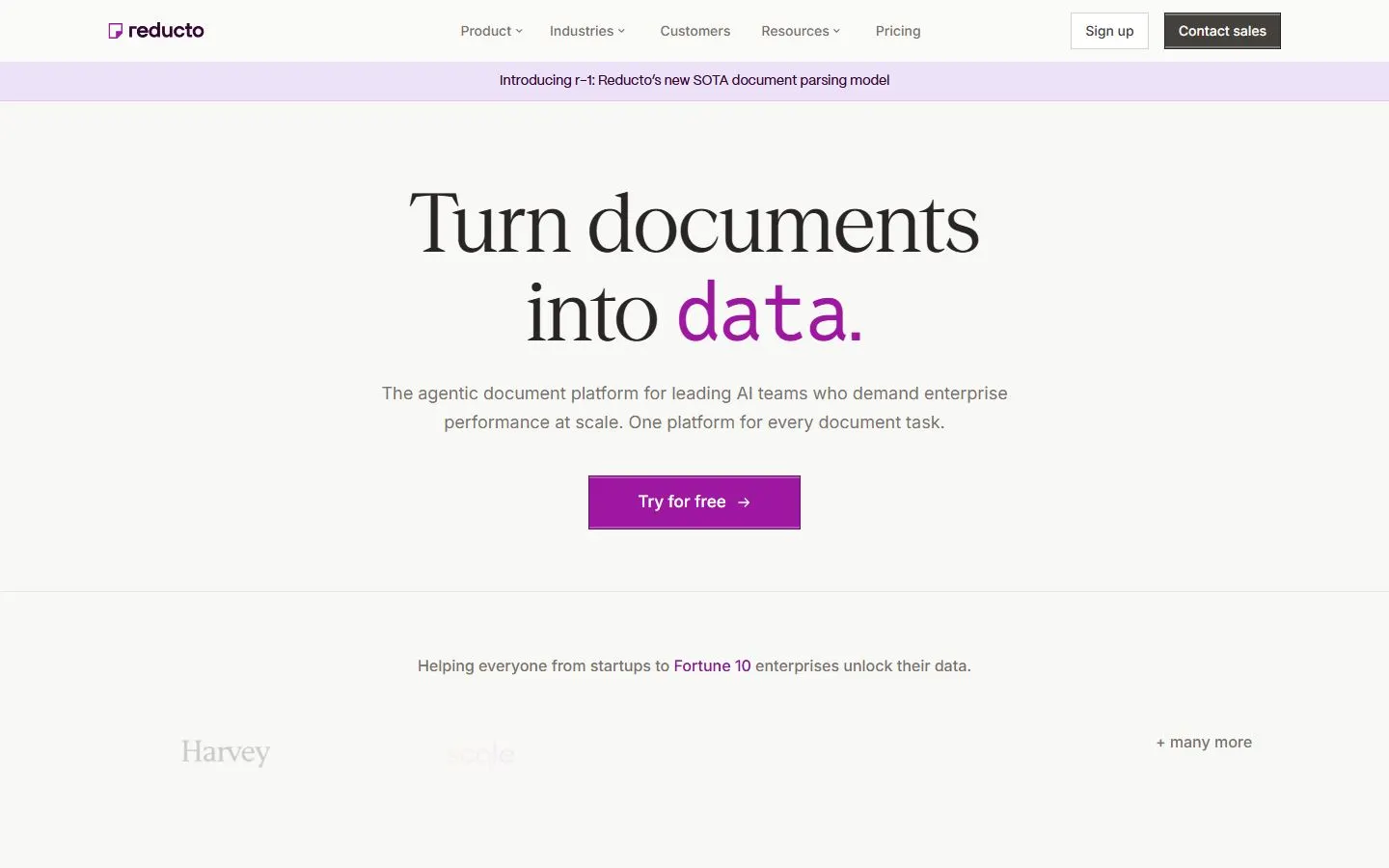
Reducto is a general-purpose document parsing API that reconstructs layout structure, including merged cells and multi-page tables, and returns visually grounded output.
Key functionalities
- Parse API (documents to structured blocks and markdown) and Extract API (schema-based JSON)
- Split and classify endpoints for combined files
- Visual grounding of extracted content
Pros:
- Strong on complex tables
- Transparent per-page pricing with free starting credits
Cons:
- General-purpose: no prebuilt insurance configurations or workflow
- Per-page pricing adds up on very long documents
Pricing: Per page, after $150 in free usage: Parse $10 per 1,000 pages, Extract $20 per 1,000 pages, Deep Extract $40 per 1,000 pages; volume tiers by quote. (source)
Verdict: A good building block for engineering teams comfortable assembling their own insurance logic on top of a parsing API.
7. Nanonets: Best for no-code extraction workflows
 From $100 · Free trial: $50 in creditsFull profile →
Best for: Mid-size agencies and TPAs that want extraction plus workflow automation without developers, mostly on standard document types.
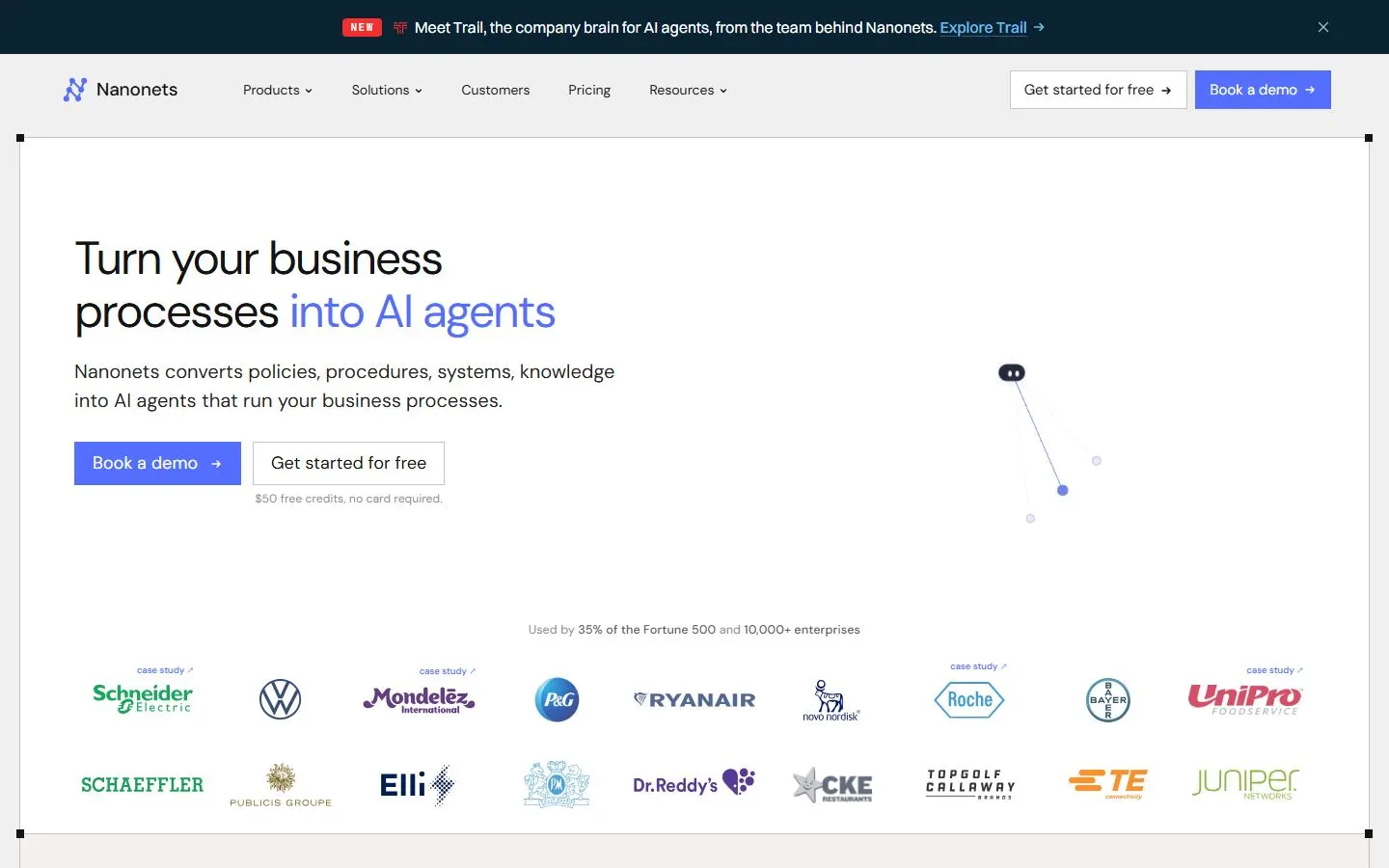
Nanonets pairs pre-trained extraction models with a visual workflow builder for validation, approvals and exports.
Key functionalities
- Pre-trained models for common document types, plus custom models
- Visual workflow builder for routing, validation and export
- SOC 2, HIPAA and private cloud or on-prem deployment on the enterprise tier (source)
Pros:
- Usable by operations teams without engineering support
- Low starting cost
Cons:
- Less depth on complex insurance documents such as SOVs and bordereaux
- Usage-based credits can be harder to forecast
Pricing: Starts free with $50 in credits, then $100 per month for 100 credits; workflow steps cost $0.02 to $0.30 per run. (source)
Verdict: A practical choice for standard documents and simple workflows. Teams with complex insurance documents will hit its limits sooner.
How do these tools compare side by side?
| Tool | Approach | Best for | Pricing | Free trial | Security |
|---|---|---|---|---|---|
| 1Sensible | Hybrid developer infrastructure | Engineering, product and operations teams at MGAs, carriers, brokers and insurtechs that process varied insurance documents and want extraction logic they own and can audit. | From $499 | 14 days | SOC 2 Type II |
| 2Hyperscience | Enterprise IDP | Large carriers with legacy paper workflows and handwritten documents needing near-perfect extraction accuracy on structured forms | Quote only | — | SOC 2 unverified |
| 3Indico Data | Enterprise IDP | Large carriers and London Market participants processing high volumes of diverse document types across multiple languages and lines of business | Quote only | — | SOC 2 unverified |
| 4Roots Automation | Insurance workflow automation | Carriers and MGAs wanting AI workers that handle complete insurance workflows including submission intake, policy checking, and bordereaux management | Quote only | — | SOC 2 Type II |
| 5SortSpoke | Insurance workflow automation | E&S and specialty carriers processing non-standard submission packages who need underwriter-configurable extraction without developer dependency | Quote only | — | SOC 2 Type II |
| 6Reducto | Parsing API | Engineering teams processing complex insurance documents (SOVs, bordereaux, multi-page loss runs) where table extraction accuracy is critical | Free to start | $150 in free usage | SOC 2 unverified |
| 7Nanonets | No-code workflow automation | Mid-size agencies and TPAs who need extraction and workflow automation without developer resources, particularly for standard document types | From $100 | $50 in credits | SOC 2 unverified |
Which tool fits your team?
- You want to own extraction inside your product or operations, across many document types: Sensible.
- You are a large carrier standardizing paper and handwritten documents across departments: Hyperscience or Indico Data.
- You want submission intake automated end to end: Roots, or SortSpoke if underwriters should control configuration.
- You are an engineering team that needs a parsing building block for complex tables: Reducto.
- You are an agency or TPA without developers, processing standard documents: Nanonets.
Conclusion: match the tool to the gap in your current process
No single tool wins on every dimension. Start from the document types that cause the most manual work today, decide whether you want structured data or a finished workflow, and check who will maintain the extraction when formats change. Then run your own documents through two or three shortlisted tools; three of these seven let you start without a sales call.
FAQs
What is the best document extraction software for insurance?
It depends on who owns the work. Sensible fits teams that want to own extraction logic across ACORD forms, loss runs and other varied documents, with published pricing. Hyperscience and Indico Data fit large carriers standardizing document handling across departments. SortSpoke fits E&S underwriting teams that want to configure extraction themselves. Reducto fits engineers who need table-heavy parsing at a per-page price.
Which tools can extract data from ACORD forms?
All seven can process ACORD forms. Sensible and Indico Data document insurance-specific ACORD support; the others extract them through general models or custom configuration.
How do you extract data from insurance loss runs?
Loss runs vary by carrier, so the key question is how a tool handles formats it has not seen. Layout-based configuration handles known carrier formats deterministically, while LLM-based extraction covers unfamiliar layouts. Sensible combines both in one configuration; Reducto focuses on complex multi-page tables; enterprise platforms like Indico train models on your corpus.
How much does insurance document extraction software cost?
Published prices: Sensible starts at $499 per month for 750 documents ($0.57 per extra document); Reducto charges $10 per 1,000 pages to parse and $20 per 1,000 pages to extract, after $150 in free credits; Nanonets starts free with $50 in credits, then $100 per month for 100 credits. Hyperscience, Indico Data, Roots and SortSpoke quote by sales.
Is per-document or per-page pricing better for insurance documents?
Per-document pricing is easier to budget for long documents such as multi-hundred-page loss runs and policy packets, because cost does not grow with page count. Per-page pricing is cheaper for short, high-volume documents such as certificates of insurance.
Which insurance extraction tools are SOC 2 Type II and HIPAA compliant?
Sensible documents SOC 2 Type II on every plan, with HIPAA and a signed BAA on Enterprise. SortSpoke documents SOC 2 Type 2 and HIPAA-compliant infrastructure. Nanonets lists SOC 2 and HIPAA on its enterprise tier. Check each vendor's trust center for current reports.
Do these tools replace underwriters or claims staff?
No. They turn documents into structured data and flag low-confidence fields for review. Workflow products such as Roots go further into intake and triage, but underwriting and claims decisions stay with people.