Best AI Governance and Model Risk Software for Insurers in 2026
Six AI governance and model risk platforms for insurers compared: Monitaur, Credo AI, ValidMind, IBM watsonx.governance, Holistic AI and Arthur, by approach, regulatory coverage, pricing and who each fits.
TL;DR
- AI governance tools for insurers fall into four shapes: insurance-specific governance (Monitaur), cross-industry governance, risk and compliance platforms (Credo AI, Holistic AI, IBM watsonx.governance), model risk management (ValidMind), and runtime monitoring and agent control (Arthur).
- Monitaur is the only tool here that presents its governance product as built for insurance, and shows SOC 2 Type II on its site; Credo AI lists NAIC and Colorado policy packs and suits insurers governing many AI systems.
- The NAIC Model Bulletin (adopted December 4, 2023) is guidance, not a law. It expects insurers to keep a written AI Systems Program; whether it applies to you depends on whether your state has adopted it.
- Colorado's insurance rules come from SB21-169, implemented by the Division of Insurance; SB24-205 is a separate, broader Colorado AI law. Quantitative testing standards under SB21-169 were still being developed in the latest sources reviewed.
- None of the six publishes list pricing. IBM offers a 14-day free trial; the rest quote by sales.






Insurers have used predictive models for pricing and claims for decades, but regulators now ask for evidence that those models, and newer machine learning and generative AI systems, are inventoried, tested for unfair discrimination and overseen by accountable people. The rules are a patchwork: a national model bulletin that states adopt individually, Colorado’s insurance-specific regulations, a separate Colorado AI law, and the EU AI Act for anyone operating in Europe. Vendors describe their products with overlapping terms such as governance, model risk, observability and compliance, which makes comparison hard.
This guide compares six tools insurers shortlist. It starts with the regulations in plain terms, then how the tools differ, then each tool, a side-by-side table and a guide to which fits which team. It is desk research from vendor and regulator pages, not legal advice.
What do the NAIC, Colorado and EU rules actually require?
- NAIC Model Bulletin. Adopted by NAIC members on December 4, 2023, it is guidance for state regulators rather than a model law or regulation (NAIC). It expects insurers to maintain a written AI Systems (AIS) Program scaled to risk, and it lists documentation regulators may request during investigations or exams. It reaches an insurer only where its state has adopted it or issued similar guidance; see the NAIC adoption map.
- Colorado SB21-169. A 2021 law (bill page) that bars insurers from using external consumer data and algorithms in ways that unfairly discriminate. The Division of Insurance implements it through regulations: a governance and risk management regulation for life insurers effective November 2023, amended in 2025 to add private passenger auto and health benefit plans (Willkie summary). The quantitative testing standards, which matter most to bias-testing tools, were still under development in the latest sources reviewed, so confirm status with the Division.
- Colorado SB24-205. A different, broader Colorado law on high-risk AI systems (bill page). Its effective date was moved to June 30, 2026 by a 2025 special-session bill, and later amendments could not be verified. It is not the source of the insurance testing requirements.
- EU AI Act. Regulation (EU) 2024/1689 (official text) classes AI used for risk assessment and pricing in life and health insurance as high-risk. Obligations phase in over several years, so check dates against the official text.
Different tools solve different parts of the governance problem
| Shape | What it focuses on | Tools in this list |
|---|---|---|
| Insurance-specific governance | Model inventory, bias monitoring, documentation and audit trails framed around insurance | Monitaur |
| Cross-industry governance, risk and compliance | AI registry, risk classification and policy packs mapped to many regulations | Credo AI, IBM watsonx.governance, Holistic AI |
| Model risk management | Model documentation, validation and independent challenge for banks and insurers | ValidMind |
| Runtime monitoring and agent control | Observing and enforcing policy on AI systems and agents in production | Arthur |
Insurance-specific governance fits carriers whose main driver is answering state insurance regulators. Cross-industry platforms fit larger groups that govern AI across insurance and non-insurance functions. Model risk tools fit actuarial and risk teams that already run validation processes, and runtime monitoring fits teams with engineers operating generative AI in production.
The 6 best AI governance tools for insurers
1. Monitaur: Best for insurance-specific model governance
 Quote only · SOC 2 Type IIFull profile →
Best for: Carriers answering state insurance regulators about underwriting, pricing and claims models, who want a vendor that frames its product around insurance.
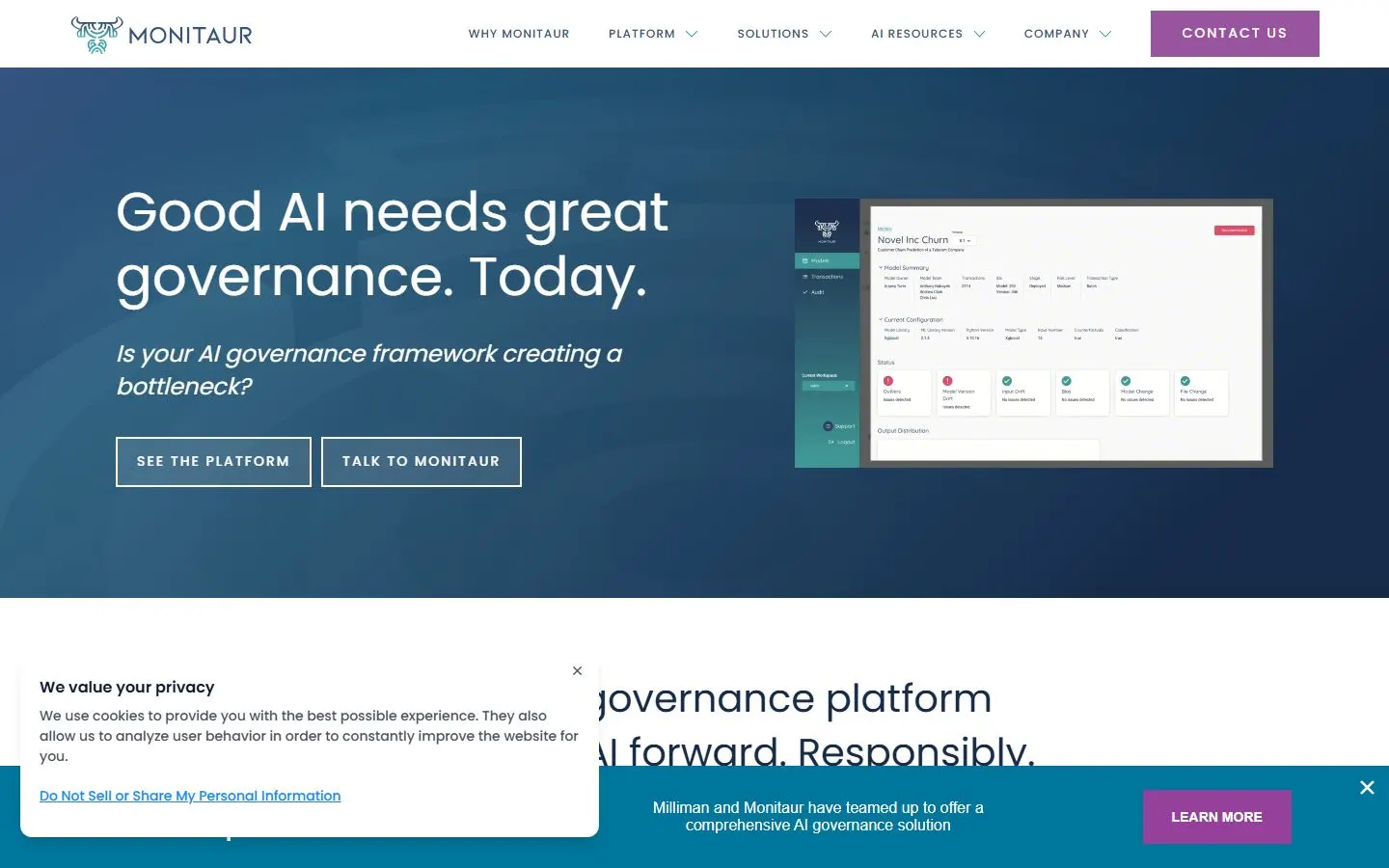
Monitaur sells an AI governance platform organized around defining policy, managing models and controls, and automating evidence collection. Its site lists “model governance built for insurance” as a solution area and features insurance customers and an insurance integrations page.
Key functionalities
- Policy definition and an inventory of models and AI systems
- Controls and lifecycle management with an audit trail
- Drift and bias monitoring on deployed models
- Vendor governance for third-party AI
- Insurance-oriented integrations, listed on the vendor’s site
- SOC 2 Type II, per the badge on the vendor’s site (source)
Pros:
- Lists model governance built for insurance as a solution area, with insurance case studies on its site
- Covers policy, inventory, controls, drift and bias monitoring and vendor governance in one platform
- SOC 2 Type II badge shown on the vendor's site
Cons:
- Its homepage does not name the NAIC bulletin or Colorado rules, so confirm regulatory mapping in a demo
- Pricing is not published and a sales conversation is required
Pricing: Not published; quoted by sales.
Verdict: The most insurance-focused option here, and a natural first demo for a carrier with regulated models. Verify exactly how its templates map to the states you operate in.
2. Credo AI: Best for governing many AI systems across a multi-line insurer
 Quote onlyFull profile →
Best for: Multi-line insurers and groups with many AI systems across functions that need a registry, risk assessment and regulation-mapped policy packs.
Credo AI is an AI governance platform with an AI registry, risk and compliance management, regulatory and policy intelligence, and an assistant called GAIA. Its site names insurance among the sectors using it and describes an agent governance capability.
Key functionalities
- AI registry, including shadow AI discovery
- Risk and compliance workflows with policy packs, including ones labeled NAIC AI, CO ADMT and EU AI Act
- Policy engine and regulatory intelligence
- Agent governance for AI agents
- Integrations with data and cloud platforms such as Snowflake, Databricks, AWS and Azure
- Advisory services
Pros:
- Lists NAIC AI, CO ADMT and EU AI Act policy packs on its site
- AI registry that includes discovery of unsanctioned AI use
- Integrations with Snowflake, Databricks, AWS and Azure
Cons:
- Cross-industry product; its site does not describe an insurance-specific module
- Pricing is not published
- Policy pack names are listed without detail on scope, so ask to see them
Pricing: Not published; quoted by sales.
Verdict: A strong fit for large insurers that want one governance system across many business units. Smaller carriers with few models may find it more platform than they need.
3. ValidMind: Best for teams extending model risk management to AI
 Quote onlyFull profile →
Best for: Insurers with actuarial or model risk teams that already validate models and want one control framework for traditional models and AI.
ValidMind is an AI governance platform for regulated industries, headquartered in Palo Alto, that says it serves banking and insurance. Its offering centers on governance, validation and automation of model documentation.
Key functionalities
- Unified AI and model risk management under one control framework
- Validation and documentation workflows
- Automation of audit-ready evidence
- Integrations, listed in the vendor’s navigation
- Insurance industry page on the vendor’s site
Pros:
- Frames traditional and AI model risk under one control framework
- Has a dedicated insurance industry page
- Audit-ready evidence aimed at supervisory expectations including the EU AI Act, per its site
Cons:
- Its homepage does not mention the NAIC bulletin or Colorado rules
- Strongest fit is where a model validation function already exists
- Pricing is not published
Pricing: Not published; quoted by sales.
Verdict: A good match for risk and actuarial teams whose starting point is validation and documentation. Compliance-led teams without a model risk function may prefer a governance-first tool.
4. IBM watsonx.governance: Best for large enterprises on IBM or hybrid cloud
Quote only · Free trial: 14 days, with included creditsFull profile →
Best for: Large insurance groups that want AI governance across cloud and on-premises environments and can buy through IBM, AWS or Azure channels.
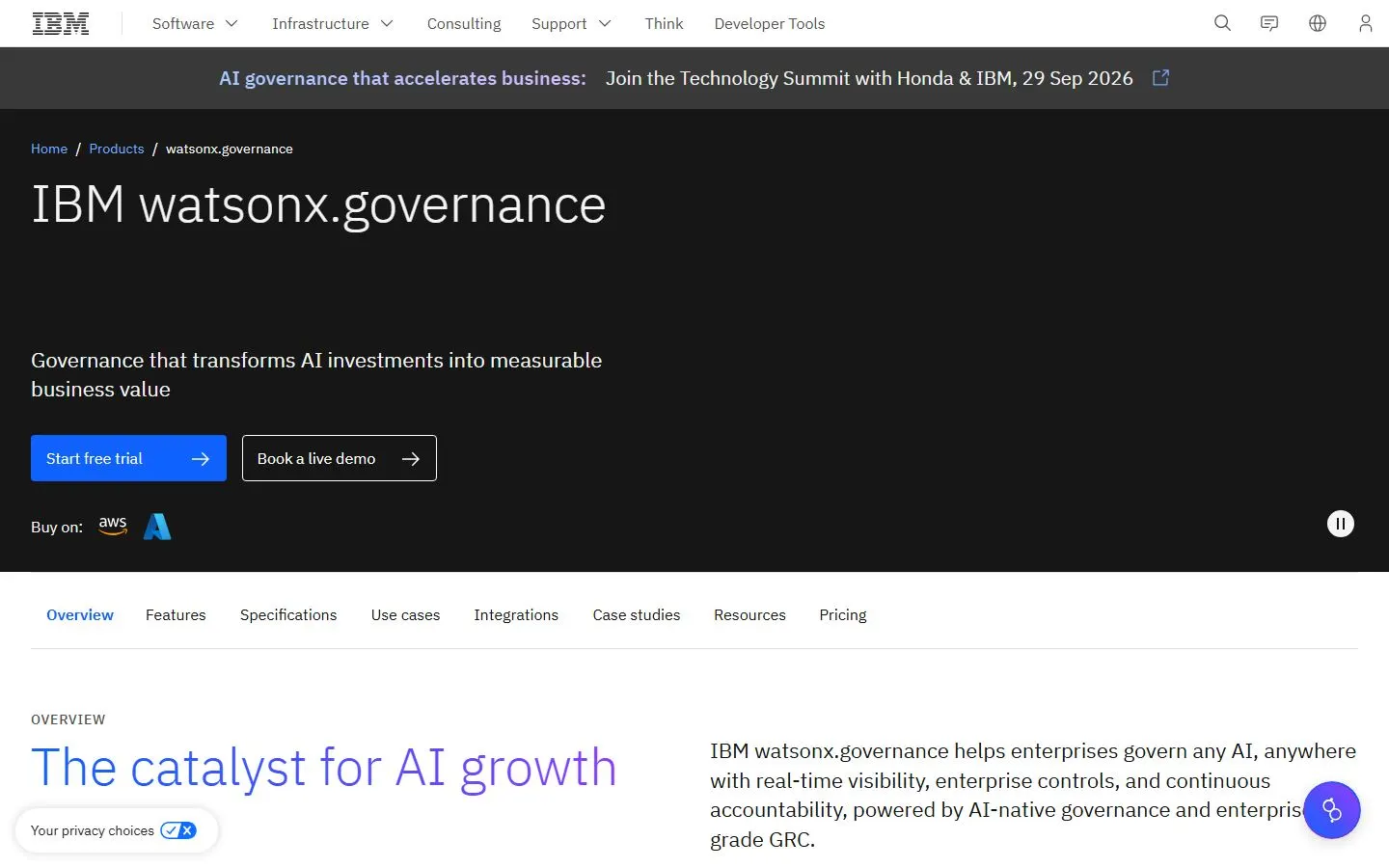
IBM watsonx.governance is IBM’s AI governance product. IBM describes it around visibility into the AI ecosystem, control through policy enforcement and obligation mapping, and accountability for outcomes.
Key functionalities
- Governance graph mapping AI assets
- Automated policy enforcement and compliance evidence capture
- Obligation mapping, with EU AI Act, NIST and ISO 42001 named on the page
- Shadow AI detection and continuous monitoring
- Deployment across cloud and on-premises environments
Pros:
- Works across cloud and on-premises environments, and is sold through AWS and Azure marketplaces
- Free 14-day trial with credits
- Names EU AI Act, NIST and ISO 42001 content
Cons:
- Its page does not mention NAIC or Colorado
- Pricing details sit behind the pricing page and sales
- Likely heavier than needed for small teams
Pricing: No fixed prices on the product page; a free 14-day trial with included credits is offered, and purchase options are on IBM's pricing page. (source)
Verdict: A fit for large enterprises that already run IBM tooling or need on-premises deployment. It is the only tool here with a self-serve trial, but insurance-specific mapping would be your team's work.
5. Holistic AI: Best for EU AI Act readiness and AI discovery
Quote onlyFull profile →
Best for: Insurers with European operations that want AI discovery, testing and policy enforcement mapped to the EU AI Act, NIST AI RMF and ISO 42001.
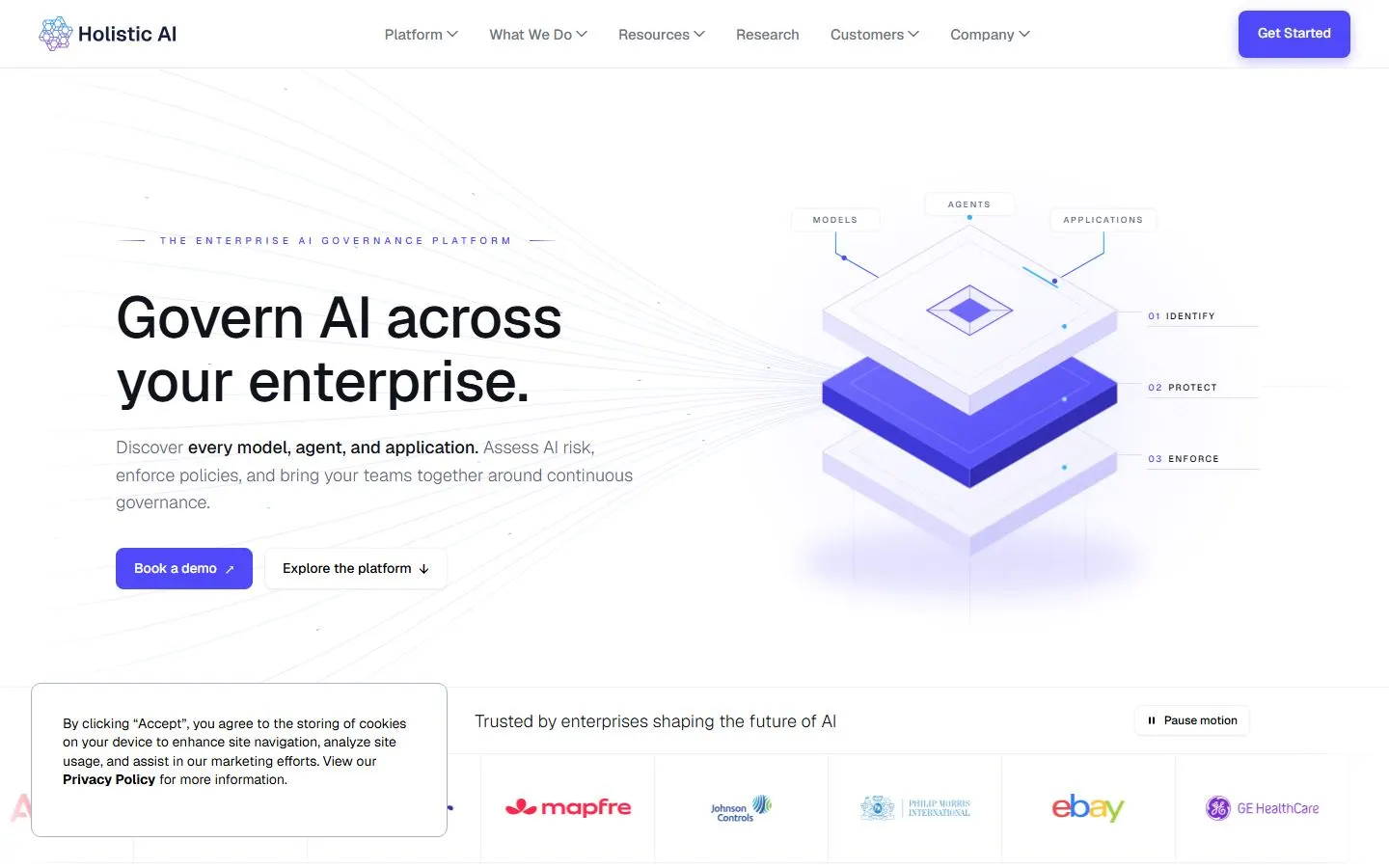
Holistic AI sells an enterprise AI governance platform in three layers: Identify (AI discovery and inventory), Protect (testing and risk management) and Enforce (policy and compliance).
Key functionalities
- AI discovery and inventory
- AI testing and risk management
- Policy and compliance enforcement
- Controls mapped to EU AI Act, NIST AI RMF and ISO/IEC 42001
- Monitoring and enforcement agents
Pros:
- Controls mapped to EU AI Act, NIST AI RMF and ISO/IEC 42001, per its site
- Covers discovery, testing and enforcement in three layers
- Includes agent-based monitoring and enforcement
Cons:
- No insurance, NAIC or Colorado content on its homepage
- Pricing is not published
- Insurance-specific testing would need to be configured by your team
Pricing: Not published; quoted by sales.
Verdict: Best when EU exposure drives the purchase. For US-only carriers focused on state insurance regulators, an insurance-specific tool is a closer start.
6. Arthur AI: Best for monitoring generative AI and agents in production
 Quote onlyFull profile →
Best for: Insurers with engineering teams running LLM applications or AI agents that need observability, evaluation and runtime guardrails.
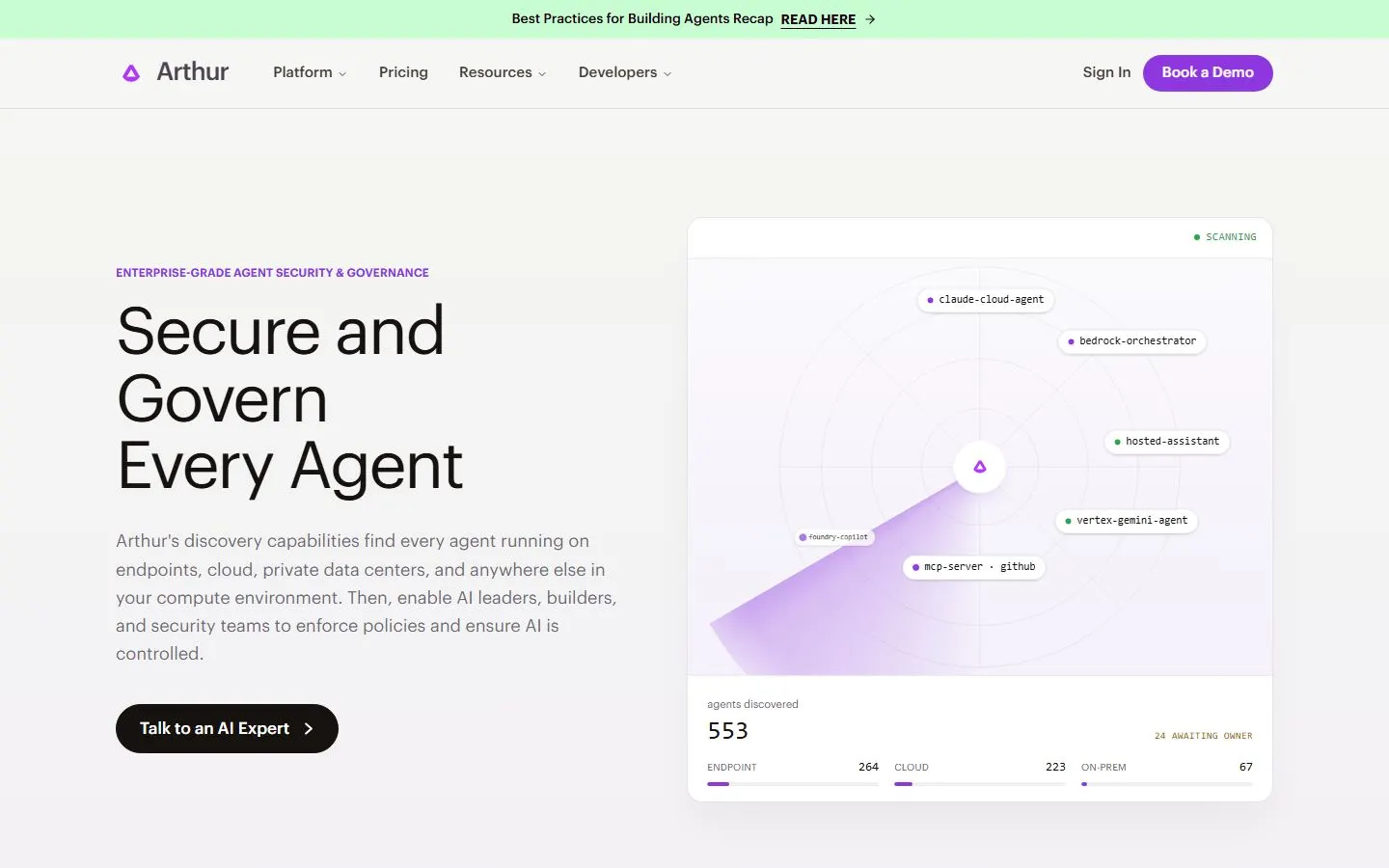
Arthur now describes its product around agent discovery and governance, runtime security and evaluations. Earlier descriptions of Arthur as a bias and drift monitoring tool for ML models may not reflect its current emphasis.
Key functionalities
- Agent discovery across endpoints, cloud and data centers, including unsanctioned agents
- Observability with step-level traces of reasoning, tools and retrieval
- Runtime guardrails and anomaly alerting
- Evaluations including groundedness, PII leakage and relevance
- Spend tracking by team
Pros:
- Evaluations for groundedness, tool selection, PII leakage and relevance, per its site
- Agent discovery, step-level tracing and runtime guardrails
- Open-source engine repository linked from its site
Cons:
- Technical monitoring tool, not a regulatory documentation system
- No insurance, NAIC or Colorado content on its homepage
- Pricing not confirmed on the pages reviewed
Pricing: Not published on the page reviewed; contact the vendor.
Verdict: A fit for technical teams that need to see and control what deployed AI is doing. Pair it with a governance platform for regulator-facing documentation.
How do these tools compare side by side?
| Tool | Approach | Best for | Pricing | Free trial | Security |
|---|---|---|---|---|---|
| 1Monitaur | AI Governance | Carriers in regulated states (Colorado, Connecticut, and others adopting AI governance rules) who need insurance-specific compliance tooling built by people who understand insurance regulation | Quote only | — | SOC 2 Type II |
| 2Credo AI | AI Governance | Multi-line insurers managing dozens of AI models across underwriting, claims, and pricing who need a GRC-style governance framework that scales and produces board-ready reporting | Quote only | — | SOC 2 unverified |
| 3ValidMind | Model risk management | Insurers with actuarial or model risk teams that already validate models and want one control framework for traditional models and AI. | Quote only | — | SOC 2 unverified |
| 4IBM watsonx.governance | Enterprise AI governance | Large insurance groups that want AI governance across cloud and on-premises environments and buy through IBM, AWS or Azure. | Quote only | 14 days, with included credits | SOC 2 unverified |
| 5Holistic AI | AI governance and compliance | Insurers with European operations that want AI discovery, testing and policy enforcement mapped to the EU AI Act and NIST AI RMF. | Quote only | — | SOC 2 unverified |
| 6Arthur AI | AI Governance | Carriers with in-house data science teams who need technical ML monitoring and observability, particularly those deploying LLMs alongside traditional ML models | Quote only | — | SOC 2 unverified |
Which tool fits your team?
- You are a carrier mainly answering state insurance regulators: start with Monitaur, and also look at Credo AI.
- You run many AI systems across business units and regions: Credo AI, IBM watsonx.governance or Holistic AI.
- You have a model validation function and want AI under the same framework: ValidMind.
- You operate in the EU and need AI Act readiness: Holistic AI or Credo AI.
- You need on-premises deployment or a self-serve trial: IBM watsonx.governance.
- You run LLM applications or agents and need production monitoring: Arthur, alongside a governance platform.
Conclusion: decide which regulator you answer to first
The right tool depends on the rule driving the purchase: a state insurance department, Colorado’s regulations, or the EU. Ask each shortlisted vendor to show how its templates map to the specific states you operate in, confirm the current status of the rules with counsel, and treat vendor regulatory claims as starting points to verify.
FAQs
What is AI governance software for insurance?
It is software that keeps an inventory of the AI and predictive models an insurer uses, documents and tests them for accuracy and unfair discrimination, records approvals and changes, and produces evidence for regulators and auditors. Some tools add production monitoring. Insurers use it to support rules such as the NAIC Model Bulletin and Colorado's insurance regulations.
What does the NAIC Model Bulletin on AI require of insurers?
The NAIC adopted the Model Bulletin on the Use of Artificial Intelligence Systems by Insurers on December 4, 2023. It is guidance for state regulators, not a model law. It expects insurers to maintain a written AI Systems (AIS) Program, scaled to risk, and it lists documentation regulators may request in an investigation or exam. It applies to an insurer only where its state has adopted it or issued similar guidance.
Which states have adopted the NAIC AI Model Bulletin?
Adoption is state by state and the count changes, so check the NAIC's published legal adoption map rather than a vendor blog. The NAIC map also shows some states, including Colorado, New York, California and Texas, as having their own insurance-specific AI rules.
What is Colorado SB21-169 and what does it require of insurers?
SB21-169 is a 2021 Colorado law that prohibits insurers from using external consumer data and algorithms in ways that unfairly discriminate based on protected classes. The Division of Insurance implements it through regulations. The governance regulation for life insurers took effect in November 2023 and was amended in 2025 to add private passenger auto and health benefit plans. Quantitative testing standards were still under development in the latest sources reviewed, so confirm current status with the Division.
Is Colorado SB24-205 the same as the insurance AI rules?
No. SB24-205 is Colorado's broader consumer protection law for high-risk AI systems, separate from the insurance-specific SB21-169. Its effective date was moved from February 1, 2026 to June 30, 2026 by SB25B-004. Later changes could not be verified, so check the Colorado General Assembly site and ask counsel how it applies to your business.
Does the EU AI Act apply to insurers?
It can. The EU AI Act treats AI used for risk assessment and pricing in life and health insurance as high-risk, and it applies to providers and deployers whose systems are used in the EU. Obligations for high-risk systems are phased in; Holistic AI's site states they apply from 2 December 2027. Confirm dates against the official text and with counsel.
What is the difference between AI governance and model risk management software?
Model risk management focuses on validating and documenting individual models, including independent challenge and ongoing performance review. AI governance is broader: it adds an inventory of every AI system, policy and risk classification, approvals and regulatory mapping. Several tools in this list cover both, but their starting points differ.
How much does AI governance software cost?
None of the six tools publishes list pricing on the pages reviewed. Credo AI, Monitaur, ValidMind, Holistic AI and Arthur direct buyers to sales or a demo. IBM watsonx.governance offers a free 14-day trial, and says it is also sold through the AWS and Azure marketplaces.
Sources
- NAIC: Members approve model bulletin on use of AI by insurers
- NAIC: AI Model Bulletin legal adoption map
- Colorado General Assembly: SB21-169
- Colorado General Assembly: SB24-205
- EU AI Act (Regulation 2024/1689)
- Willkie: Colorado Division of Insurance adopts amended AI governance regulation (2025)
- Credo AI
- Monitaur
- ValidMind
- IBM watsonx.governance
- Holistic AI
- Arthur