Best Underwriting Workbench and Submission Intake Software in 2026
Seven underwriting workbench and submission intake tools compared: Kalepa, Sixfold, hyperexponential, Cytora, Send, Federato and FurtherAI, by approach, lines of business, pricing, security and who each fits.
TL;DR
- Underwriting workbench tools fall into four shapes: end-to-end underwriting platforms (Kalepa, hyperexponential), submission scoring agents (Sixfold), intake and digitization (Cytora, FurtherAI), and system-of-record platforms (Send, Federato).
- Kalepa leads this list for commercial carriers and MGAs that want one product from submission ingestion through clearance, triage, rating, quote and bind, and portfolio management.
- hyperexponential is the pick when actuarial pricing models need to run inside the underwriter's workbench; it lists SOC 2 Type 2 and ISO 27001:2022.
- Sixfold, Cytora and FurtherAI focus on the front of the process (reading submissions, scoring and routing them), while Send and Federato replace or sit closer to the system of record.
- None of the seven publishes prices; every one is quoted by sales, so security documentation and a pilot on your own submissions are the practical comparison points.







Underwriters in commercial and specialty lines spend much of their day on work that comes before judgment: opening broker emails, reading ACORD forms and loss runs, checking whether the account is in appetite, looking up the insured, and rekeying data into a rating tool. Workbench and intake software targets that layer. Buyers struggle to compare these products because the same words (“underwriting AI”, “copilot”, “workbench”) cover tools that read documents, tools that score risks, and tools that replace the system of record.
This guide compares seven tools by what they actually take on. It starts with how they differ, then covers each tool, and ends with a side-by-side table and a short guide to which fits which team.
Different tools solve different parts of the underwriting problem
Grouping the seven by shape is more useful than ranking them on one scale.
| Shape | What it focuses on | Tools in this list |
|---|---|---|
| End-to-end underwriting platform | Ingestion, clearance, triage, analysis, rating and quote in one product | Kalepa, hyperexponential |
| Submission scoring agent | Reading submissions, scoring against appetite, recommending a next step | Sixfold |
| Intake and digitization | Turning broker, insurer and client documents into structured schemas and routing them | Cytora, FurtherAI |
| Underwriting system of record | Configurable workflow, rating and binder management, or a full core platform | Send, Federato |
End-to-end platforms suit teams that want one workspace and are willing to change how underwriters work. Scoring agents and intake tools suit teams that keep their policy and rating systems and want AI in front of them. System-of-record platforms suit carriers and MGAs replacing legacy tooling, particularly where delegated authority, bordereaux or full policy lifecycle matter.
The 7 best underwriting workbench and submission intake tools for commercial insurers
1. Kalepa: Best for an end-to-end workbench from intake to portfolio
 Quote onlyFull profile →

Best for: Commercial carriers, MGAs, mutuals and brokers that want submission ingestion, clearance, triage, rating and quote in one product.
Kalepa describes its platform as seven connected steps, from submission ingestion to portfolio management. It says it classifies submissions and extracts data from hundreds of document types, from ACORDs and SOVs to loss runs and supplemental applications, then enriches them with third-party and public data.
Key functionalities
- Submission ingestion that classifies documents and extracts data from ACORDs, SOVs, loss runs and supplementals
- Clearance that detects conflicts, checks completeness, screens for sanctions and confirms appointed producers
- Triage that prioritizes submissions by likelihood to bind and fit with appetite and guidelines
- A single risk analysis view of exposures, controls, terms and communications, with red, yellow and preferred flags
- Rating that incorporates pricing models from Excel, external raters or internal systems
- Portfolio management with targets, guardrails and appetite adjustments
Pros:
- Covers the full path from ingestion through quote and bind and portfolio management, according to its site
- Clearance steps include conflict detection, sanctions screening and producer checks
- Rating can pull in models from Excel, external raters or internal systems rather than forcing a replacement
Cons:
- Broad scope means a longer rollout than a single-purpose scoring tool
- Pricing and security documentation are not published on its site
Pricing: Not published; quoted by sales.
Verdict: The broadest fit on this list for commercial teams that want one workspace. Teams that only need scoring on top of an existing platform may find it more than they need.
2. Sixfold: Best for explainable submission scoring on top of existing systems
 Quote only · SOC 2 Type IIFull profile →
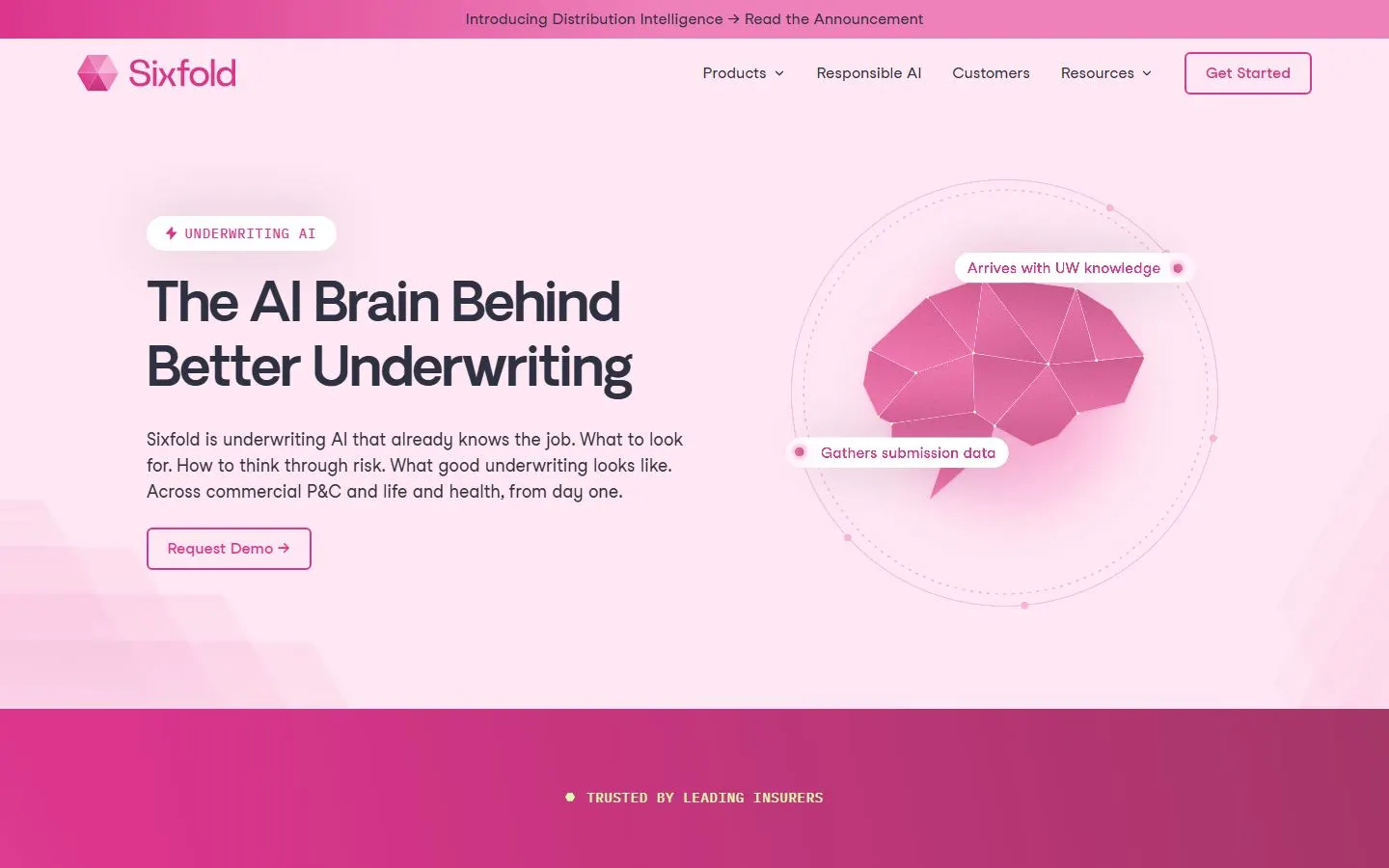
Best for: Commercial P&C carriers and MGAs, and life and health underwriters, that want AI to read, assess and recommend a next step on every case.
Sixfold positions itself as an underwriting agent that reads complex documents such as loss runs and SOVs, scores risk with explainable signals, evaluates appetite and portfolio fit, and recommends the next action. Its site lists customers including Zurich North America, AXIS, Skyward Specialty, Mosaic and Guardian; the efficiency and bind-ratio figures shown there are the company’s own.
Key functionalities
- Reads loss runs, SOVs and other submission documents
- Scores risk with signals that cite their source
- Evaluates appetite and portfolio fit on each submission
- Recommends a next best action to move the case forward
- Life and health product that assesses prescription histories, lab results and driving records against guidelines
- Governance program and an annual Responsible AI report
Pros:
- Every fact is cited to source, according to the company
- Covers both P&C and life and health underwriting
- Trust center lists SOC 2 Type 2 and HIPAA
Cons:
- Not a system of record, so it relies on your policy and rating systems
- Pricing not published; the efficiency figures on its site are company claims
Pricing: Not published; quoted by sales.
Verdict: A good fit for carriers that want AI assessment layered onto an existing workflow with underwriters keeping the final call. Teams wanting rating and binding in the same tool should look elsewhere.
3. hyperexponential (hx): Best for pricing models inside the underwriter's workbench
Quote only · SOC 2 Type IIFull profile →
Best for: Commercial and specialty carriers, MGAs and Lloyd's market participants that want actuarial models and underwriting workflow in one platform.
hyperexponential (hx) calls its product an agentic underwriting workbench. It says top global carriers use it for underwriting decisions across more than $75bn of annual commercial P&C premium. It appears in this list’s companion on rating and pricing software as well, because the pricing models sit in the same platform.
Key functionalities
- Submission triage from inbox to ranked queue, including ACORD extraction and bordereaux ingestion
- Complex risk assessment that runs bespoke actuarial models and flags decision bounds
- Quote generation with novel risk pricing, rate justification and what-if scenarios
- Renewals that pull history, reprice the account and draft terms
- Portfolio monitoring for exposure, concentration limits and drift
- Reinsurance management and wording and regulation monitoring, including Lloyd’s bulletins
Pros:
- Runs bespoke actuarial models within the underwriting workflow
- Also covers renewals, portfolio monitoring and reinsurance management
- Lists SOC 2 Type 2 and ISO 27001:2022
Cons:
- Focused on commercial P&C, so personal lines teams are not the target
- Pricing not published
Pricing: Not published; quoted by sales.
Verdict: The strongest candidate when actuaries and underwriters need to work from the same models. Teams that only want intake automation will find it broader than needed.
4. Cytora: Best for digitizing and routing submissions across brokers and insurers
 Quote onlyFull profile →
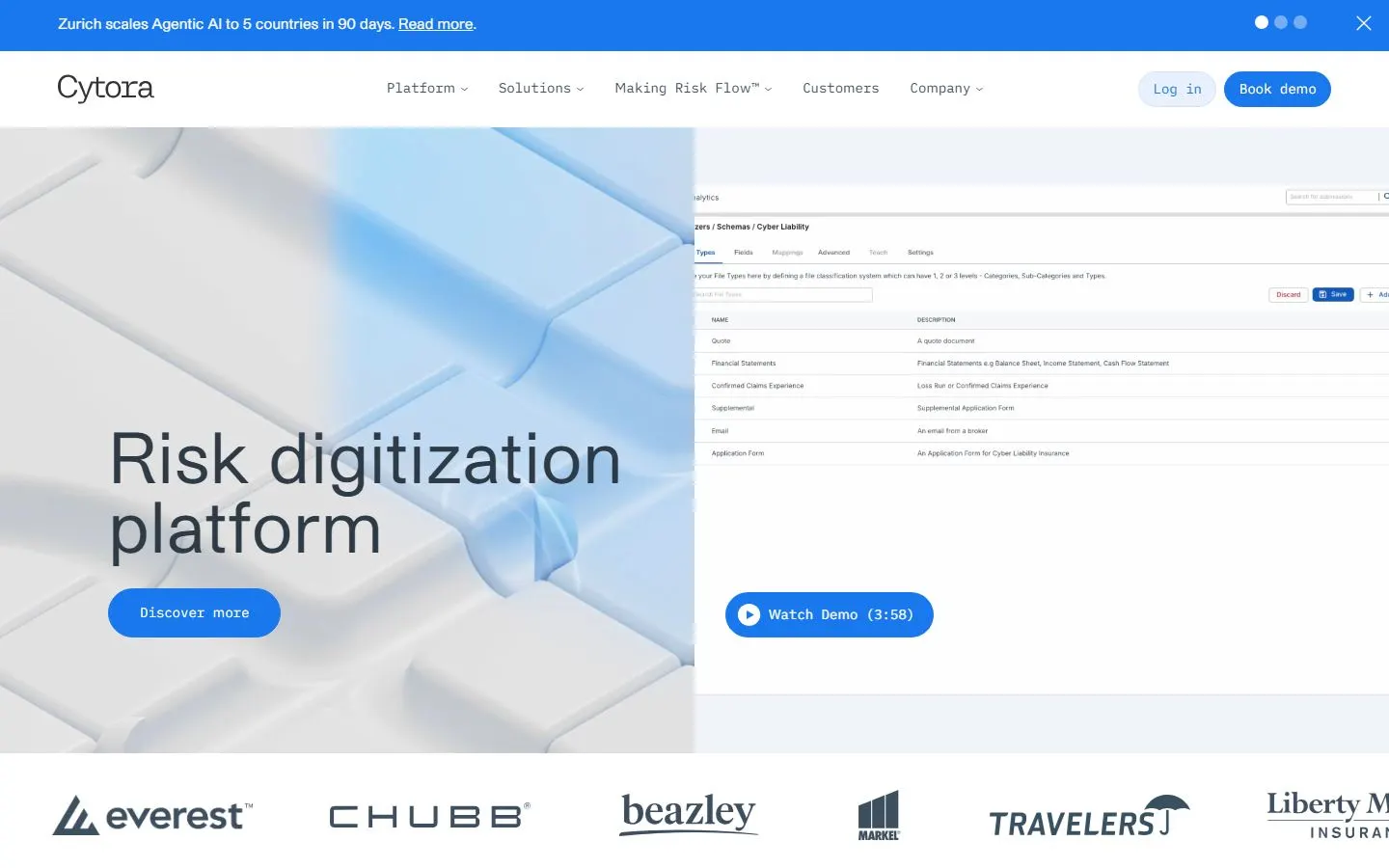
Best for: Commercial insurers, MGAs, wholesale brokers and reinsurers that want control over how risks are received, digitized and routed.
Cytora describes itself as a risk digitization and automation platform. It says the platform is agentic-AI powered and does not require training, and that clients design workflows for different levels of risk complexity. Its site highlights Zurich scaling the platform to five countries in 90 days and Markel improving productivity by over 100%; both are company-reported.
Key functionalities
- Out-of-the-box schemas by segment, line of business and country
- Digitization of client submissions, insurer quotes, policies and invoices
- Pre-integrated data sources for clearance, accumulation and risk evaluation
- Routing, human review and explainability controls
- Use cases across new business, renewals, claims and mid-term adjustments
Pros:
- Schemas cover client submissions, quotes, policies and invoices
- Serves brokers as well as insurers, which few tools here do
- Site lists ISO 27001 and ISO 42001
Cons:
- Intake and routing focus, not a rating or pricing tool
- Pricing not published; SOC 2 status is not stated on its site
Pricing: Not published; quoted by sales.
Verdict: A fit for organizations whose main problem is the volume and variety of inbound risk documents. Teams needing pricing in the same product should pair it with a rating tool.
5. Send: Best for delegated authority and specialty workflow
 Quote onlyFull profile →
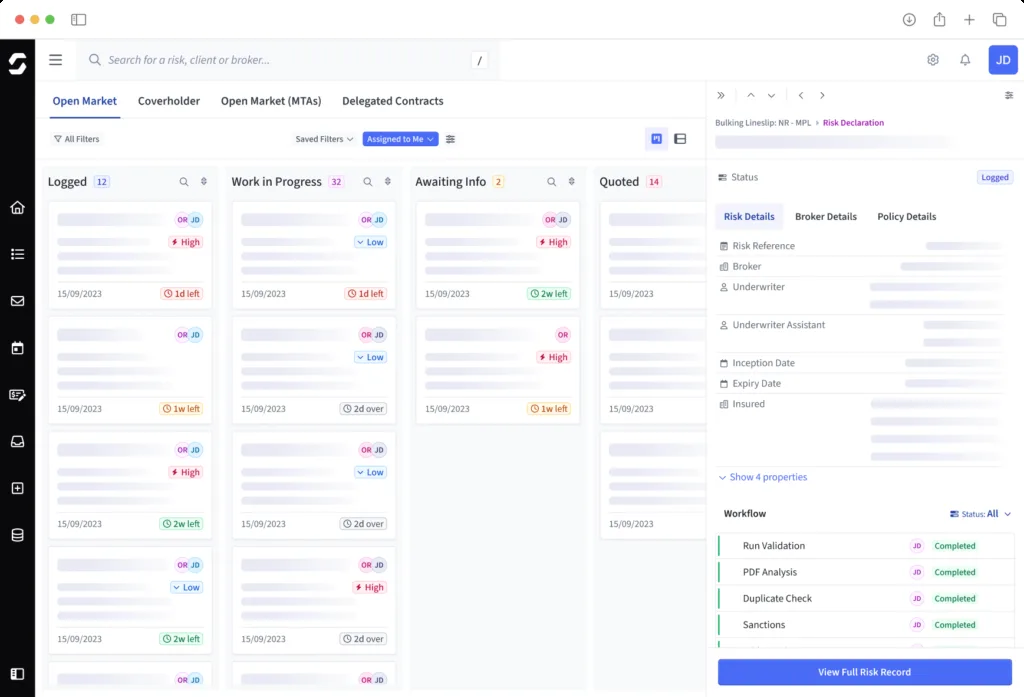
Best for: Specialty insurers, MGAs and reinsurers that need a configurable system of record for submissions, rating, binders and bordereaux.
Send describes itself as the orchestration engine connecting underwriting data, workflows and decisions for commercial and specialty insurers. The company says more than $26bn of GWP has been written through the platform and that it cut product launch time by 65%; those figures are its own.
Key functionalities
- Submission management and risk workflow
- Quote and rate lifecycle management
- Binder management for binding authority agreements
- Bordereaux ingestion that validates contract terms and standardizes data
- Automation and rules with configurable workflows
- An agentic framework that runs AI within the platform with guardrails, audit trails and usage controls
Pros:
- Covers binder management and bordereaux ingestion, which delegated business needs
- Separate offerings for direct, delegated and reinsurance underwriting
- Company says it supports 40+ lines of business
Cons:
- A platform implementation rather than an add-on, so expect a longer project
- Pricing and security certifications are not published on its site
Pricing: Not published; quoted by sales.
Verdict: A good fit for specialty and delegated underwriters replacing spreadsheets or older systems. Teams wanting a lightweight AI layer on a system they keep should look at Sixfold or FurtherAI.
6. Federato: Best for carriers moving underwriting into an AI-native core
 Quote onlyFull profile →
Best for: Carriers, MGAs and MGAAs that want portfolio steering and underwriting decisions tied to policy, billing and claims.
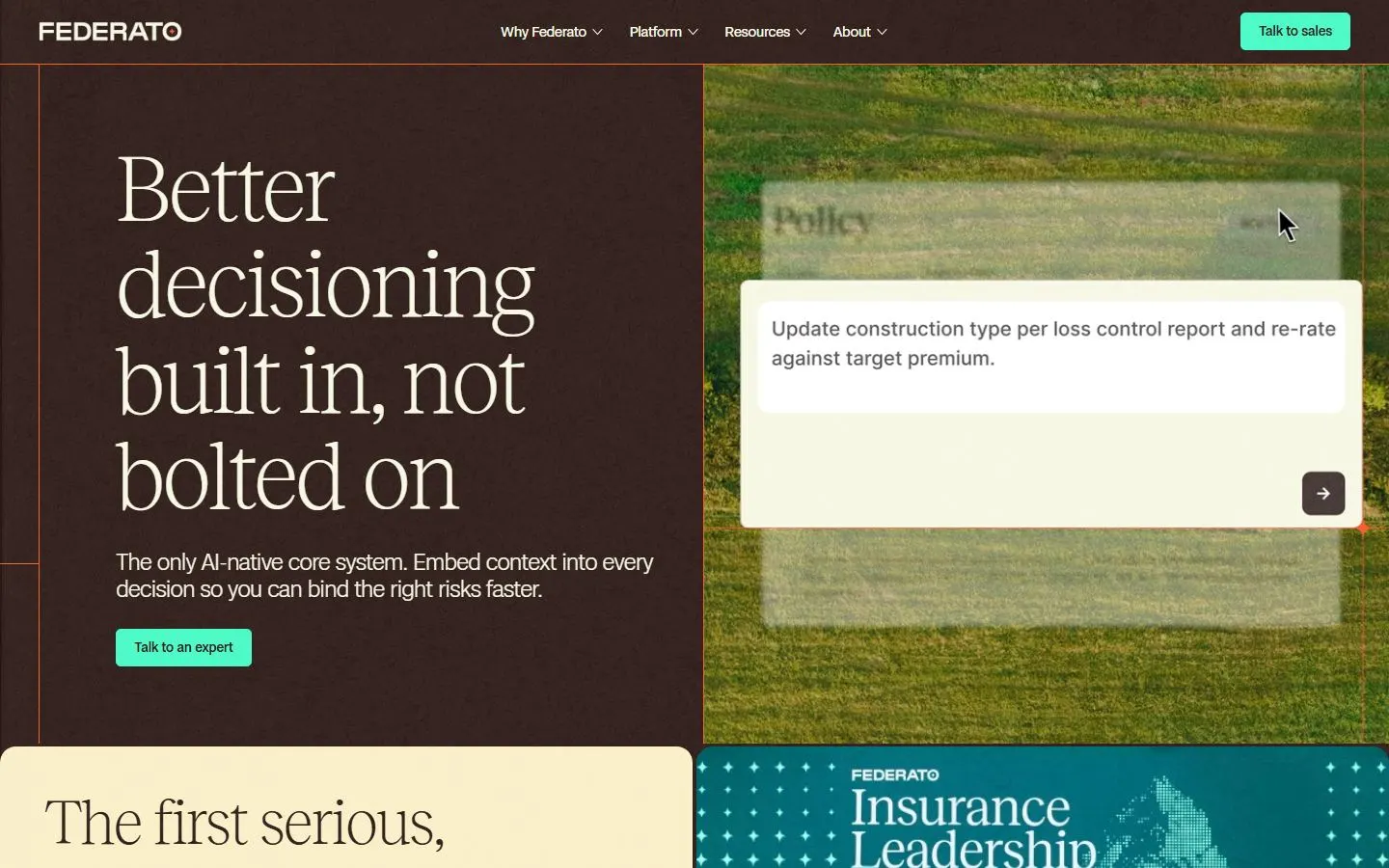
Federato began as a portfolio-aware underwriting prioritization tool. Its site now describes an AI-native core platform covering policy administration, billing, claims, product configuration and partner portals, with Control Tower for portfolio steering. It reports figures such as a 50% increased hit ratio and 30% lift in high-appetite premiums, which are company claims.
Key functionalities
- Policy administration, billing and payments, and claims on one platform
- Control Tower for real-time portfolio steering
- Product Studio for building and launching products
- Partner portals for agents and MGAs
- Appetite and portfolio context embedded in underwriting decisions
Pros:
- Control Tower gives real-time portfolio steering
- Policy, billing and claims in one platform, according to its site
- Customer references on its site include Nationwide and QBE
Cons:
- Now positioned as a core platform, which is a larger change than adding a workbench
- Pricing not published; customer outcome figures on its site are vendor-reported
Pricing: Not published; quoted by sales.
Verdict: Worth a look for carriers already considering core replacement. Teams that want to keep their core and add submission tooling will find the other options on this list lighter.
7. FurtherAI: Best for AI intake and guideline checks at MGAs
 Quote only · SOC 2 Type IIFull profile →

Best for: MGAs, carriers, brokers and reinsurers that want AI to handle submission intake, SOV mapping and guideline checks across several lines.
FurtherAI offers domain-specific AI for insurance workflows. Its site lists agents for submission intake, SOV mapping, authority checks, guideline checks, bind order verification, policy check and compare, and claims intake.
Key functionalities
- Submission intake and processing
- SOV mapping and verification for commercial property
- Guideline and authority checks
- Policy check and compare, and bind order verification
- Claims intake and FNOL
- Customer-managed encryption keys, according to its security page
Pros:
- Lists SOC 2 Type II, ISO 27001, GDPR and HIPAA on its security page
- Line-specific workflows for commercial property, auto and fleet, E&S, cyber and life and health
- Available through Microsoft Marketplace
Cons:
- Younger vendor, with a $25M Series A announced on its site
- Pricing not published
Pricing: Not published; quoted by sales.
Verdict: A practical choice for teams that want intake and checking automated without replacing their platform. Buyers with strict vendor-maturity requirements should review its customer references.
How do these tools compare side by side?
| Tool | Approach | Best for | Pricing | Free trial | Security | Lines of business |
|---|---|---|---|---|---|---|
| 1Kalepa | Underwriting Intelligence | Specialty carriers and MGAs writing workers compensation, commercial auto fleet, or professional liability who need appetite enforcement and loss run automation | Quote only | — | SOC 2 unverified | Commercial, all lines (per site) |
| 2Sixfold | Underwriting Intelligence | Commercial lines carriers with high submission volumes who need automated scoring and triage to focus underwriter time on the best-fit risks | Quote only | — | SOC 2 Type II | Commercial P&C; life and health |
| 3hyperexponential (hx) | Pricing and underwriting platform | Commercial and specialty carriers, MGAs and Lloyd's market participants that want actuarial pricing models and the underwriter workbench in one platform. | Quote only | — | SOC 2 Type II | Commercial P&C and specialty |
| 4Cytora | Risk digitization platform | Commercial insurers, MGAs and wholesale brokers that want to control how submissions are digitized and routed across lines of business. | Quote only | — | SOC 2 unverified | Commercial insurance, all lines |
| 5Send | Underwriting orchestration platform | Specialty insurers, MGAs and reinsurers that want a configurable system of record for the underwriting workflow, including delegated authority. | Quote only | — | SOC 2 unverified | 40+ commercial and specialty lines (company claim) |
| 6Federato | Underwriting Intelligence | Mid-to-large carriers with diversified books who need portfolio-level submission prioritization and real-time risk appetite management across underwriting teams | Quote only | — | SOC 2 unverified | Commercial; multi-line carriers |
| 7FurtherAI | Intelligent Document Processing | Fast-growing MGAs and specialty carriers who want modern LLM-powered submission intake without enterprise IDP platform overhead | Quote only | — | SOC 2 Type II | Property, auto and fleet, E&S, cyber, life and health |
Which tool fits your team?
- You want one workspace from submission to quote for commercial lines: Kalepa.
- You want AI assessment on top of your existing policy and rating systems: Sixfold.
- Actuaries and underwriters need to share pricing models in the workbench: hyperexponential.
- Your bottleneck is the volume of broker and insurer documents: Cytora, or FurtherAI if you are an MGA that also needs guideline checks.
- You write delegated or specialty business and need binders and bordereaux: Send.
- You are replacing your core system and want underwriting built into it: Federato.
- You need document extraction only, without scoring or workflow: see the document extraction guide.
Conclusion: decide whether you need AI in front of your system or a new system
The first decision is structural: add AI in front of the policy and rating systems you keep, or move underwriting onto a new platform. Scoring and intake tools are quicker to adopt; platforms change more but remove handoffs. With no published pricing, ask each vendor to run your own recent submissions, including the messy ones, and compare corrections, source citations and how your team changes appetite rules.
FAQs
What is an underwriting workbench?
An underwriting workbench is the screen and workflow where an underwriter reviews a risk: submission documents, third-party data, appetite and guideline checks, loss history, pricing and referral notes. Modern products add AI that reads submissions and recommends a next step, but the underwriter still makes the decision.
What is the best underwriting software for MGAs and commercial carriers?
It depends on the gap. Kalepa covers the full path from submission ingestion to quote and bind and portfolio management. hyperexponential suits teams that want pricing models inside the workbench. Send suits delegated and specialty business that needs a system of record. Sixfold and FurtherAI suit teams that want AI added in front of an existing platform.
What is the difference between submission intake and an underwriting workbench?
Submission intake reads emails, ACORD forms, loss runs and statements of values and turns them into structured data. A workbench adds what happens next: clearance, appetite checks, triage, risk analysis, rating and quote. Cytora and FurtherAI start from intake; Kalepa, hyperexponential and Send cover more of the workbench.
How much does underwriting workbench software cost?
None of the seven vendors in this list publishes pricing. Expect a sales process, an enterprise contract, and a pilot on your own submissions before a price is quoted.
Do these tools make underwriting decisions automatically?
They automate reading, scoring, clearance and routing, and some can decline out-of-appetite risks by rule. Vendors such as Sixfold describe underwriters as reviewing and owning the final call. Whether a given risk is bound without a person is a configuration choice at the carrier.
Which underwriting AI tools are SOC 2 compliant?
hyperexponential lists SOC 2 Type 2 and ISO 27001:2022 on its site. Sixfold's trust center lists SOC 2 Type 2 and HIPAA. FurtherAI's security page lists SOC 2 Type II, ISO 27001, GDPR and HIPAA. Cytora lists ISO 27001 and ISO 42001. Kalepa, Send and Federato should be asked for current reports.
Can an underwriting workbench replace a policy administration system?
Usually not. Most workbenches sit in front of or beside the policy system and pass bound risks into it. Federato now describes itself as an AI-native core covering policy, billing and claims, and Send describes itself as the orchestration layer for underwriting, so those two are closer to a replacement than the others.
How should I compare underwriting AI vendors?
Run the same set of recent submissions, including messy ones, through each shortlisted vendor. Compare how many fields needed correction, whether the recommendation cites its source, how appetite rules are changed and by whom, and what the integration with your policy and rating systems requires.