Best Insurance Rating and Pricing Software in 2026
Six insurance rating and pricing tools compared: Akur8, Earnix, hyperexponential, Guidewire PricingCenter, Insurity Ratio Content and Rating Engine and Duck Creek Rating, by who uses them, lines, pricing, security and fit.
TL;DR
- Rating and pricing software splits into two jobs: building the rates (modeling, elasticity, rate making) and running them in production (the rating engine that quotes in real time). Some tools do both; others do one.
- Akur8 leads this list for P&C actuarial teams: it covers data preparation, GLM and GAM modeling, rate making and a rating engine, and lists SOC 2 Type II and ISO 27001.
- Earnix suits larger insurers that want pricing, rating and underwriting decisioning on one platform, and states it maintains SOC 2 Type II.
- Guidewire PricingCenter and Duck Creek Rating sit inside their core suites; Insurity's Ratio engine focuses on bureau content for commercial lines; hyperexponential puts pricing models in the underwriter's workbench.
- None of the six publishes prices; all are quoted by sales.






Pricing an insurance product involves two separate jobs that vendors often blur together. Actuaries build the rates: they prepare data, fit models, test price sensitivity and assemble a rate plan. Then a rating engine applies those rates to every quote in real time, and the policy system, the underwriter’s workbench and the regulator’s filing all depend on the two staying in sync. Buyers struggle to compare tools because some cover only one of the jobs, some are bundled into a core suite, and “AI pricing” can mean anything from a modeling accelerator to an underwriting decision engine.
This guide compares six tools. It starts with how they differ, then covers each tool, and ends with a side-by-side table and a short guide to which fits which team.
What does the incumbent approach look like and where do teams outgrow it?
Many carriers still build models in R, Python or SAS, translate the results into rate tables by hand, and have IT code them into the policy system. That approach works until rate changes need to ship faster than IT can implement them, or until nobody can show which model version produced a given quote. The tools below mostly aim at that handoff: moving approved models into production with version control and an audit trail.
Different tools solve different parts of the pricing problem
| Shape | What it focuses on | Tools in this list |
|---|---|---|
| Actuarial pricing platform | Data preparation, modeling, rate making and deployment in one cloud product | Akur8 |
| Pricing and decisioning platform | Pricing, rating and underwriting decisions sharing models and governance | Earnix |
| Underwriting workbench with pricing | Actuarial models running inside the underwriter’s quote workflow | hyperexponential |
| Core-suite pricing and rating | Pricing or rating built into the carrier’s core system | Guidewire PricingCenter, Duck Creek Rating |
| Content and rating engine | Bureau rates, rules and forms delivered to production systems | Insurity Ratio Content and Rating Engine |
Actuarial platforms fit teams whose bottleneck is building and shipping rate changes. Decisioning platforms fit larger insurers that want pricing and underwriting rules governed together. Workbench-based tools fit commercial lines where each quote involves underwriter judgment. Core-suite tools fit carriers that prefer one vendor for policy and rating, and content engines fit commercial carriers licensing bureau content.
The 6 best insurance rating and pricing tools for carriers and MGAs
1. Akur8: Best for actuarial teams building and deploying P&C rates
 Quote only · SOC 2 Type IIFull profile →
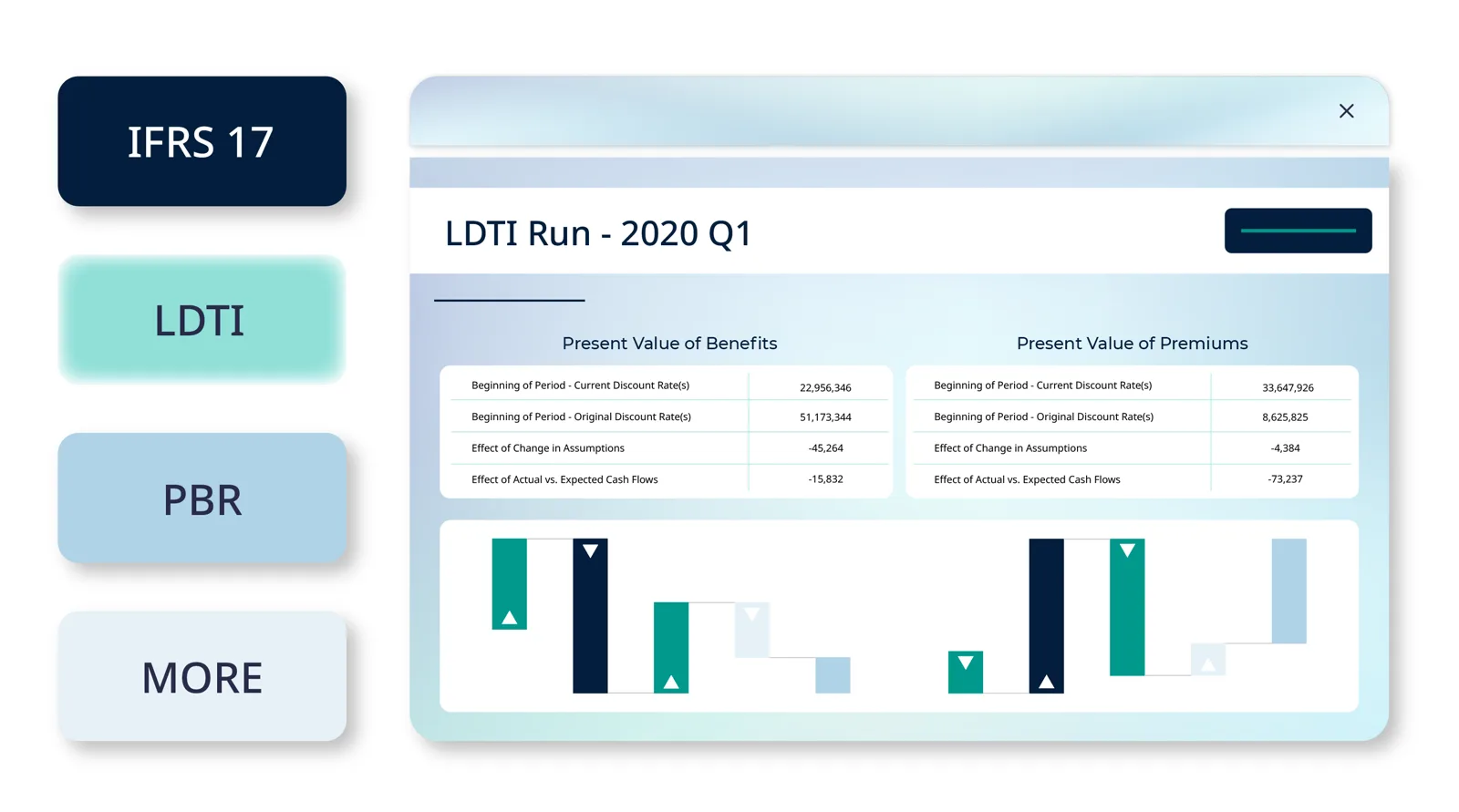
Best for: Personal and commercial lines P&C insurers and MGAs whose actuaries want to build, review and deploy rates in one governed platform.
Akur8 describes Akur8 Pricing as end-to-end actuarial pricing software for P&C insurers, covering market intelligence, data, risk, demand, rate making, a rate repository and deployment. Its customer quotes on the site come from Hagerty, MAIF, Europ Assistance and Hellas Direct.
Key functionalities
- Risk models built with proprietary algorithms that produce transparent GLMs and GAMs
- Demand and price-sensitivity modeling
- Rate and Rate Repo modules for building the rate plan and keeping a single source of truth
- Optim to find rates that meet business objectives, where regulation allows
- Deploy, a rating engine that exposes the rating structure as an API, with A/B testing, simulations and approval tracking
- Guidewire Marketplace accelerator for Deploy and support for Verisk ISO electronic rating content, per the company’s news
Pros:
- Covers data preparation, risk and demand modeling, rate making and a rating engine
- Models are built as GLMs and GAMs that actuaries can inspect, according to the company
- Lists a SOC 2 Type II report and ISO 27001 certification
Cons:
- Aimed at pricing teams; it does not handle submission intake or underwriting workflow
- Pricing not published, and some modules (Optim) are only available where regulation allows
Pricing: Not published; quoted by sales.
Verdict: The broadest fit on this list for P&C actuarial teams. Carriers that want pricing tied to underwriting rules in one decision platform should also look at Earnix.
2. Earnix: Best for pricing, rating and underwriting decisions on one platform
 Quote only · SOC 2 Type IIFull profile →
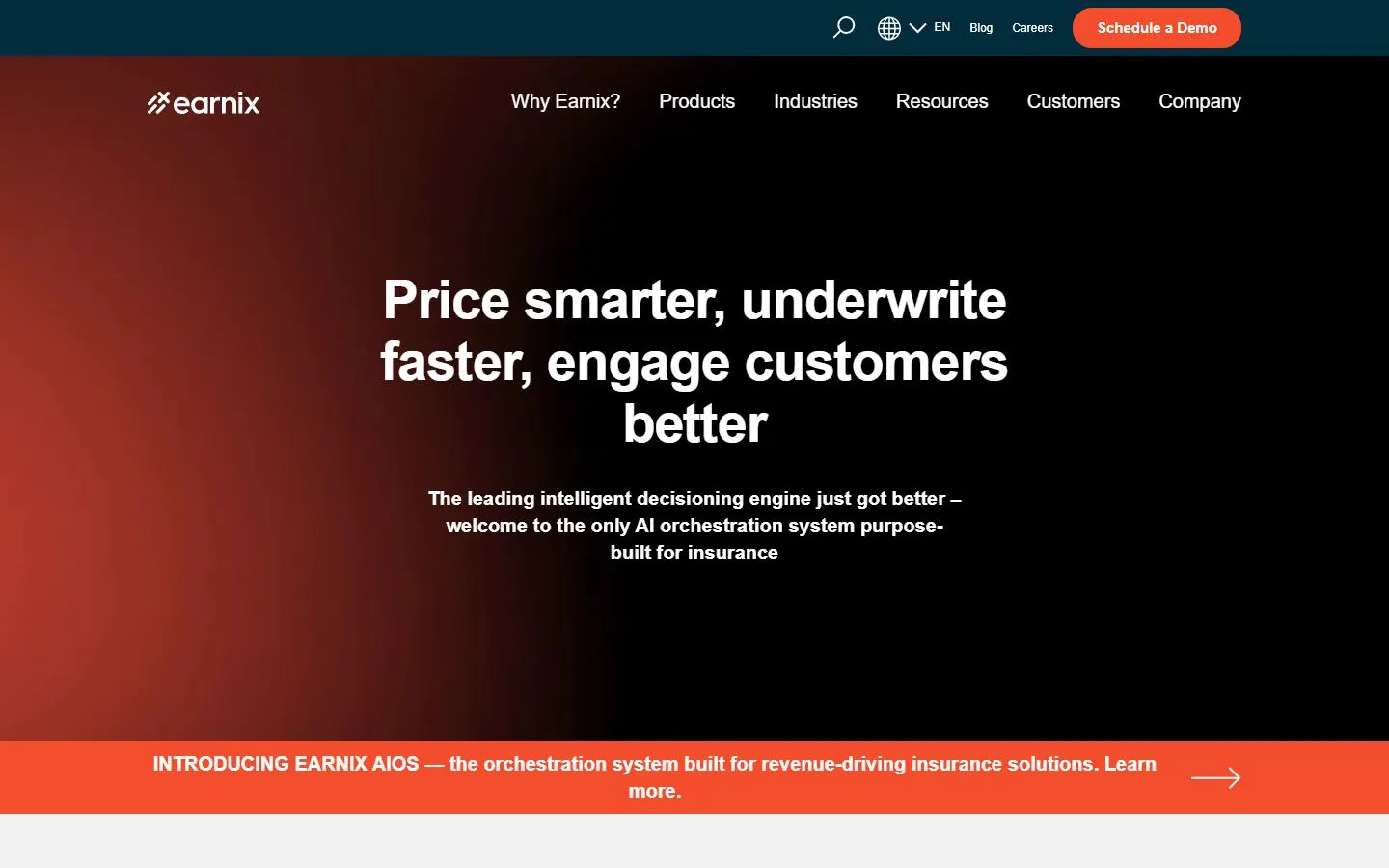
Best for: Larger insurers with actuarial teams that want pricing, rating, underwriting and customer engagement decisions to share models and governance.
Earnix now markets Earnix AIOS, which it describes as an AI orchestration system for insurance decisioning across pricing, rating, underwriting and customer engagement. Its site says more than 100 insurers use it, and customers quoted include Link4, Matmut and Hollard; the speed claims on its site are company figures.
Key functionalities
- Price-It for dynamic pricing with analytical modeling and real-time monitoring against demand and revenue goals
- A rating engine that integrates rating and pricing processes, as a Hollard executive describes it
- Underwrite-It for automated underwriting rules combined with machine learning and simulation
- Governance, with decisions that are explainable, auditable and traceable according to the company
Pros:
- Pricing, rating, underwriting and engagement solutions on one platform, according to its site
- States it maintains SOC 2 Type II
- Explainable and auditable decisions are a stated design goal
Cons:
- Broad platform means significant implementation effort
- Pricing not published
Pricing: Not published; quoted by sales.
Verdict: A strong fit for larger carriers standardizing decisioning across pricing and underwriting. Smaller actuarial teams may find a focused tool quicker to adopt.
3. hyperexponential (hx): Best for commercial pricing inside the underwriter's workflow
Quote only · SOC 2 Type IIFull profile →

Best for: Commercial and specialty carriers, MGAs and Lloyd's market participants whose underwriters price risks with actuarial models.
hyperexponential (hx) sells an underwriting workbench with pricing at its center. Its site lists novel risk pricing, rate justification and what-if scenarios among the quote steps, and actuarial modeling functions such as loss curve benchmarking, model re-parameterization and version publishing. See also the underwriting workbench guide.
Key functionalities
- Bespoke actuarial model execution with appetite validation and decision bounds
- Quote generation with rate justification and what-if scenarios
- Renewal repricing with drafted terms and rate change rationale
- Batch portfolio runs, loss curve benchmarking and model version publishing
- Portfolio monitoring for exposure and concentration limits
- Reinsurance treaty stress-testing
Pros:
- Runs bespoke actuarial models inside quote generation
- Also covers triage, renewals and portfolio monitoring
- Lists SOC 2 Type 2 and ISO 27001:2022
Cons:
- Aimed at commercial P&C, not personal lines rating
- Pricing not published
Pricing: Not published; quoted by sales.
Verdict: The best fit when the question is how underwriters and actuaries share models on individual commercial risks. Personal lines teams need a different tool.
4. Guidewire PricingCenter: Best for Guidewire carriers who want pricing in the suite
 Quote onlyFull profile →
Best for: P&C carriers, especially Guidewire customers, whose pricing teams want modeling and deployment connected to the core system.
Guidewire PricingCenter is the pricing and rating application in Guidewire’s InsuranceSuite. Guidewire says it takes teams from data preparation through modeling to API deployment and works with any core system through an API-first design.
Key functionalities
- AI-assisted GLM and GAM modeling and gradient boosting machines
- Explainability tools such as feature importance and partial dependency plots
- Scenario testing on an analytical canvas
- Deployment of approved models through APIs without a manual IT handoff
- Version control and audit trail
Pros:
- Modeling, scenario testing and API deployment in one application
- Version control and an audit trail for regulatory compliance
- Named customers include Red River Mutual, InterRisk and Bryte
Cons:
- Timing and impact figures on the page are Guidewire or customer claims, not independently verified
- Pricing not published
Pricing: Not published; quoted by sales.
Verdict: A natural option for carriers already on Guidewire. Others should compare it against standalone platforms such as Akur8.
5. Insurity Ratio Content and Rating Engine: Best for bureau content and commercial rating at scale
 Quote onlyFull profile →
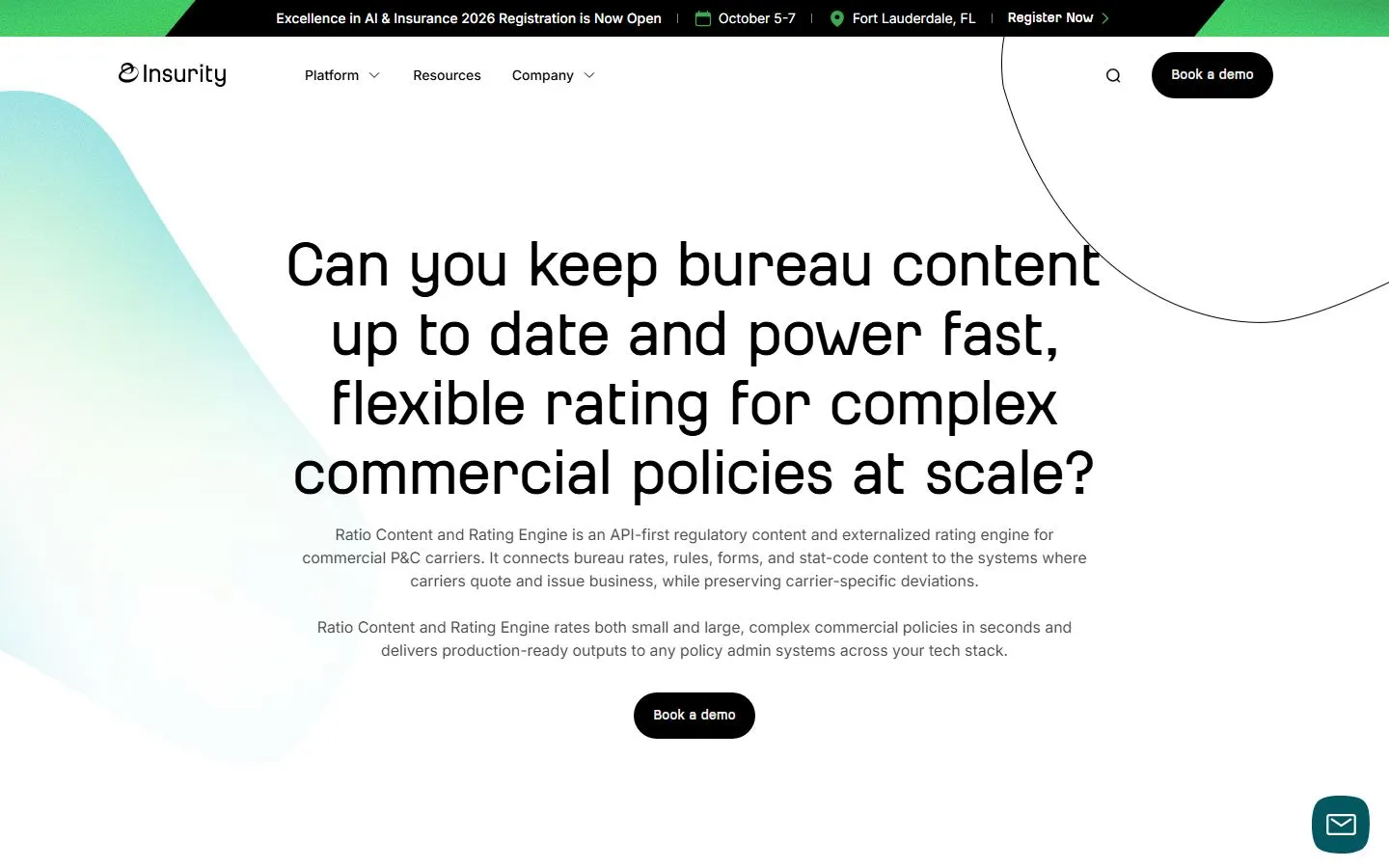
Best for: Commercial P&C carriers that license bureau content and need rating and regulatory content delivered to their policy systems.
Insurity’s Ratio Content and Rating Engine is an API-first regulatory content and externalized rating engine for commercial P&C. Insurity says it rates small and large commercial policies in seconds.
Key functionalities
- Content ingestion and normalization from bureau sources
- Carrier deviations layered on top of bureau content
- Externalized rating engine delivering production-ready logic to policy systems
- API-first integration across multiple policy administration systems
Pros:
- Connects bureau rates, rules, forms and stat codes to production systems
- Preserves carrier-specific deviations
- Delivers to one or many policy systems by API
Cons:
- Not a predictive modeling workbench for actuaries
- Pricing not published
Pricing: Not published; quoted by sales.
Verdict: A fit for commercial carriers whose pain is keeping bureau content current across systems. Teams building their own predictive models need another tool alongside it.
6. Duck Creek Rating: Best for Duck Creek customers managing rates in the suite
 Quote onlyFull profile →
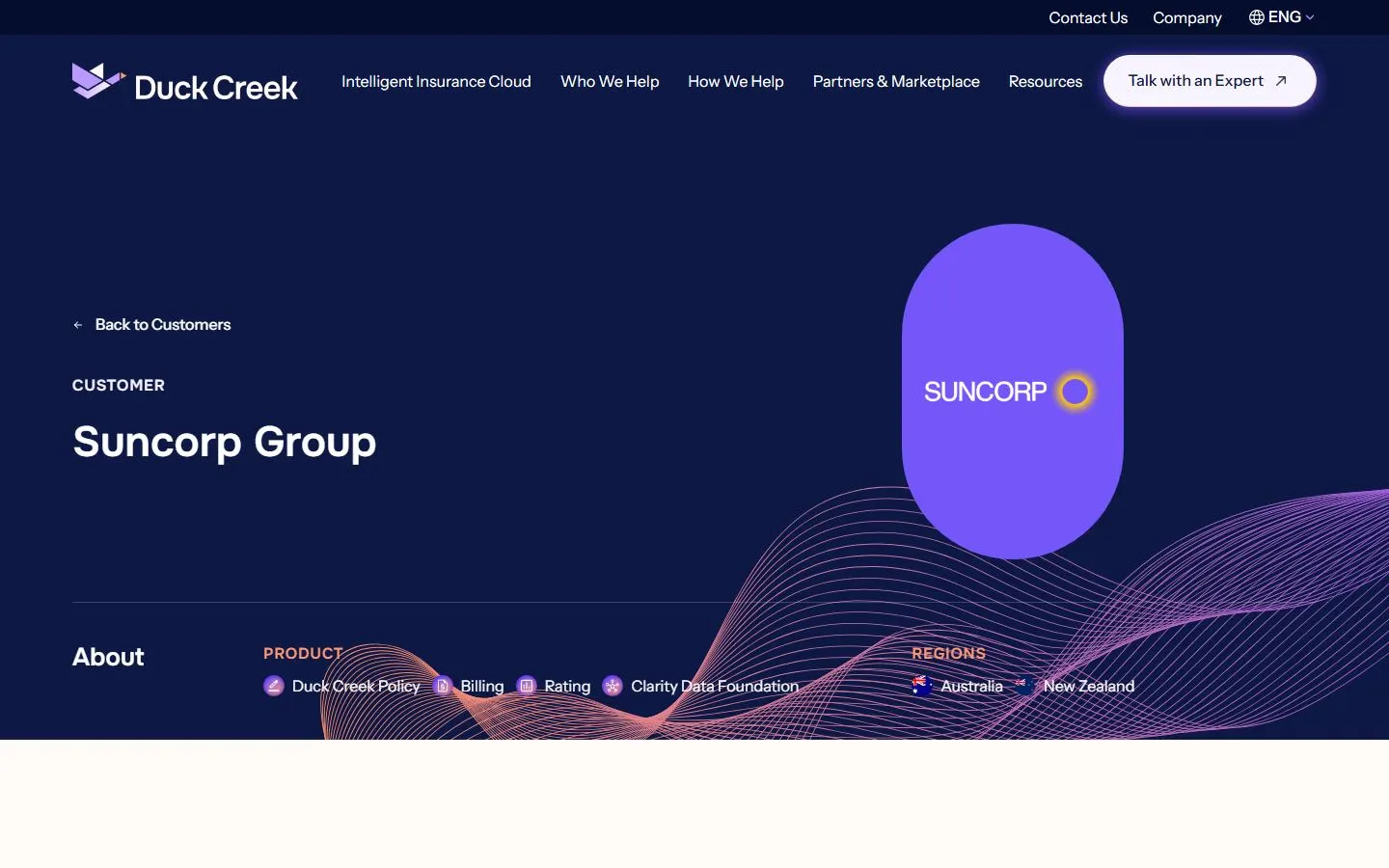
Best for: Insurers on Duck Creek that want business users to control rate management inside the same suite as policy and billing.
Duck Creek Rating is one of four core applications in the Duck Creek suite. The company says it helps insurers execute pricing strategies faster with business-controlled rate management and real-time accuracy.
Key functionalities
- Business-controlled rate management
- Integration with Duck Creek Policy and Billing
- Used by Suncorp Group alongside Duck Creek’s data foundation, per the company
Pros:
- Business-controlled rate management in the Duck Creek suite
- Named customer Suncorp Group uses it with Duck Creek Policy and Billing
Cons:
- Product page gives little detail on lines, modeling or deployment
- Pricing not published
Pricing: Not published; quoted by sales.
Verdict: Reasonable for existing Duck Creek customers. Others should weigh it against standalone pricing platforms, and ask Duck Creek for technical documentation because its page is brief.
How do these tools compare side by side?
| Tool | Approach | Best for | Pricing | Free trial | Security | Who uses it | Lines of business |
|---|---|---|---|---|---|---|---|
| 1Akur8 | Actuarial pricing platform | Personal and commercial lines P&C insurers and MGAs whose actuarial team wants to build, review and deploy rates in one governed tool. | Quote only | — | SOC 2 Type II | Actuaries and pricing teams | Personal and commercial P&C, health |
| 2Earnix | Pricing Analytics | Mid-to-large carriers with dedicated actuarial teams who need to optimize rates, deploy pricing models to production, and manage multi-state regulatory compliance | Quote only | — | SOC 2 Type II | Actuaries, pricing and underwriting teams | Multiple lines, insurance and banking |
| 3hyperexponential (hx) | Pricing and underwriting platform | Commercial and specialty carriers, MGAs and Lloyd's market participants that want actuarial pricing models and the underwriter workbench in one platform. | Quote only | — | SOC 2 Type II | Underwriters and actuaries | Commercial and specialty P&C |
| 4Guidewire PricingCenter | Pricing and rating application | P&C carriers, especially Guidewire customers, whose pricing team wants modeling and deployment in the same suite as the core system. | Quote only | — | SOC 2 unverified | Actuaries, pricing teams and product managers | P&C (page names motor and home) |
| 5Insurity Ratio Content and Rating Engine | Content and rating engine | Commercial P&C carriers that license bureau content and want rating and content updates delivered to one or more policy systems. | Quote only | — | SOC 2 unverified | Product and rating teams, IT | Commercial P&C |
| 6Duck Creek Rating | Core-suite rating application | Duck Creek policy customers that want business users to manage rates inside the same suite. | Quote only | — | SOC 2 unverified | Underwriters and line of business owners | Not stated on page |
Which tool fits your team?
- Your actuarial team needs to ship rate changes faster across personal or commercial lines: Akur8.
- You want pricing, rating and underwriting rules governed on one platform: Earnix.
- Underwriters price individual commercial risks using actuarial models: hyperexponential.
- You run Guidewire and want pricing in the same suite: Guidewire PricingCenter.
- You are a commercial carrier struggling to keep bureau content current: Insurity Ratio Content and Rating Engine.
- You run Duck Creek and want business users to manage rates: Duck Creek Rating.
- You want to price on cleaner data first: see the document extraction guide and property data providers.
Conclusion: separate the modeling decision from the production decision
Decide first who builds the rates and who runs them in production. Standalone platforms such as Akur8 and Earnix are strongest when actuaries own the process; suite tools win when the core system dictates; workbench tools win when underwriters price each risk. Since no vendor publishes a price, ask for a reference customer on your line of business and core system, and a clear account of how a rate change moves from model to live quote.
FAQs
What is the best insurance rating and pricing software?
It depends on who owns pricing. Akur8 fits actuarial teams that want modeling, rate making and a rating engine in one cloud product. Earnix fits larger insurers that want pricing, rating and underwriting decisioning together. Guidewire PricingCenter and Duck Creek Rating fit carriers already on those cores. hyperexponential fits commercial teams that want models in the underwriting workflow.
What is the difference between pricing software and a rating engine?
Pricing software is where actuaries build and test the models and rate plans: loss cost, price sensitivity, scenarios. A rating engine is the production system that applies the approved rates to a quote in real time. Akur8 and Earnix sell both; Insurity's Ratio engine is mainly the production side for bureau content.
Do these tools replace actuaries?
No. They automate data preparation, model fitting and deployment steps, and add governance, but actuaries choose the models and sign off on rates. Akur8 describes its models as natively transparent GLMs and GAMs so that actuaries can review each factor.
Which tools support commercial lines and which support personal lines?
Akur8 lists personal and commercial P&C and health. Insurity's Ratio engine targets commercial P&C. hyperexponential targets commercial and specialty P&C. Guidewire PricingCenter is described for P&C and its page names motor and home customers. Earnix says it works across multiple lines of business.
How much does rating and pricing software cost?
None of the six vendors publishes pricing. These are enterprise contracts quoted by sales, and the largest cost is often implementation and integration with the policy system rather than the license.
How long does it take to deploy a new rate change?
Vendors make different claims. Akur8 says rates can be imported in minutes and deployed in seconds on its engine; Guidewire says PricingCenter moves model deployment from months to minutes. These are vendor claims, so ask for a reference customer with a similar line and core system.
Which rating and pricing tools are SOC 2 compliant?
Akur8 lists a SOC 2 Type II report and ISO 27001. Earnix states it maintains SOC 2 Type II. hyperexponential lists SOC 2 Type 2 and ISO 27001:2022. Guidewire, Insurity and Duck Creek publish security information through their own trust programs; ask for current reports.
Can I keep my policy admin system and add a separate pricing tool?
Yes. Akur8 Deploy, Earnix and Insurity's Ratio engine are built to run outside the policy system and return rates by API. Akur8 lists a Guidewire Marketplace accelerator for Deploy. Core-suite tools such as PricingCenter and Duck Creek Rating are designed to work with their own suites first.